

Most people in financial distress have been sitting with the problem for months before they call anyone. They’ve searched at 2 a.m., read articles that contradict each other, and still don’t know whether selling the house helps them or blows up their case. That uncertainty is expensive. The gap between a sale that protects your equity and one a trustee reverses in court can come down to a single decision made on the wrong day.
California filed more bankruptcy cases than any other state in 2024, with 47,621 total filings, and the pace has climbed since. For homeowners weighing bankruptcy, the real estate piece is what tends to go sideways. The Romine Group Team buys houses throughout the Central Valley from sellers in exactly this position. What follows walks through the full picture, in the order that matters.
Sorting Out What You Are Actually Dealing With
Picture the situation that shows up most often. A divorce settlement finalizing at the same time credit card debt has gone past manageable. One spouse takes the house, has no income to support a traditional listing, and needs the sale done without drama. A sale that lands before the bankruptcy filing becomes necessary pays the priority credit obligations down out of the proceeds. Wait, and the court decides instead.
That combination isn’t unusual. Two things are almost always true. The house holds more equity than the owner realizes, and the owner has less time to make clean decisions than they think. That’s what separates selling during or before bankruptcy from a normal real estate transaction. The court can enter the picture at any moment, which means a sale that looks solid on Monday can unravel by Friday.
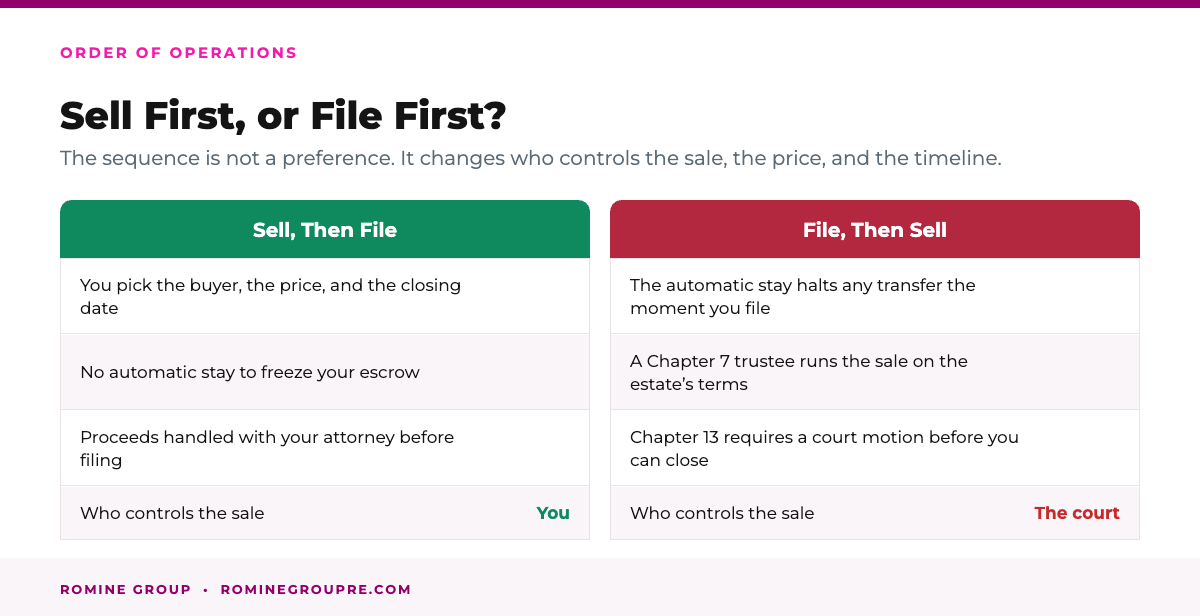
Under 11 U.S.C. 362, filing bankruptcy immediately triggers an automatic stay that halts all property transfers, including a pending home sale in escrow. An escrow you opened in good faith last week can freeze the day you file your petition, and the buyer can walk. Which step comes first, and why, shapes every decision after it. The order of operations isn’t something you can work out after the fact.
What Your Home Is Worth Before You File Anything
Getting the valuation wrong costs you equity you can’t get back. Sellers who lowball their own home before filing sometimes find the trustee’s appraisal puts them above the homestead exemption threshold, which turns a protected asset into one the court can liquidate.
In June 2026, the statewide median home price in California was $904,640, and that number hides enormous local variation. A property in Visalia or Lindsay holds nothing like the value of one on the coast. That cuts both ways for a Valley homeowner, and mostly in your favor. Get a formal comparative market analysis from a local real estate agent who knows your neighborhood, not a zip code average. A licensed appraiser’s report carries weight with your bankruptcy attorney and potentially with a trustee, and a single credible appraisal has shifted a trustee’s position on plenty of cases.
One pattern repeats constantly. Sellers pull a Zillow estimate, like the number, and treat it as gospel. Zillow doesn’t know the kitchen was updated two years ago, or that the neighbor’s unpermitted addition is visible from the backyard. Both facts move value, in opposite directions. If there’s unpermitted work on your own property, read our guide on selling a house with unpermitted work in California before you price anything.
Your bankruptcy attorney uses fair market value to determine whether equity remains after subtracting the mortgage balance, any liens, and the applicable homestead exemption. Get that number right before any conversation about filing, not after.
Is It Legal to Sell Your House Before Bankruptcy in California?
Selling the home before you file isn’t just legal. For many California homeowners it’s the smarter path.
California homeowners can generally sell the home before they file for bankruptcy. If your equity exceeds the homestead exemption, selling first is often the right move: you keep the equity, pay down creditors, and start fresh. Before is the key word. Once you file, the automatic stay locks down the property and any escrow in progress with it, even one days from closing.
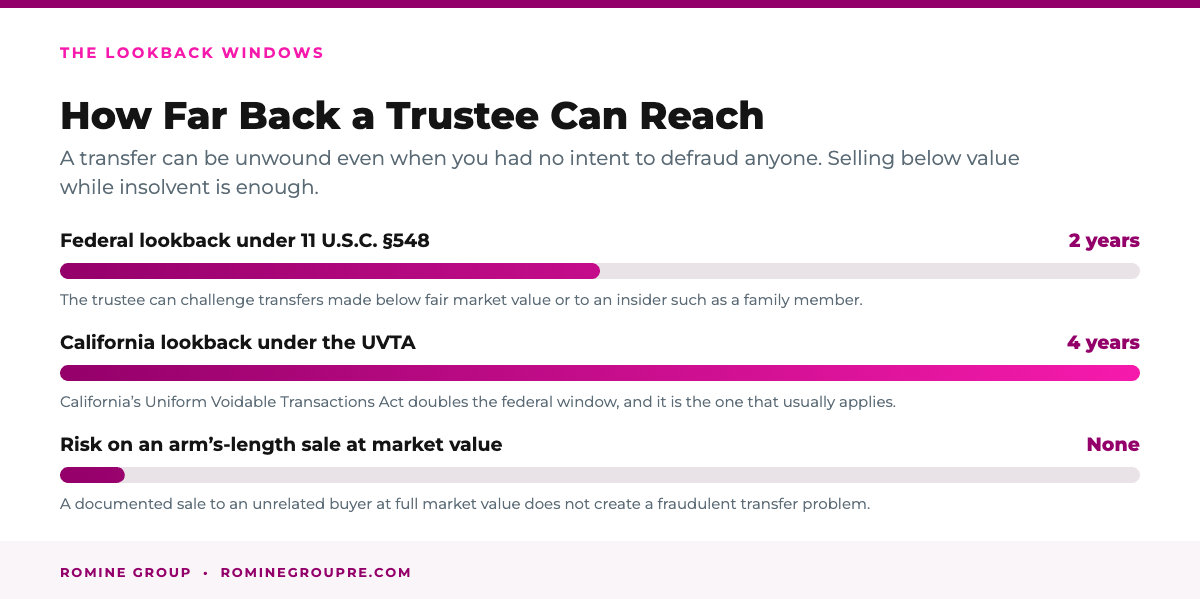
Pre-bankruptcy sales work best when the numbers are clear and the transaction is clean. An arm’s-length sale to a stranger at full market value raises no flags. What a trustee examines is whether you moved value out of your creditors’ reach by selling cheap to a family member, a business partner, or anyone who isn’t a genuine third-party buyer. A regular sale, properly documented, never touches that question.
Your bankruptcy attorney needs to know about the sale. Disclose it. Keeping the transaction separate from your case creates exactly the problem you’re trying to avoid.
The Fraudulent Transfer Trap: What Not to Do Before You File
Some sellers hear “sell before you file” and figure they can move the equity into a relative’s hands right before filing. That isn’t a loophole. It’s a trap with statutory teeth.
Under 11 U.S.C. 548, a bankruptcy trustee can challenge property transfers made within two years of filing if the property sold below fair market value or went to an insider such as a family member. That’s the federal window. California adds a longer one. Under the state’s Uniform Voidable Transactions Act, the lookback period runs four years.
A transfer can be fraudulent even when you had no intent to defraud anyone. Selling property below its value while insolvent is enough for the trustee to reverse it. That’s the constructive fraud concept, and it’s how sellers get caught while genuinely believing they did nothing wrong. Below market is not always a gift in the eyes of the court.
So what happens when a trustee reverses a sale? The trustee may review sales contracts, question you about the facts and circumstances of the sale, and determine fair market value as of that date. Anything that looks off may prompt the trustee to sue the buyer to recover the asset. That process, called unwinding the sale, lets the trustee take the property back and sell it for your creditors’ benefit. The appraisal from the sale date becomes central evidence.
Sell at full market value to an unrelated buyer. Document everything. Those two steps eliminate the risk.
How Long Do You Have Before Bankruptcy Limits Your Options?
Most sellers assume the automatic stay is the main timing problem. It isn’t. Escrow length is.
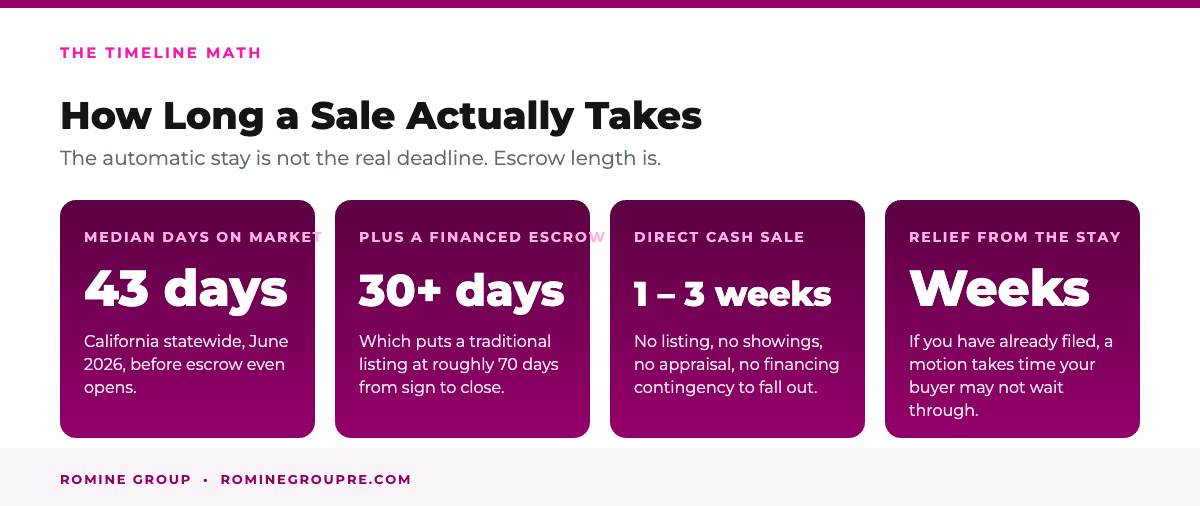
The median days on market in California was 43 days as of June 2026, and that’s just the marketing period. Add 30 days of escrow and you’re looking at 70-plus days from listing to closing. With finances deteriorating and a creditor about to win a judgment, 70 days is a long time to hold everything together.
A direct sale to a local buyer compresses that to weeks. No listings, no open houses, no contingencies waiting to fall apart. Speed matters when the window is shrinking. The calculation isn’t about sentiment. It’s about whether you can close before filing becomes unavoidable, and that closing date is the only number that really counts. You can see exactly how Romine Group buys homes and how fast each step moves.
Already filed with the home in escrow? Ask your bankruptcy attorney immediately about a motion to lift the automatic stay. The court can grant it. It takes time, and the motion has to be filed correctly.
Selling Before Bankruptcy: When It Makes Sense If You Have Equity
California’s homestead exemption doesn’t protect unlimited equity. Most sellers never run that math first.
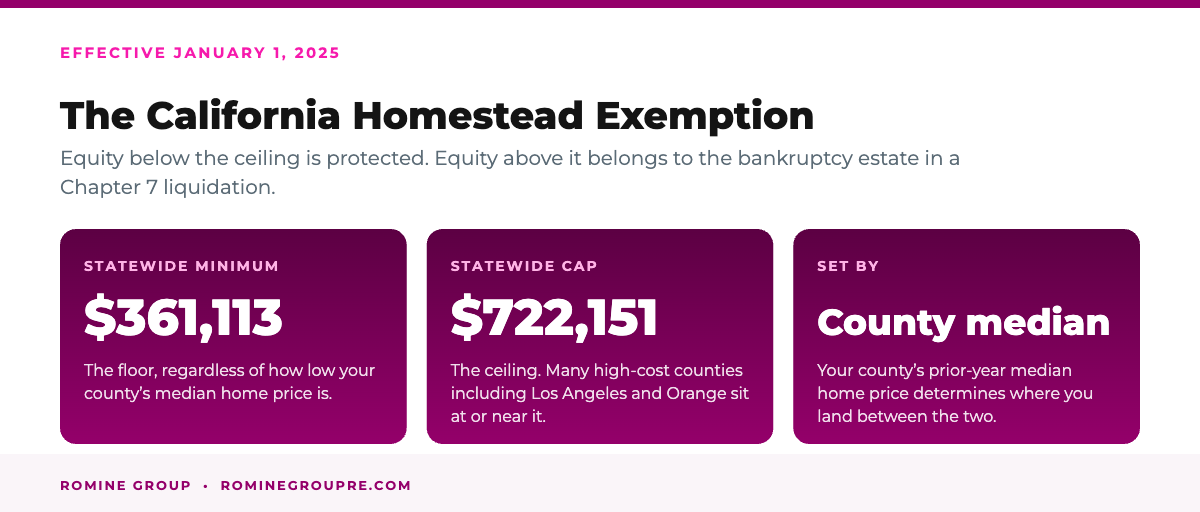
As of January 1, 2025, the adjusted California homestead exemption minimum is $361,113 and is capped at $722,151, with the exact amount set by your county’s prior-year median home price. Because the exemption tracks county medians, Central Valley homeowners generally land nearer the floor than the ceiling. Tulare County, Kings County, Fresno County and Kern County all run well under the statewide median, which means a Valley seller’s protected amount tends to sit closer to that $361,113 figure. Ask your attorney to confirm the current number for your county rather than assuming the cap applies.
If net equity exceeds the exemption ceiling for your county, everything above that line belongs to the bankruptcy estate in a Chapter 7 liquidation. A trustee sells the home, pays you the exempt amount, and files the rest out to creditors. You don’t choose the buyer, the price, or the timeline.
Selling the home on your own terms lets you control all three. You pick the buyer, negotiate terms, and keep the full proceeds minus what’s owed. Then you pay creditors strategically, with your bankruptcy attorney’s guidance, before filing. That’s a very different outcome than a forced trustee sale where you watch someone else handle your most valuable asset.
Chapter 13 is a different animal. Rather than liquidating assets, a reorganization bankruptcy lets you propose a repayment plan over three to five years. With equity above the exemption in a Chapter 13 case, the plan has to pay unsecured creditors at least that much. Your attorney can model both scenarios. The Bankruptcy Basics guide published by the United States Courts is a solid plain-English starting point before that conversation.
Liens, Tax Consequences, and Other Costs That Change the Numbers
A homeowner who believes there’s $400,000 of equity in the property might net $290,000 once everything clears. That gap decides whether a plan works.
Not every judgment lien traces back to a lender or a credit card. Medical debt is one of the most common sources of a recorded judgment in California, and it behaves differently from the rest. If that’s part of your picture, read whether medical bills can take your house in California, including the homestead protections that usually stop a forced sale.
Real estate commissions on a traditional sale run roughly 5 to 6 percent of the sale price. On a California home at the statewide median, that’s somewhere between $45,000 and $55,000 gone before any other cost. Add title fees, escrow costs, and seller concessions, and selling through an agent typically runs 8 to 10 percent of the sale price all in.
Liens recorded against the property get paid from proceeds before you see a dollar. Second mortgages. A home equity line of credit. Mechanics liens from a contractor dispute. Or a judgment lien from a creditor who already won in court. Every one has to be paid off or negotiated at closing. Your title report surfaces all of them, so read it line by line.
Tax consequences matter too, and they’re often smaller than people fear. California offers no state capital gains exemption for primary residences beyond what federal law provides, so your bankruptcy attorney and a CPA should both weigh in before closing. Federal law may exclude a meaningful portion of your gain from income when the home was your primary residence for at least two of the five years before the sale.
What You Keep From the Sale: Net Proceeds by Scenario
What actually lands in your hands after everything gets paid?
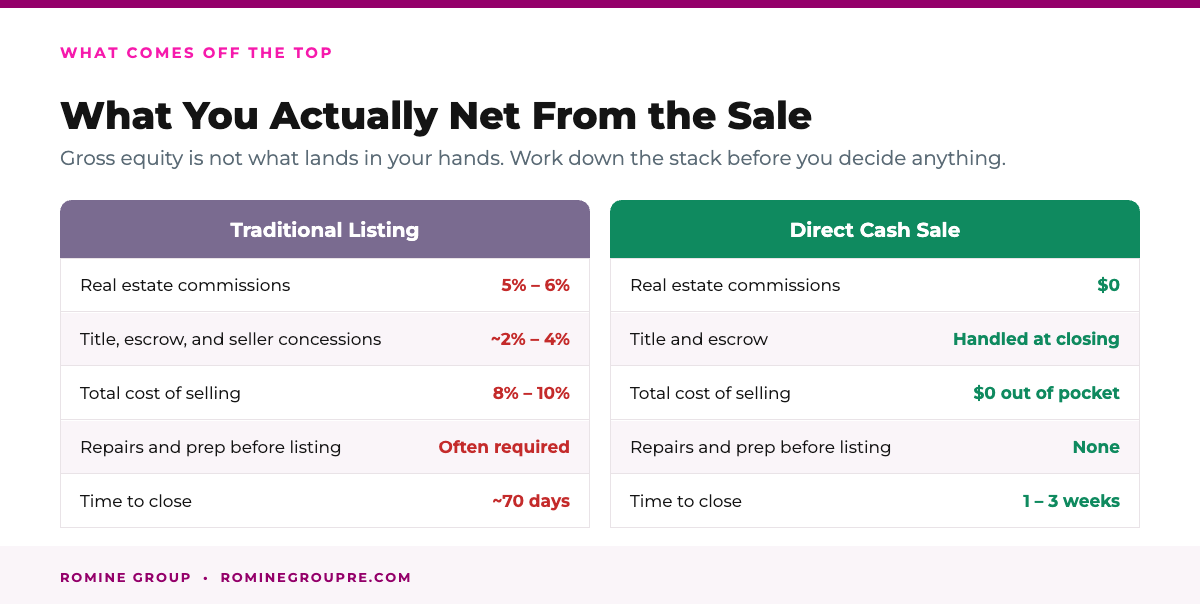
Three numbers work together: the sale price, the total cost of selling, and the obligations recorded against the property. Start with the sale price. Subtract the mortgage payoff, then any second liens or judgment liens, then closing costs. What remains is gross equity. Apply the homestead exemption only if the sale happens inside a bankruptcy proceeding. Sell the home before you file and no exemption applies to the sale itself, because the exemption protects equity inside the bankruptcy estate rather than the proceeds of a sale that closed first.
That distinction trips people up. Close the sale before filing and receive $350,000 in proceeds, and those funds are available to creditors unless you spend them on permitted living expenses or pay creditors first. Your bankruptcy attorney will advise on exactly how to handle proceeds. It isn’t a decision to make alone.
A direct buyer instead of the open market changes the net proceeds picture in ways that aren’t obvious. A cash buyer moves faster and requires no repairs or staging, which offsets part of the gap from a slightly lower offer. For a seller on a tight pre-bankruptcy timeline, certainty of a quick close can be worth more than a marginally higher offer that might collapse. Our guide to selling a house as-is in California works through how that trade-off actually prices out.
What Happens to the Money After Your Home Sells?
The money goes straight to you, and plenty of sellers assume that’s where the story ends.
It isn’t. File bankruptcy before or shortly after the sale and those proceeds become part of your bankruptcy estate. Trustees liquidate assets to repay credit obligations, and without protections, home equity is one of the first places they look. Cash proceeds from a sale before filing are far easier to trace than equity sitting inside a property. Trustees are good at this.
Handle the sale proceeds in direct coordination with your bankruptcy attorney before filing anything. Paying ordinary living expenses is generally fine. Paying down one credit card while ignoring others can create a preferential payment issue. Gifting money to family lands in the same category of problem as a fraudulent transfer, and the trustee can claw it back. Your attorney can tell you what’s permissible in your specific case.
In a Chapter 13 case where the court approves a home sale after filing, proceeds flow through the plan. Your plan may be modified to account for the new funds. Secured creditors get paid first, then priority unsecured creditors, then general unsecured creditors, in that order. Whatever remains after the plan terms are satisfied may come to you, depending on how the court handles the case.
What Happens to Your Home the Moment You File Bankruptcy in California?
This is the sequence that catches sellers. An accepted offer, three weeks from closing, and then a financial situation that forces a Chapter 7 filing. The escrow freezes that same day. The buyer waits two weeks, exercises the cancellation clause in the purchase agreement, and the seller starts over.
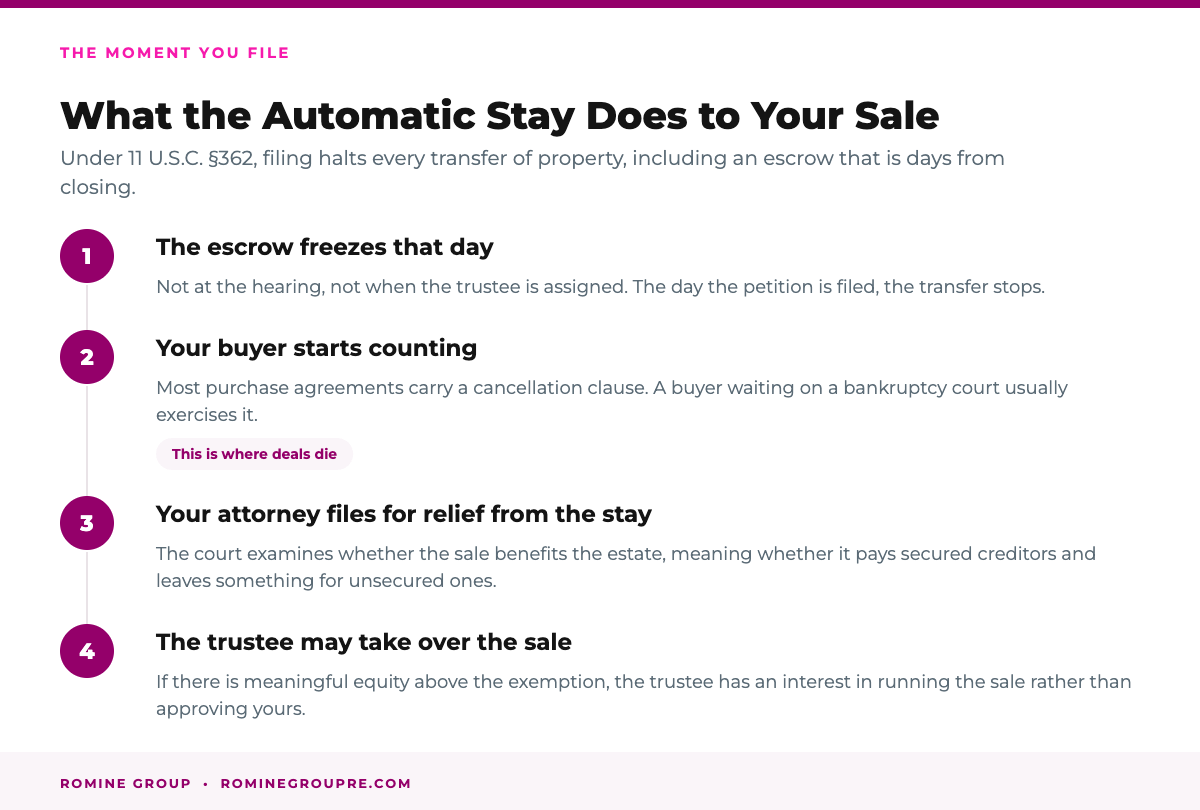
That happens more often than the filing data suggests. Under 11 U.S.C. 362, filing bankruptcy immediately triggers an automatic stay that halts all property transfers, including a pending home sale in escrow. If your home is in escrow when you file, the sale freezes unless the bankruptcy court grants relief from the stay.
Past the open escrow problem, filing puts the home itself into the bankruptcy estate immediately. In a Chapter 7 liquidation, the trustee evaluates whether your equity exceeds the applicable homestead exemption. If it does, the trustee has authority to sell the property and generate funds for creditors. You receive the exempt amount. Creditors divide what’s left.
Under Chapter 13 you can keep the home. The condition is that your repayment plan pays unsecured creditors at least what they’d receive in a Chapter 7 liquidation, and that you stay current on the mortgage throughout the plan period.
What Happens If Escrow Is Already Open When You File?
Already filed with escrow open on the home? The path forward runs through a motion for relief from the automatic stay, and that motion takes time your buyer may not wait through.
Your bankruptcy attorney files it with the court, asking permission to finish the sale. The court examines whether the sale benefits the bankruptcy estate, meaning whether it produces proceeds enough to pay secured creditors and leave something for unsecured ones. Thin net equity often means quick approval. Significant equity above the exemption often means the trustee wants to oversee or participate in the sale so creditors get their share.
Buyers in standard market transactions are rarely prepared to wait on bankruptcy court approval. That’s one more reason pre-filing sales to buyers who understand the situation, like direct buyers who work with homeowners in distress, can close when others can’t. A cash buyer’s escrow timeline doesn’t depend on mortgage financing falling into place, which makes the window between signing and closing predictable.
Can You Sell a House While Bankruptcy Is Already in Progress?
You can, though not on your own. The court owns that decision.
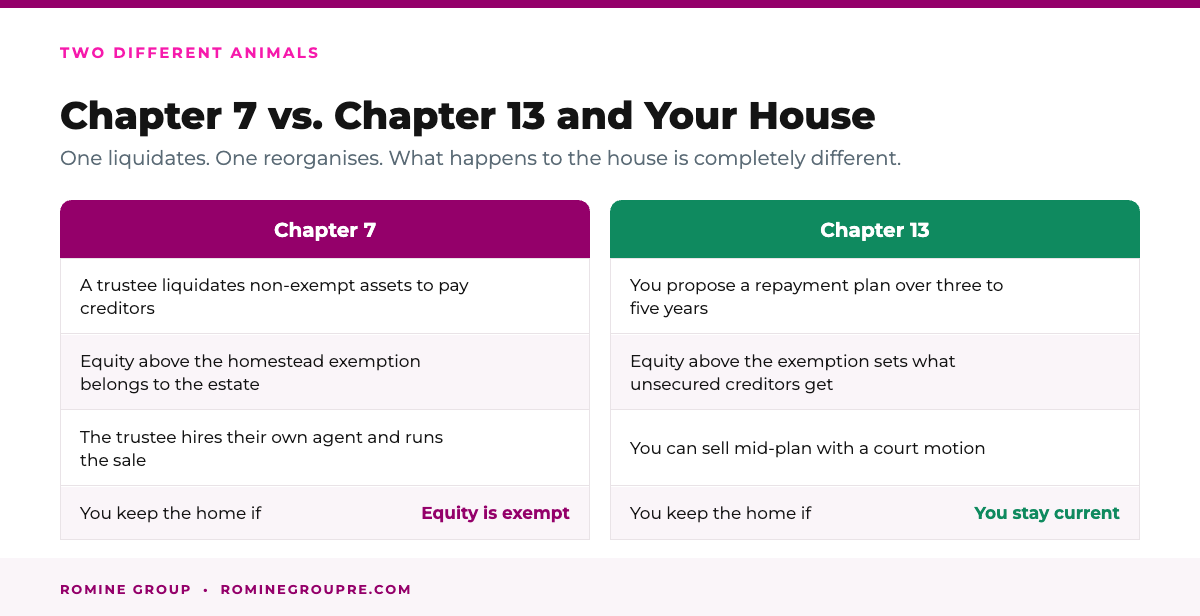
In a Chapter 7 case with a trustee already assigned, any sale of the home goes through the trustee. Their job is maximizing recovery for creditors, so they hire their own real estate agent, order their own appraisal, and run the process on their terms. You can offer input. You don’t control the outcome.
Chapter 13 gives you more room. You can file a motion with the court to sell during an active plan. Proceeds get applied according to the plan terms, and the plan may be restructured afterward. Plenty of Chapter 13 debtors in California move the home mid-plan to escape an unaffordable mortgage or capture equity before the market shifts.
Speed is where a direct sale separates itself. An estate that needs settling, a job transfer with a hard move date, a garage nobody has sorted since a parent passed. A direct buyer can work backward from your date and close in weeks, cleanout included. Trying to push a Chapter 13 sale through the court gives you none of that flexibility unless your buyer is prepared for a process that looks nothing like a standard escrow.
California consistently ranks among the states with the highest number of bankruptcy filings, with 47,621 filings in 2024 alone. Every one of those cases involved a homeowner with choices to make. The sellers who do best made those choices early, with accurate numbers, and with people in their corner who understood the real estate side and the legal side both. If the pressure is coming from a lender rather than a court, read how to sell a house in foreclosure in California, because those deadlines move faster. We work with sellers across the whole Valley, from Fresno and Hanford down through Tulare and Dinuba.
Frequently Asked Questions
Can I Sell My House and Then File Chapter 7?
Yes, and in many California cases that’s the right sequence. As long as the sale closes before you file, the automatic stay won’t interrupt escrow. The proceeds then need careful handling, ideally with your bankruptcy attorney guiding it, because cash from the sale becomes part of your financial picture at filing. A home sold to an unrelated buyer at full market value won’t trigger a fraudulent transfer challenge.
What Assets Do You Lose in Chapter 7 Bankruptcy?
Chapter 7 is a liquidation process, so the trustee can sell assets that exemptions don’t protect and pay credit obligations from the proceeds. For homeowners the critical protection is the homestead exemption. As of January 1, 2025, California’s homestead exemption runs from a minimum of $361,113 up to a cap of $722,151, depending on your county’s median home price. Equity below that threshold is protected. Equity above it can be claimed by the trustee. Retirement accounts, tools of the trade, and basic household goods carry their own separate protections.
How Soon Can I Sell My House After Filing Chapter 13?
You can sell at any point during an active Chapter 13 plan, though the court has to approve the transaction first. Your bankruptcy attorney files a motion, the trustee reviews it, and the court enters an order. That can move fairly quickly when the sale clearly benefits the estate and every secured creditor gets paid at closing. Proceeds feed into your plan, which may then be modified or terminated depending on how much equity the sale generates.
Can I Keep My House If I File Chapter 7 in California?
Many California homeowners do keep their homes through Chapter 7, particularly since the state expanded its homestead exemption. With the 2025 minimum at $361,113, homeowners may be able to file Chapter 7 and keep the home, provided their equity stays under the county-specific cap and they stay current on the mortgage. If equity sits above the exemption ceiling, the trustee can sell the property. Have your bankruptcy attorney run the equity calculation against the current exemption before you file, because that answer drives the entire strategy. You can also check out other frequent questions or reach out to Romine Group to talk through the property side first.
More California Selling Guides
- Selling a House in Foreclosure in California
- Can Medical Bills Take Your House in California?
- Selling a House As-Is in California
- California Real Estate Withholding and Form 593
Carrying a House and a Bankruptcy Question at the Same Time?
You do not have to solve both at once. We buy California houses in any condition, close in as little as one to three weeks, and we are used to working alongside a bankruptcy attorney and an escrow timeline that cannot slip. Tell us about the property below and we will get you a fair cash offer. No pressure, no obligation, and no fee for the conversation.
"*" indicates required fields
Prefer to talk it through first? Contact Romine Group and we will walk the situation with you before you commit to anything. You can also read how Romine Group buys homes to see exactly what the process looks like.