

Most sellers who reach us have already spent three or four weeks in a contractor spiral. One quote leads to another. The second comes back 40% higher than the first. Meanwhile the original plan, fix up the house and list it on the MLS, takes on a life of its own. By the time we talk they’re worn out, and they’re wondering whether they ever needed to start down that road at all.
Selling a house as-is in California works. It only works, though, if you understand what the phrase actually means, what it costs you, and what it protects you from. Get those three wrong and you’ll leave real money behind. Either you over-repair a property that cash buyers would have taken anyway, or you underprice because you never figured out your leverage. Both failure modes are covered below.
What Does As-is Condition Mean in Real Estate?
Plenty of California sellers hear “as-is” and think loophole. Sell the place, say nothing, walk away. That reading is the one that lands people in court, so it’s worth clearing up before anything else.

Even when a purchase agreement states that a property is sold as-is, the seller must still disclose known material facts. The as-is label just means the buyer agrees not to ask for repairs. Your disclosure duties stay fully intact. Legally, “as-is” does not mean “as unknown.” It means the buyer accepts the home as it stands, without the seller making improvements before closing.
In California, selling a home as-is means the buyer agrees to take the property in its current condition based on what they can see. The buyer does not surrender their legal rights, though. Even in an as-is transaction, a seller can still be held to account for lying about the property, hiding problems on purpose, or failing to disclose known issues a normal buyer would never spot.
So what does as-is actually buy you? It removes your obligation to fix things. Buyers can still inspect. They can still walk away if they don’t like what they find. What they can’t do is accept the condition and then demand you replace the roof or reroute the plumbing. For anyone facing deferred maintenance, an inherited property, or a home that needs more work than the proceeds would justify, skipping the repair treadmill is worth plenty.
The practical version is short. You price the property at a number that reflects its condition, you disclose what you know, and you let the buyer decide. That’s the whole transaction.
Fast Facts About Selling a House As-is in California
An as-is sale in California does not automatically mean a bargain-basement price. That assumption costs sellers money every year.
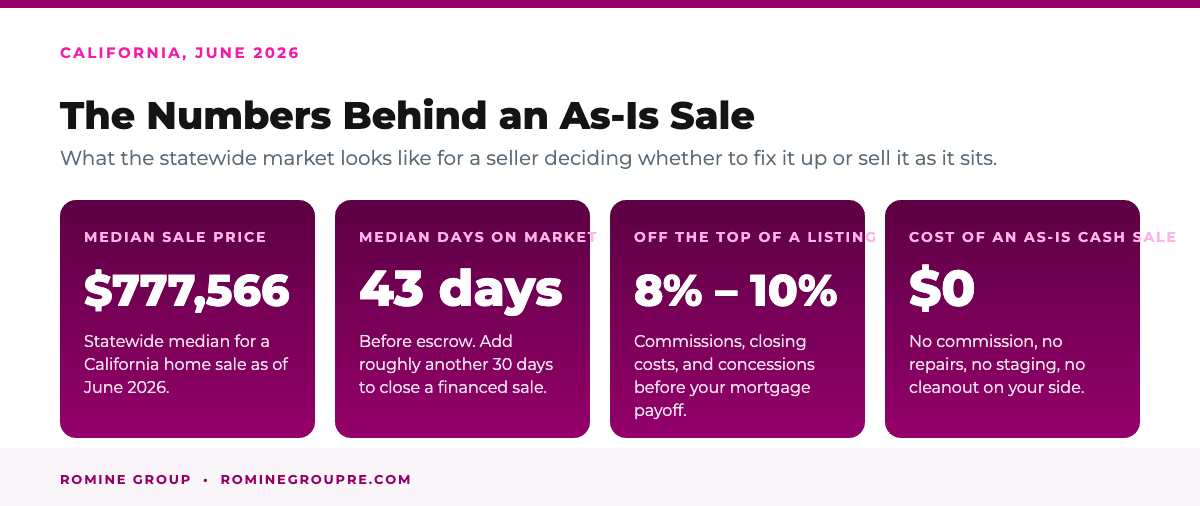
In June 2026, California home prices sat at a median of $777,566, up 2.0% over the prior year. Roughly 23,633 homes sold that month, at a median of 43 days on market. Even with that longer time on market compared to the frenzied pace of 2021, sellers are still working from a position of relative strength. A correctly priced listing rarely sits long. Usually the pricing decides how fast it moves, not the condition.
Average realtor fees in California run about 5.47% of the sale price, split between a listing agent fee averaging 2.73% and a buyer’s agent fee averaging 2.74%. Layer in title costs and transfer taxes and you’re giving up roughly 8 to 10 percent of your gross sale price on a traditional listing. On a $900,000 home that’s somewhere between $72,000 and $90,000 off the top, before you’ve touched a single repair bill.
Central Valley numbers run well below the state median, which changes the arithmetic. A property in Selma or Dinuba carries the same commission percentage as one on the coast, but the repair bills don’t shrink to match the lower sale price. That squeeze is exactly why as-is sales are common across Tulare County, Kings County, Fresno County and Kern County.
Cash buyers who specialize in as-is properties typically move faster and skip agent commissions on the sell side. Their offers reflect the home’s condition, but so does your cost structure. Romine Group works with sellers across the Valley who need to close without the back-and-forth of a traditional listing, and we’re upfront about what we can offer and why.
Valley buyers behave differently from California buyers on the coast, and that shapes what an as-is home listing can do for you. Median prices across Fresno County and Tulare County run well under the statewide California number, so the pool of cash buyers is deeper relative to the price point. An investor hunting margin can’t find it easily in a coastal market. In Bakersfield or Hanford, that math works on an ordinary three-bedroom home. More cash offers chasing the same distressed home is good news for whoever owns it.
One more piece of data that surprises sellers: as of December 2025, the statewide sales-price-to-list-price ratio had slipped to 97.9%. That isn’t a crisis. It does mean the price has to be tighter now than it did two years ago. List at the right number and as-is homes still close near asking. Overshoot and you sit.
Which Types of Homes Are Typically Sold As-is in California?
Misprice a California house because you picked the wrong category and you’ll either scare off the buyers who would have moved fast or attract the ones who renegotiate mid-escrow.
Inherited properties make up a big share of the as-is market. The pattern repeats itself. A parent lives in the same house for thirty years and passes. The adult children are scattered across three states, and the garage is full of lawn equipment and boxes nobody wants to sort. Nobody in that situation wants a six-week listing prep. They want the estate settled and a date on the calendar. A traditional listing with repairs, staging and a 30-plus day close does not serve that family.
Landlords are the other big group. Rentals in Fresno, Bakersfield and Clovis often go as-is once a tenant has let the place slide, and investor demand in those markets holds steady year round. Older stucco homes in Visalia and Lemoore with original electrical panels land here too. So do properties with foundation movement from Valley clay soil, fire-damaged homes, houses in probate, and anything carrying open code violations. Probate alone can stall a conventional sale for months.
The common thread isn’t the condition. It’s the seller’s position. A timeline that won’t accommodate a six-month rehab. An estate that needs to settle. Or finances that can’t absorb $60,000 in repairs on the hope of a higher price later.
What Problems Do You Legally Have to Disclose in California?
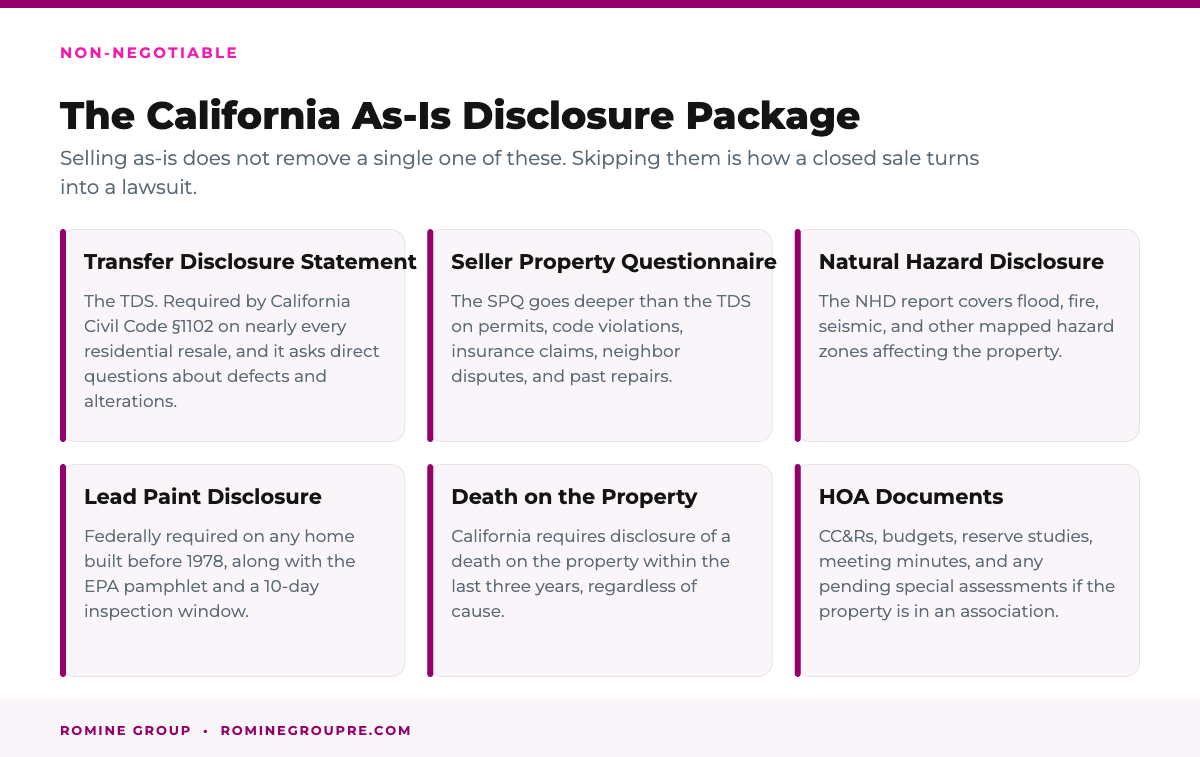
Past repairs count. Sellers ask constantly whether they have to disclose something they already fixed, and in most cases the answer is yes.
One disclosure trips up more California sellers than any other, and that’s construction nobody ever pulled a permit for. A converted garage, an enclosed patio, a granny flat built decades ago, all of it has to be disclosed even when you sell as-is. The rules are specific enough to deserve their own guide. Read the full breakdown on how to sell a house with unpermitted work in California, including what legalizing it costs and when it’s smarter not to.
California sellers complete a form called the Transfer Disclosure Statement, usually shortened to TDS, with language drawn straight from state statute. A seller must disclose known material facts that affect the property’s value, desirability, safety, or intended use. That list runs long. Water intrusion, mold, roof leaks, drainage problems, foundation movement, plumbing failures, electrical problems, structural issues. Unpermitted work, code violations, easement disputes, boundary disputes. Anything else a reasonable buyer would want to know before closing belongs on the seller’s disclosure form.
State law in California requires sellers to disclose known defects, with no obligation to go looking for them or commission expert inspections. You don’t have to hire an inspector just to hand the report to a buyer. You do have to tell the truth about what you know. Those two things are very different.
Natural hazard disclosure is its own document, separate from the TDS. California Civil Code section 1103 requires natural hazard disclosures for six mapped hazard types. That form matters more in the Valley than sellers expect, given how much of Tulare and Fresno County sits in flood-prone ground between the Sierra Nevada foothills and the west side canals.
You have to tell buyers about any material defect that could harm the value of the property and isn’t readily apparent. That covers harmful substances like lead paint or asbestos if you know they’re present.
If the TDS never reaches the buyer before the transaction closes, that buyer has a legal right to cancel the real estate contract within three days of receiving it. Get your disclosures out early. Waiting until mid-escrow turns a paperwork item into a blown sale.
What Are Your Options to Sell a House As-is in California?
Three paths exist. Only one of them fits any given situation.
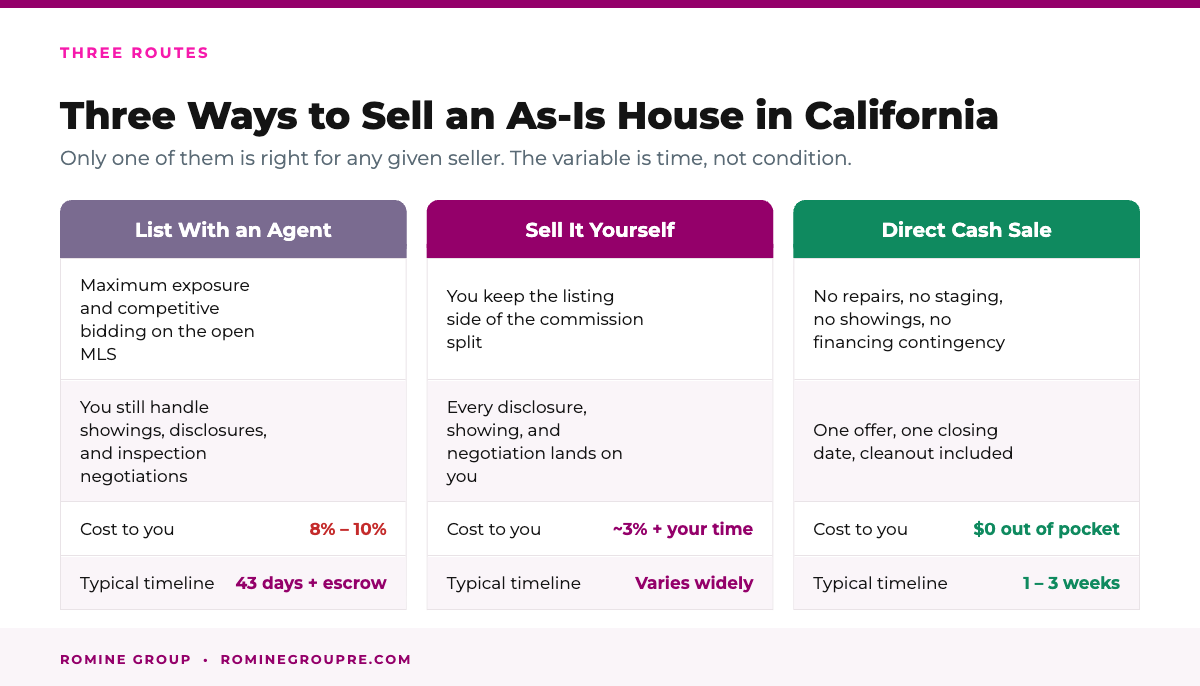
Listing with a traditional agent on the open MLS gives you maximum exposure and competitive bidding. It also takes time, requires disclosures before showings, and often triggers inspection requests that turn into credit negotiations anyway. You’re as-is on paper. The buyer still has leverage in practice.
Selling directly to a cash investor or a home-buying company cuts out agent fees, repair negotiations, and most of the risk of a sale falling apart. Offers come in lower than retail. Certainty and speed offset a good part of that gap. For a seller who can’t afford to carry the property through a 60 or 90 day listing, the gap matters less than people expect. Carrying costs add up fast.
For-sale-by-owner is the third route, and it’s the one we’d argue against hardest on an as-is property. You’re already selling at a discount. Pile on the disclosure paperwork, the contract terms, and running your own escrow, and you’ve taken on real risk without the commission savings making it worth the exposure. Most FSBO sellers in California end up paying a buyer’s agent fee regardless. If you’re set on that route, read selling your house without a realtor in California first so you know what you’re signing up for.
Your timeline decides everything here. A seller with three months and the discipline to price carefully should test the open market. A seller who needs out in 30 days is in a different spot. Same for anyone with code violations, probate complications, or liens on title. Going straight to a buyer who can take those knots on almost always nets more. Title issues alone kill conventional sales regularly.
How Do You List an As-is Home with a California Real Estate Agent?
Sometimes an agent is still the right call, particularly in the Valley submarkets where fixer-upper demand holds up. Clovis, north Visalia, and the older core of Bakersfield all have steady buyer pools for properties that need work.
The mechanics aren’t complicated. The strategy is where sellers slip. Price the home below comparable renovated listings, far enough to signal a genuine condition discount, not so far that you invite investors to lowball from there. An agent who has actually sold distressed properties, not just listed them, knows where that line sits in your zip code.
Buyers financing through conventional loans face appraisal scrutiny. Lenders won’t approve financing on properties with certain health and safety problems: no working kitchen, missing handrails, electrical that can’t pass inspection. If your home has those, a financed buyer probably isn’t your target. Price and market toward cash buyers or investors with bridge financing, and hire someone who’s comfortable in that buyer pool.
One more thing about agents in this market. A Valley agent who mostly lists move-in-ready homes in Clovis will price a fixer by comp and hope for the best. A broker who works probate and distressed listings knows which repairs a lender will demand and which ones an investor shrugs at. Ask directly how many such homes they’ve listed and closed in the past California selling season. That answer means more than any marketing packet.
A clean house beats a staged one. A swept, uncluttered as-is home photographs far better than a packed one, even when both are equally dated. Listing copy should be honest, naming the property’s potential instead of hiding its condition. People who show up expecting one thing and find another waste everyone’s afternoon.
How Does Selling Directly to a Cash Buyer Work in California?
The most common version of this call starts with a foundation estimate sitting on the kitchen table. Valley clay soil moves, older homes crack, and the number on that estimate is usually five figures. The seller hasn’t listed yet and is already dreading the inspection contingency that will surface it.

Selling direct removes that clause from the picture. The offer prices in the foundation issue, escrow opens, and the property closes in weeks. No staging, no open houses, no waiting to learn whether a financed buyer’s lender will approve a property with visible structural movement.
Direct means what it sounds like. No listing agent standing between you and the buyer, no MLS, no showings on a stranger’s schedule. You work with one cash buyer, and the offer you shake on is what you get unless something turns up on title.
The process with a direct buyer is straightforward. You contact the company, they walk the property, and an offer follows within 24 to 72 hours. Escrow opens, title gets checked for liens, and closing happens on a timeline you negotiate, usually a few weeks out. You still complete the required disclosures. The buyer still does their due diligence. No loan clause means no haggling after the inspection.
What you give up is the ceiling. A cash offer on an as-is property won’t match a fully renovated comparable. What you gain is certainty and a date. For sellers managing probate timelines, foreclosure deadlines, or a relocation, that certainty outweighs the spread between a cash offer and top-of-market retail. If a foreclosure clock is part of the picture, our guide on selling a house in foreclosure in California covers how the two timelines interact. A reputable local buyer, one you can check through the Better Business Bureau, will explain how they reached the offer and won’t push you to sign before you’ve thought it through.
What Home Improvements Are Worth Doing Before You List in California?
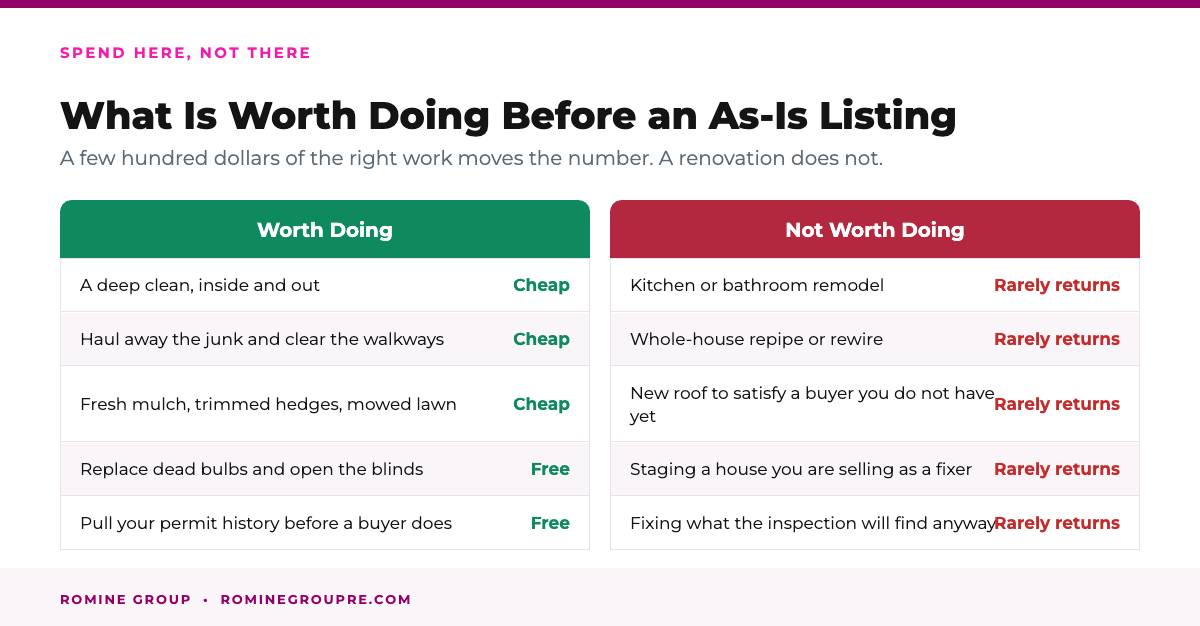
Is it ever worth spending money on a house you plan to sell as-is? Sometimes. The return is the only test that matters.
Repairs that fix health and safety problems earn their keep because they widen your buyer pool. A home that qualifies for conventional financing draws far more buyers than one limited to cash. If a broken HVAC or a dead water heater costs $3,000 to replace and moves you from cash-only to conventional-eligible, that $3,000 has done more work than any cosmetic upgrade could.
The other category worth a look is anything that moves the appraisal. Appraisers working Valley markets from Bakersfield to Fresno look at functional condition and compare it against local comps. A missing kitchen appliance or a non-functional bathroom might not register with a cash investor, but it will show up in a financed buyer’s appraisal even in a seller’s market.
Cosmetic work rarely recovers its cost on a property you’re already selling below market. New carpet, interior paint, updated fixtures. Spend $8,000 on paint and flooring and you might add $4,000 to your as-is offer price. The math doesn’t close. Put that money toward whatever is actually limiting your buyer pool, not toward better photos.
One pattern shows up again and again: sellers spend on the things they’re embarrassed about instead of the things buyers care about. Pride-driven repairs rarely pay. Buyer-driven ones usually do.
What Quick Upgrades Help Sell a California Home Faster?
Sellers walk in expecting a big refresh will shorten their time on market. New countertops, painted cabinets, a resurfaced driveway. Then the first showing happens and the buyer offers on the un-updated house two doors down, because that one was priced $40,000 lower. The upgrade didn’t shorten anything. The price would have.
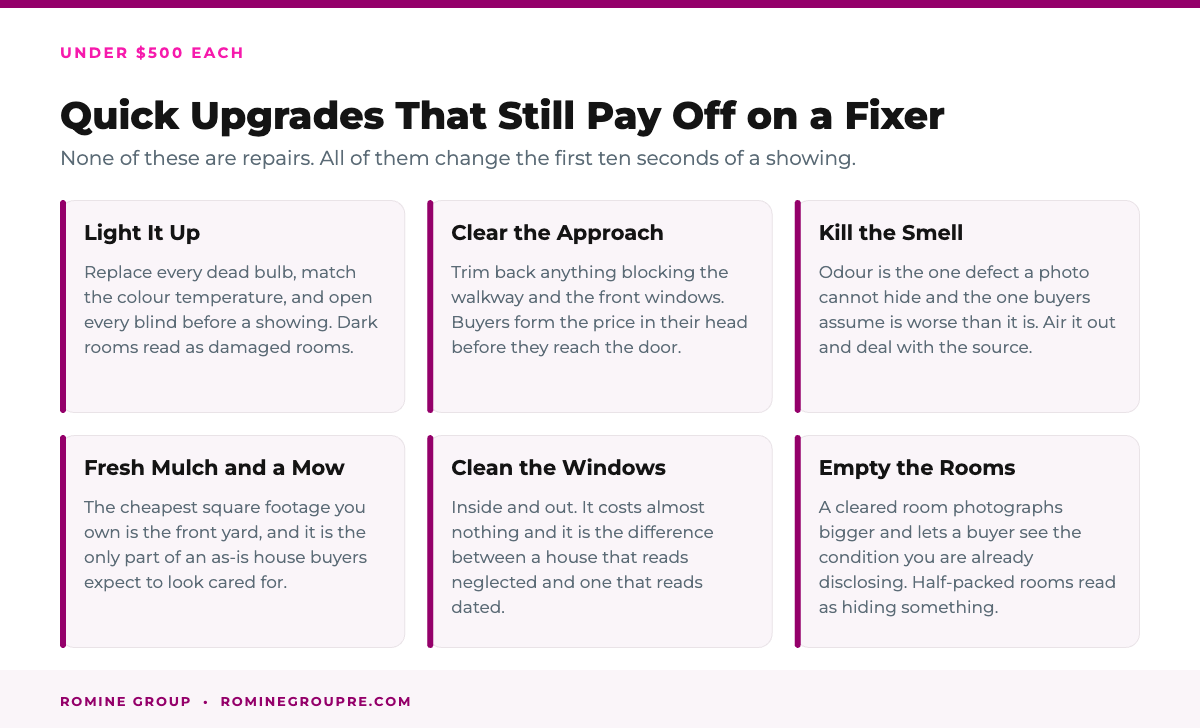
Some low-cost moves do genuinely help. Deep cleaning costs almost nothing and changes how a property photographs and feels at a showing. Pressure washing the driveway and front walk of a Visalia ranch house or a Clovis tract home takes an afternoon and runs $200 to $400. Pulling excess furniture out makes rooms read larger in photos, which matters more now that buyers filter listings on a phone screen.
Fresh neutral paint in the high-traffic areas, entryways, hallways and living rooms, runs about $500 to $1,000 on a mid-size Valley home, DIY or one painter for a day. Buyers can mentally subtract a dated kitchen. They struggle to unsee peeling walls at the front door. Fixing a broken gate latch, swapping burnt-out exterior bulbs, and making sure every door opens smoothly costs almost nothing and removes the neglected signal that makes buyers discount everything else they see.
There’s a real ceiling on this. Past a few thousand dollars you’ve crossed from prep into renovation, and the returns fall off fast.
How Do You Market a Fixer-upper to the Right Buyers?
About 16 percent of California listings take at least one price cut before they sell, according to 2026 California market data. That number climbs fast on as-is properties marketed to the wrong audience.
The right audience for a fixer-upper is not a first-time buyer stretching a 3.5% down FHA loan to reach the price. It’s an investor, a flipper, a contractor-buyer, or a cash buyer who sees the spread between your as-is price and the after-repair value. Marketing should speak to that buyer and nobody else.
Photos should be honest and complete. Hiding the cracked tile or the dated bathroom only guarantees the wrong buyer shows up. Good fixer-upper marketing shows condition plainly and leads with the lot size or the location advantage. Then it frames the opportunity. Three-bedroom on a large lot in Dinuba, priced below comps to reflect condition, ideal for an investor or an owner-occupant rehab. That kind of language filters your audience, which is the entire job of marketing a distressed property.
MLS exposure helps. Cash buyer networks help more. So do investor meetups in Fresno and Bakersfield and direct outreach to flippers already working your area. An agent who works with investors regularly has that network ready. If yours doesn’t, that mismatch is worth correcting early.
How Much Money Will You Walk Away with From an As-is Sale?
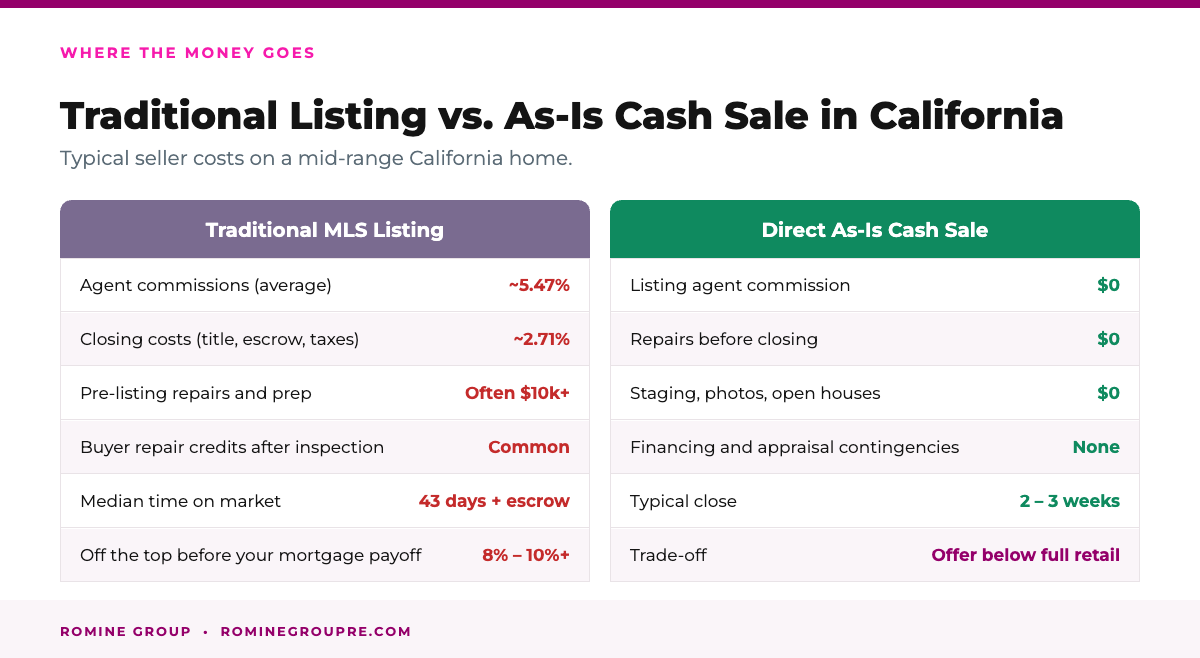
Straight across the kitchen table: the number on the offer is not the number that lands in your account.
California closing costs average around 2.71% of the final sale price, and that’s before realtor fees. Stack them together and you’re giving up more than 8 percent before you subtract any remaining mortgage balance, back property taxes, or liens. On a property with a $750,000 offer, that’s a substantial sum in selling costs before anything else comes off.
Go direct to a cash buyer without agent representation and those commission percentages come off the table. You’ll still pay title, escrow, and any outstanding property taxes. The commission savings alone can run into tens of thousands of dollars on a mid-range California property.
Repair credits are the variable that quietly shrinks your net. A buyer whose offer is contingent on inspection tends to come back asking for a credit once their inspector has walked the place. On an as-is listing you can decline, though declining sometimes costs you the buyer. Price the property for its condition upfront and you’ll face far fewer mid-escrow surprises.
Liens on title get paid out of escrow proceeds before you see a penny. Property tax liens, contractor liens from unpermitted work, HOA assessments, all of it. If you haven’t pulled a preliminary title report before listing, pull one. Surprises at closing are expensive, and sometimes they end the sale.
When Should You Lower the Price of Your As-is House?
Six weeks on market with zero offers is a price problem, not a patience problem. It usually happens when a seller anchors to what the property down the block sold for two years ago, before rates climbed. Buyers in that range have more options now, and they’re comparing your property, condition and all, against updated homes at similar prices a few streets over. A stale listing price does real damage while it sits.

Watch showing activity against offers, not the calendar. The market tells you faster than the clock does. Showings but no offers after two or three weeks means buyers like the location and reject the price for the condition. That’s pricing, not marketing. No showings at all could be either, but address price first, because price is the faster fix.
The Unsold Inventory Index across California stood at 2.7 months in December 2025. That’s still a fairly lean market, so a well-priced as-is home shouldn’t sit for months. If yours is sitting, the price is telling you something.
Don’t reduce in tiny increments. A $5,000 cut on a $600,000 listing is noise and won’t change buyer behavior. Real cuts of 3 to 5 percent move the property in search results and catch buyers who were filtering just below your old number. One real reduction beats four symbolic ones.
What Front Door Colors Hurt Your California Home’s Curb Appeal?
Front door color sounds like it couldn’t possibly matter on a California home you’re selling as-is. At the margins, it does.
Flat blacks and very deep charcoals are popular in design media and can read dated or cheap on older California stucco. Matte finishes soak up Valley heat and go chalky inside a year, which reads as neglect. On a 1960s ranch in Porterville or a 1970s split-level in Clovis, that’s the wrong signal before a buyer reaches the doorbell.
Dirty mustard yellows, terracottas that have oxidized unevenly, and browns that read as mud rather than warmth create the same problem. Any color that has faded, peeled, or chipped is worse than a plain neutral in sound condition. Condition beats color every time.
What works on Valley homes: clean navy, deep olive or sage on foothill properties, warm whites and creamy off-whites on Mediterranean-style stucco. The goal isn’t trendy. The goal is cared for. A freshly painted door in any clean, appropriate color says somebody maintained what they could, which is exactly the message an as-is seller needs to send. A $40 can of exterior paint and one afternoon is the highest-return item on this entire list.
Is Selling Your House As-is in California the Right Move for You?
Not every as-is seller has run out of options. That assumption is wrong often enough to be worth naming.
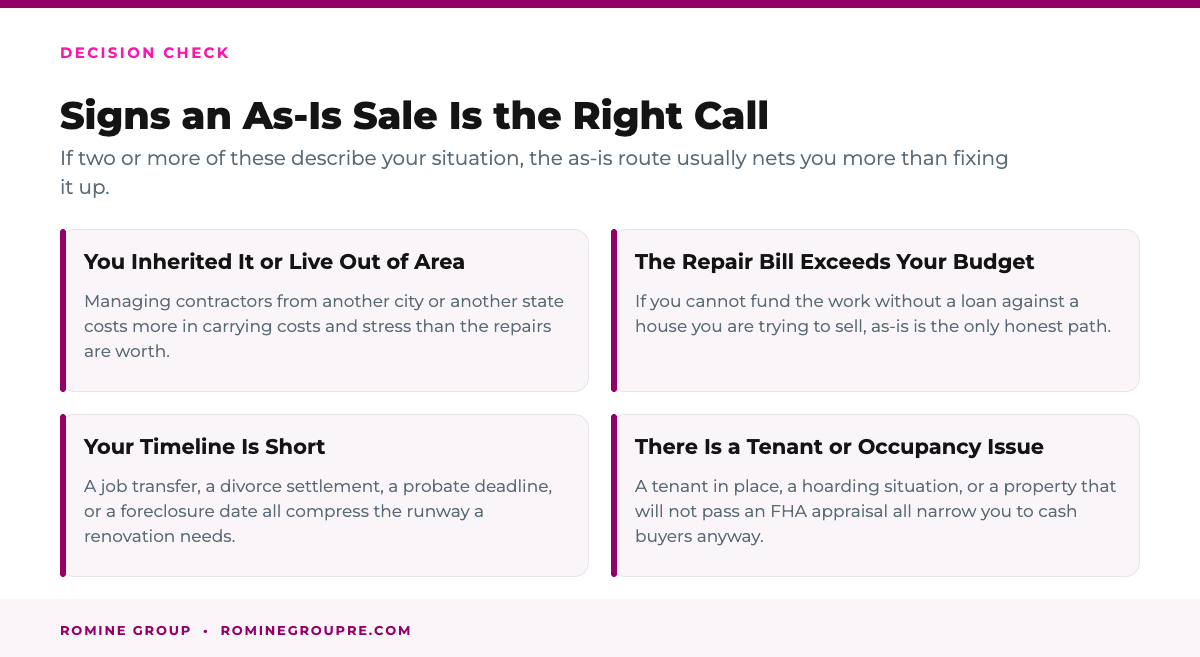
Some owners could list on the open market and wait, and skip it, because the certainty of a direct offer on the home is worth more to them than the potential upside. That’s a preference, not a distress signal. Others genuinely can’t wait, and for them an as-is sale is the difference between keeping equity and losing the property to foreclosure or back taxes.
A common version looks like this. A contractor estimate for kitchen work comes back at roughly what the new kitchen would add in resale value. The roof already ate a chunk of retirement savings the year before. Pouring another lump sum into a home you’ve decided to leave makes no financial sense. Going to market as-is keeps the equity intact, and it means a date on the calendar.
The question is simple enough to answer at the kitchen table. Does the money you’d spend on repairs and commissions come back to you in a higher sale price, with room to spare? If the honest answer is no, or even probably not, an as-is sale is the smarter path. We can walk you through what a direct sale looks like for your specific property, and we won’t pressure you to commit.
Frequently Asked Questions
Can I Sell a House As-is in California?
Yes, you can sell a house as-is in California. Listing your home in its current state, without making repairs before closing, is legal and common across the state. You’ll still complete the required disclosures, including the Transfer Disclosure Statement, because California law doesn’t let those obligations be waived even in an as-is transaction.
Is It Wise to Sell a House As-is?
California law requires sellers to disclose known defects, with no obligation to search them out. Given that, an as-is sale often makes sense when repair costs exceed what they’d recover at closing. It also makes sense when the timeline won’t allow a long listing process. Same goes for a property carrying complications like probate status, liens, or code violations that a traditional buyer pool won’t absorb easily. The answer depends on your California property and your situation, not on a general rule.
How Long Are You Liable After Selling a House in California?
Section 338 of the California Code of Civil Procedure sets the window. A buyer generally has three years to sue over non-disclosure or misrepresentation, counted from the date they discovered the defect or reasonably should have discovered it. If a buyer can prove the seller intentionally concealed a defect, that window may extend. In fraud cases the clock typically starts when the buyer discovers the fraudulent act, regardless of when the sale took place. Full, honest disclosure from the start is the safest approach.
How Do I Avoid Capital Gains Tax When Selling a House in California?
Start with the primary residence exclusion. Qualifying homeowners can exclude up to $250,000 of capital gains from federal tax if single, or up to $500,000 if married filing jointly. The catch is the occupancy test: you must have lived in the home as your primary residence for at least two of the five years before closing. There’s no state-level exclusion stacked on top of the federal one, so California capital gains tax still applies above those thresholds. A CPA who knows California real estate can help with timing, and with payment-plan sale options if your gain is large.
If you want to talk through what an as-is sale would look like for your property, reach out to Romine Group. No pressure and no obligation, just a straight conversation about your options and what makes sense for your timeline. You can also look through other frequent questions from California sellers while you weigh your next step.
More California Selling Guides
- Selling a House With Unpermitted Work in California
- Selling Your House Without a Realtor in California
- California Real Estate Withholding and Form 593
- Selling a House in Foreclosure in California
Sell Your California House As-Is, No Repairs Needed
You do not have to fix anything, clean anything out, or negotiate a repair credit. We buy California houses in whatever condition they are in and close on your timeline. Tell us about the property below and we will get you a fair cash offer. No pressure, no obligation, and no fee for the conversation.
"*" indicates required fields
Prefer to talk it through first? Contact Romine Group and we will walk the situation with you before you commit to anything. You can also read how Romine Group buys homes to see exactly what the process looks like.