
Picture this. A parent spends years keeping the family house out of probate court, does all the right estate planning, sets up a revocable living trust, and then passes away. The kids pull out the trust documents, call a title company, and take the gut punch: the house was never retitled into the trust. Technically it still belongs to the deceased. Before anyone can sell it, they have to work out what California law actually allows, and the options aren’t obvious.
This is one of the most common situations California families walk into completely unprepared.
What Families Actually Face When a Property Gets Left Out
Grieving heirs expect a clean handoff. Mom’s place is in the trust, the trustee sells it, proceeds get distributed. That works beautifully when the funding was done right. Funding a revocable living trust takes an extra step most families forget, though: an actual deed recorded in the name of the trust. Without that recorded deed the property sits in legal limbo, and closings fall apart at the title company over exactly this.
What Is a Heggstad Petition and When Does It Apply?
A Heggstad petition is a legal tool used in California to move assets into a trust after someone has passed away, even when those assets were never formally titled in the trust’s name. It rests on the landmark case Estate of Heggstad. A successor trustee can ask the court to recognize certain property as part of the trust, as long as clear evidence shows the decedent intended to include it.
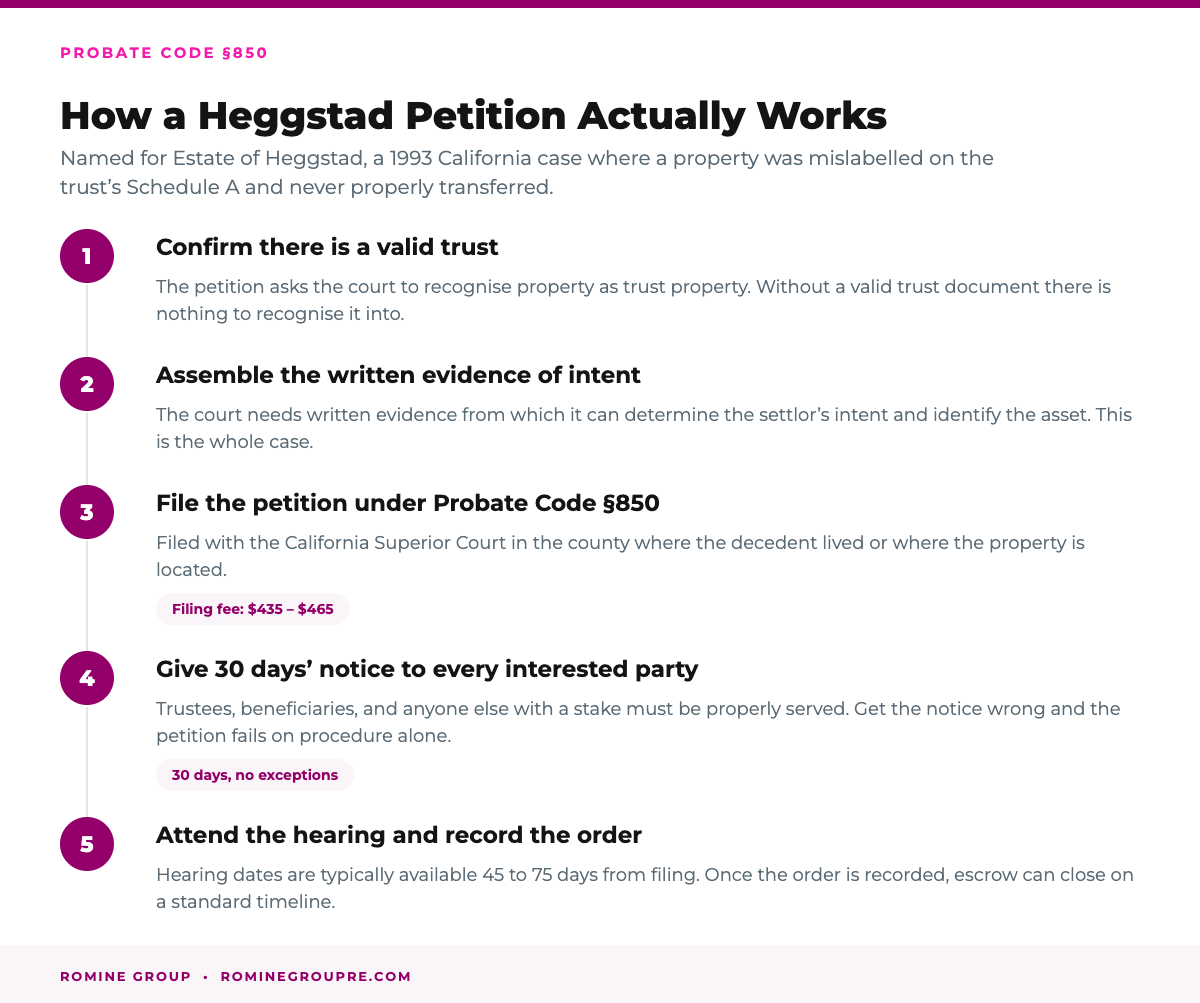
That case dates to 1993 and involved Halvard Heggstad. He executed a revocable living trust that included a Schedule A document identifying his property. One property was mislabeled and never transferred properly, so title never actually moved into the trust. After his death, his wife successfully petitioned to have the property included.
California courts have since widened the rule to cover assets not listed on a schedule of assets, provided the decedent showed other written intent, such as a general transfer statement. The petition is filed under California Probate Code section 850 and asks the probate court to confirm the property belongs in the trust despite the title gap. California Courts publishes a self-help guide to property after someone dies, and it’s a useful plain-English overview of how these proceedings fit together.
The urgent version of this shows up when a mortgage is already behind and an auction date is bearing down. The trust is airtight, the deed is still in the parent’s name, and siblings are three months into missed payments. A Heggstad petition is often the only path that fits that timeline. Auction notices don’t pause for paperwork. If that’s your situation, our guide on selling a house in foreclosure in California covers the clock you’re actually running against.
Why a House Ends Up Outside a California Trust in the First Place
Estate planning attorneys draft the trust, the settlor signs it, and everybody assumes the property automatically becomes a trust asset. That gap between signing a trust and retitling assets is where most of these problems get born.
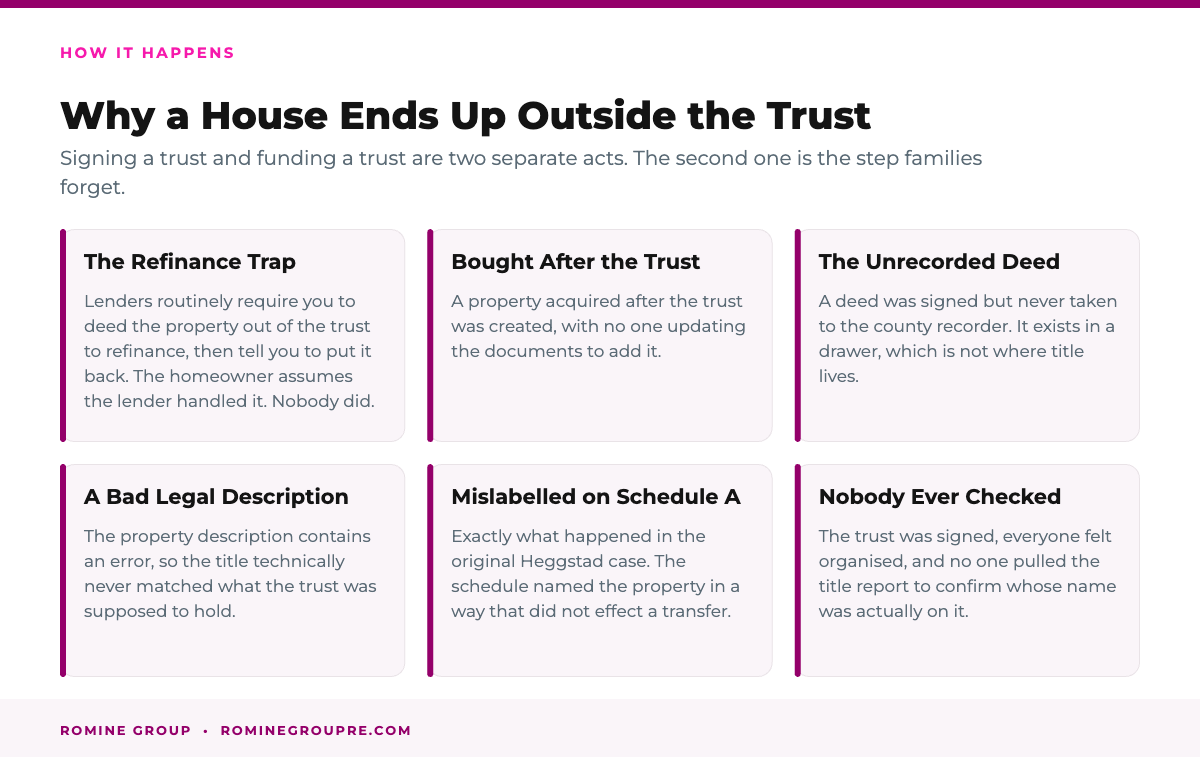
The most frequent culprit is a refinance. Real property gets temporarily removed from the trust to satisfy the lender and then never goes back. Lenders routinely require homeowners to deed property into their personal names during a refinance, then tell them to transfer it back afterward. The homeowner walks out of closing assuming the lender handles it, and the trust never gets the property back.
Other times a property gets acquired after the trust was created and nobody updates the documents. Sometimes an heir finds a deed that was signed and never taken to the county recorder’s office, which is a surprisingly common filing gap. Sometimes the property description carries an error that leaves title technically mismatched.
A trust only avoids probate when the assets are properly funded into it. When real estate gets left out, families usually discover the problem at the worst possible moment. After a death, and often while trying to sell.
The Deed Was Signed but Never Recorded. Does That Change Things?
What if you find a deed in a drawer transferring the property to the trust, and nobody ever took it to the county recorder?
In California, a Heggstad or section 850 petition may work when there’s clear proof the deceased intended the house to be in the trust. Where a signed but unrecorded deed exists, it may simply be recorded, and that’s the simplest path available. From there the trustee will sometimes have authority to sell with no court petition at all, depending on what the title company requires.
For Heggstad petitions, unrecorded deeds or related documentation showing intent to transfer can be persuasive evidence. Every title company sets its own threshold for what it will insure. Some will accept a previously unrecorded deed once it’s recorded. Others will insist on a court order. Your probate attorney, working alongside a real estate professional who knows California trust sales, can tell you which route moves faster in your county.
That county difference is real. Tulare County, Kings County, Fresno County and Kern County each run their own probate calendars, and a smaller court’s calendar can beat a crowded metro one by weeks. A trustee filing in Dinuba or Lindsay often gets a date faster than one filing on the coast. Ask your attorney what the current calendar looks like before assuming a timeline.
What You Need for a Heggstad Petition to Work
Court filing fees generally range from $435 to $465, depending on the county. Attorney fees stack on top. Many California probate lawyers charge flat fees for uncontested petitions starting around $3,500 and rising with complexity. Uncontested is never guaranteed.
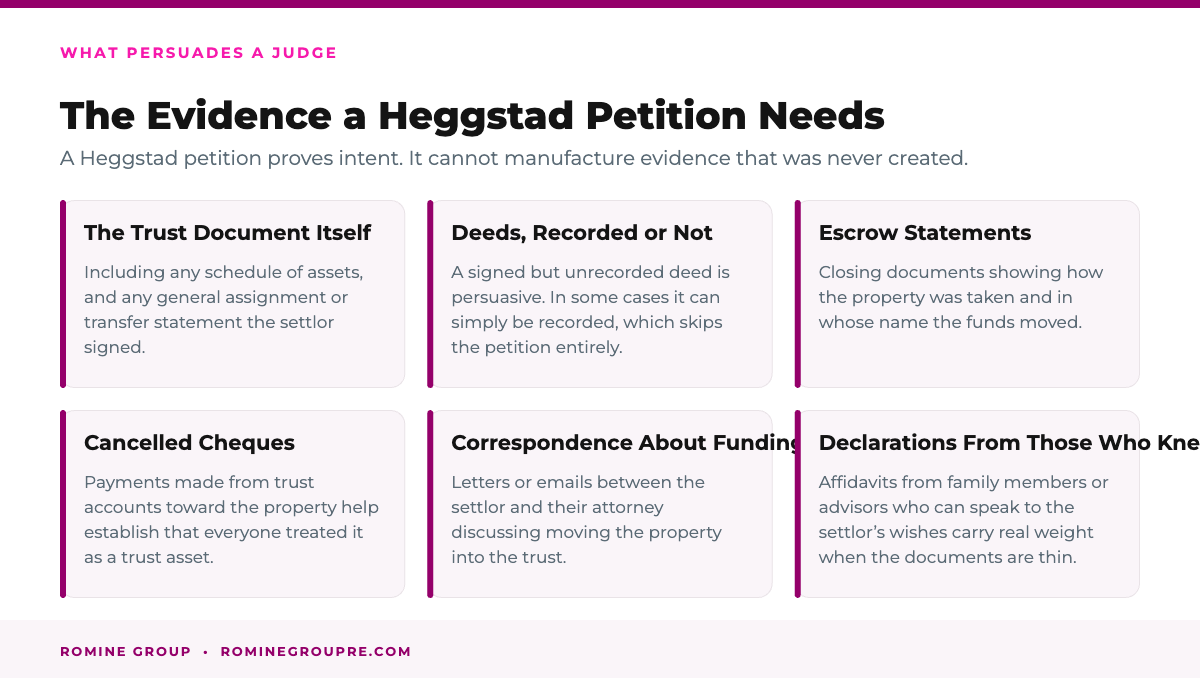
A successful petition generally needs a valid trust and clear written evidence that the deceased owner intended the specific asset to belong to it. The most helpful evidence includes the trust document itself, any recorded or unrecorded deeds, escrow statements, canceled checks, correspondence about funding the trust, and declarations from people who knew the decedent’s intent.
Filing a Heggstad petition under Probate Code 850 requires 30 days’ notice to all interested parties. Trustees, beneficiaries, and anyone else with a stake in the property has to be properly served. Skip that step or botch the notice and the petition fails no matter how strong the rest of the case is.
Heggstad Petition vs. Full Probate: a Side-by-Side Look
The comparison that convinces most trustees comes from pricing both routes. A rental property that slipped out of a trust during a refinance five years earlier looks like a small paperwork problem until somebody prices full probate on it. Then the number lands, and the timeline lands harder.
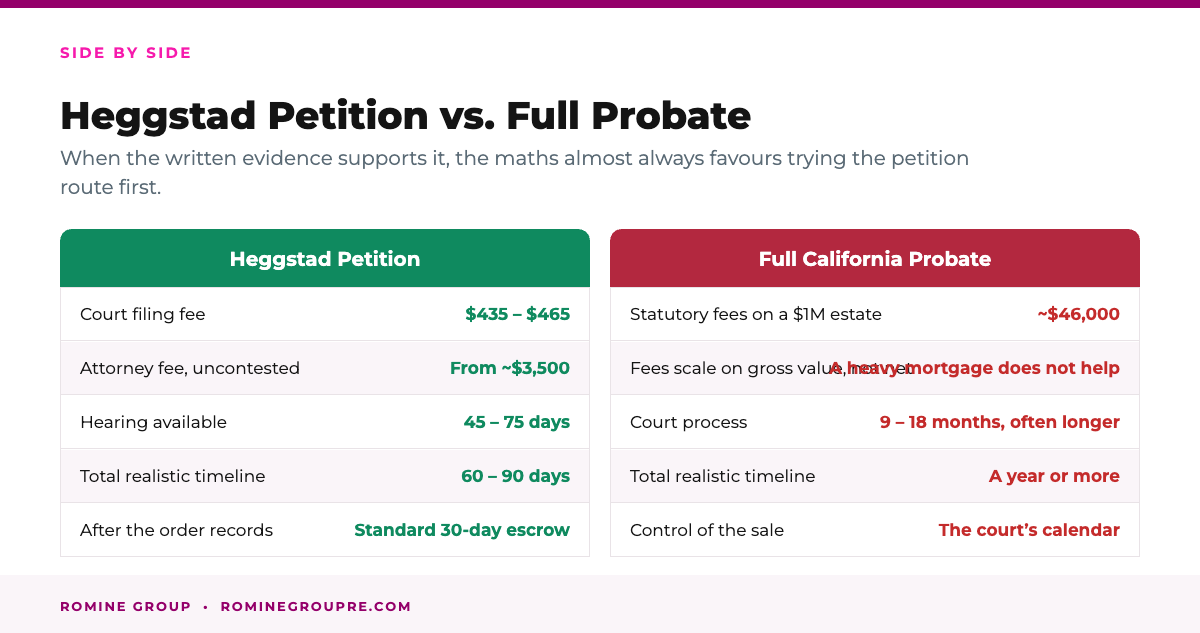
Full California probate commonly takes 9 to 18 months, often longer, with statutory fees running roughly $46,000 on a $1 million estate. Those fees scale off gross estate value, not net, so a property carrying a heavy mortgage still generates the full statutory charge.
Hearing dates for section 850 petitions are typically available within 45 to 75 days of filing, which makes a total Heggstad timeline of 60 to 90 days realistic without complications. That’s potentially a year’s difference. Once the court order is recorded, escrow can close on a standard 30-day timeline.
Families selling property in California can’t afford to sit out a full probate cycle. We work with successor trustees regularly and can structure a sale timeline that lines up with the petition’s resolution. That holds whether you need cash home buyers in Fresno or a cash for houses company in Tulare. We buy throughout the Central Valley, including Visalia, Clovis, Porterville and Bakersfield. In June 2026 the statewide median California home sold for $777,566, so a property stuck in title limbo is real money sitting still.
What a Heggstad Petition Cannot Fix
What happens when the evidence simply isn’t there? A Heggstad petition proves intent. It cannot manufacture evidence that never existed.
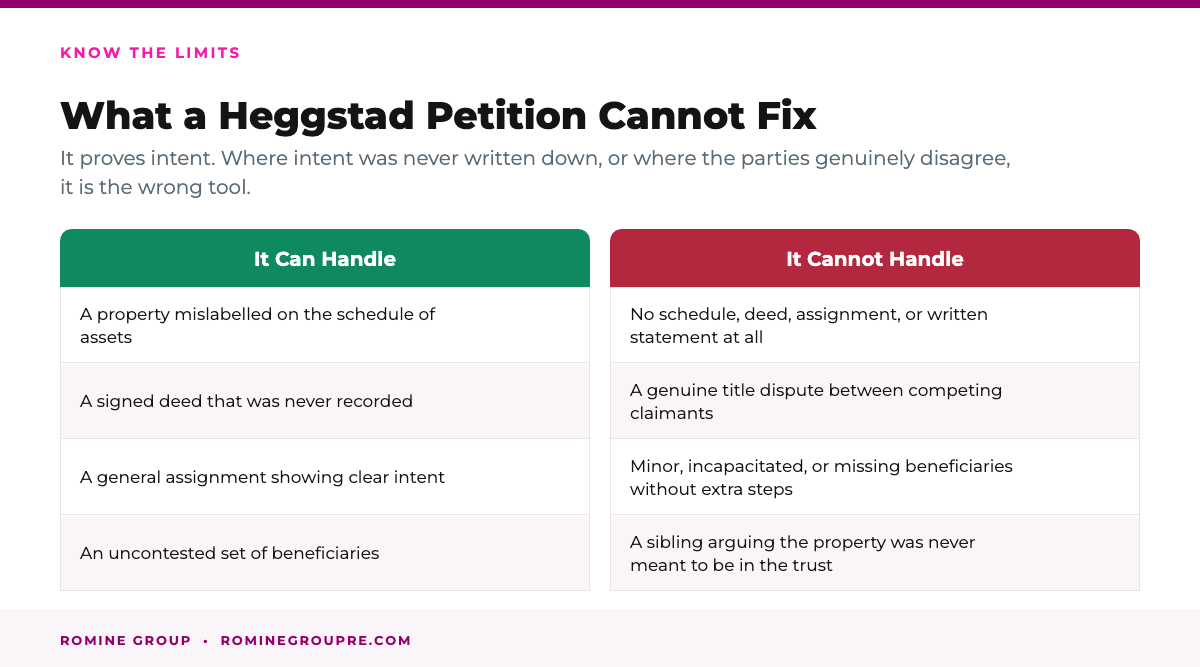
Sellers hit a harder wall when no schedule, assignment, deed, or statement connects the property to the trust. A court needs written evidence from which it can determine the owner’s intent and identify the asset at issue, and courts are strict about that. Without the paper trail the petition gets denied and the family lands in full probate anyway. In that case our guide to the small estate affidavit is worth reading to see whether a simplified route still applies.
Minor beneficiaries, incapacitated adult beneficiaries, and missing beneficiaries all complicate petition requests, which drives up fees and delays. A Heggstad petition also can’t resolve title disputes between competing claimants. If one sibling argues the property was never meant to be in the trust, that’s a contested hearing, and litigation costs can erase whatever savings the petition route offered.
Can a Heggstad Petition Be Contested in California?
The contested version usually starts with a family member who has been quietly covering two mortgage payments for months. Their own, plus the one on a late relative’s house sitting in a partially funded trust. Then a cousin hires an attorney and starts threatening to contest the trust itself.
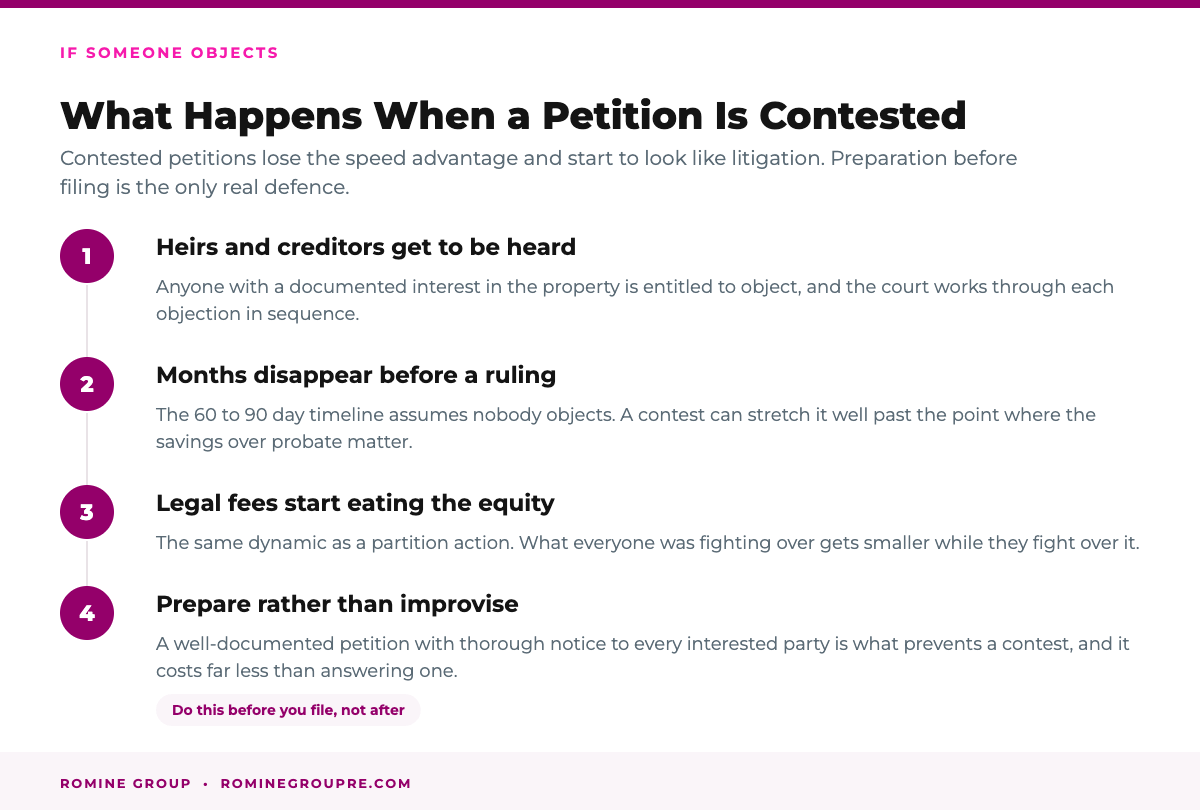
When a petition gets contested, the process loses its speed advantage and starts behaving like litigation. Heirs can object. Creditors can assert claims. Anyone with a documented interest in the property is entitled to be heard. A judge works through each objection in sequence, and months disappear before a ruling lands.
The fix is preparation before filing, not improvisation after an objection arrives. A well-documented petition with thorough notice to every interested party cuts the odds of a contested hearing. Property taxes are worth thinking about at the same time, since Prop 19 reassessment rules apply once title finally moves. When trust sales do close smoothly, a real estate partner who understands trust-related title requirements makes the last leg far less stressful. You can see how Romine Group buys homes to know what to expect.
Frequently Asked Questions
What Are the Requirements for Filing a Heggstad Petition?
A successful petition generally needs a valid trust and clear written evidence that the deceased owner intended the specific asset to belong to it. You will file with the California Superior Court in the county where the decedent lived or where the property sits, and you will need to give 30 days’ notice to all interested parties. Working with a probate attorney cuts the risk of a procedural error that gets the petition denied outright.
What Happens When You Inherit Property From a Trust?
When the trust was properly funded and the trustee has authority to act, the successor trustee can generally sell or transfer the property with no court involvement. The title company will typically want three things. A copy of the trust or a Trustee’s Certification of Trust under California Probate Code section 18100.5, any applicable recorded court order, and the recorded deed showing trust ownership. If the property was never properly transferred into the trust, a Heggstad petition may be the fastest path to clean, insurable title. Our guide on inheriting a house with a mortgage covers what the loan does meanwhile.
What Are the Requirements for Selling a House Held in a Trust?
The trustee must hold legal authority to sell under the trust document, and title must be held clearly in the trust’s name. If title still sits in the decedent’s name, you’ll need either a recorded court order from a successful Heggstad petition or a full probate administration before any sale can close. A real estate professional who knows California trust sales can help you coordinate the escrow timeline around the petition process.
How Much Does It Cost to File a Heggstad Petition?
Court filing fees run between $435 and $465 depending on the county. Attorney fees for an uncontested petition typically start around $3,500, and the total climbs if the petition gets contested or the evidentiary record is thin. Even a fully litigated Heggstad petition usually costs a fraction of what full probate would run on a California property of meaningful value. The math almost always favors trying the petition route first when the written evidence supports it. You can check out other frequent questions or reach out to Romine Group to talk the property side through.
More California Selling Guides
- Using a Small Estate Affidavit to Skip Probate in California
- How Prop 19 Changes Inherited Property in a California Trust
- Inheriting a House With a Mortgage in California
- Selling a House As-Is in California
Property Stuck Outside a Trust and You Need to Sell?
We work with successor trustees and probate attorneys constantly, and we can structure a purchase that lines up with your petition timeline instead of fighting it. Tell us about the property below and we’ll get you a fair cash offer. No pressure, no obligation, and no fee for the conversation.
"*" indicates required fields
Prefer to talk it through first? Contact Romine Group and we will walk the situation with you before you commit to anything. You can also read how Romine Group buys homes to see exactly what the process looks like.