
Nobody calls us thinking about probate after losing a family member. They’re thinking about funeral arrangements, unpaid bills, and a home full of belongings that suddenly has to be sorted. Then somebody mentions the estate has to go through court, and the stress doubles overnight. For plenty of California heirs there’s a faster and cheaper path they’ve never heard of. It’s called a small estate affidavit.
What Is a Small Estate Affidavit in California?
A small estate affidavit, officially the Affidavit for Collection of Personal Property, is a sworn legal document that lets an heir or beneficiary collect a deceased person’s assets without formal probate court. California Probate Code sections 13100 through 13116 govern the procedure. No petition, no months of waiting for a judge to appoint an executor. You prepare the affidavit, attach the required documents, and hand it straight to the bank, brokerage, or other institution holding the assets.
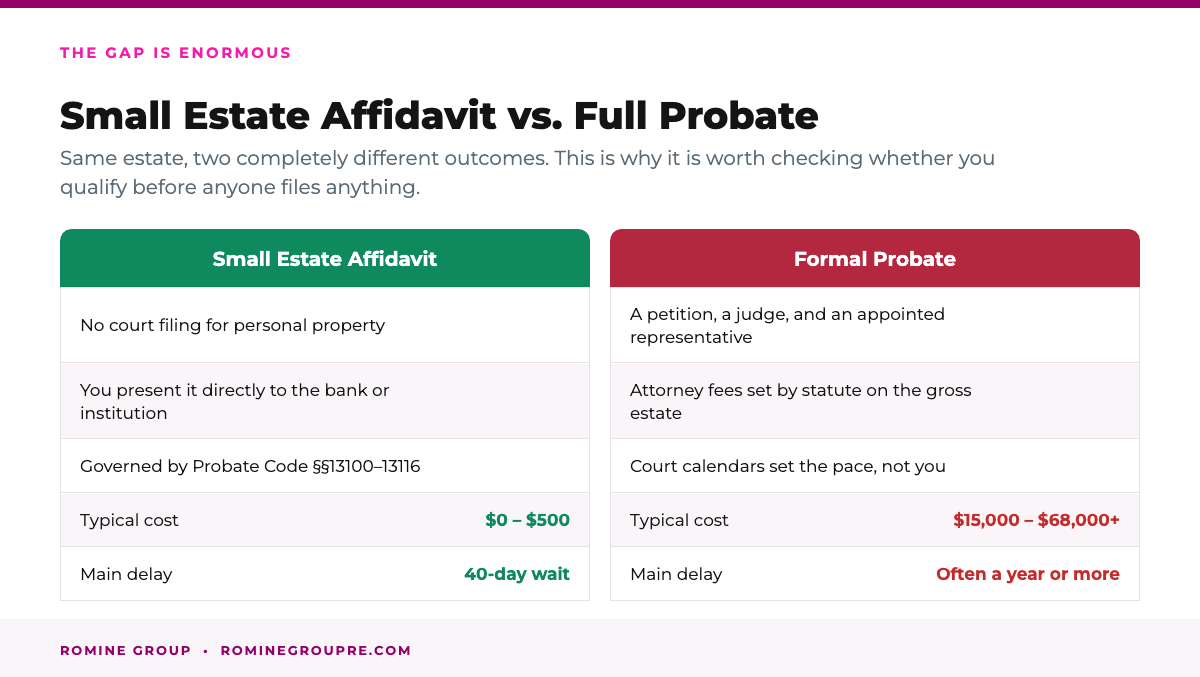
Formal probate in California is slow and expensive. The small estate route typically costs between $0 and $500, against $15,000 to $68,000 or more for full probate. That gap is staggering. On a modest estate it decides whether an heir walks away with something or walks away with nothing.
What Are the Current Dollar Limits for California Small Estates?
The threshold that applies to you is set by the date of death, not the date you file. Get that date right first. Everything else follows from it.
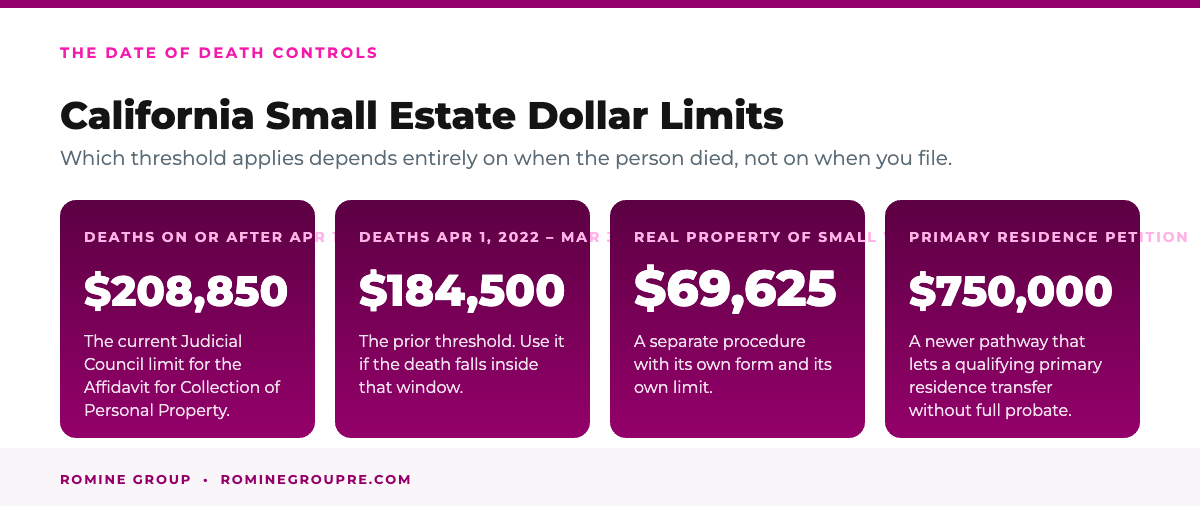
California’s Judicial Council set the limit for the Affidavit for Collection of Personal Property at $208,850, effective April 1, 2025. Deaths between April 1, 2022 and March 31, 2025 fall under the $184,500 threshold. Deaths before April 1, 2022 are governed by the $166,250 limit.
For real property of small value, the limit rose to $69,625. A newer petition pathway allows primary residences worth up to $750,000 to transfer without full probate. Those are separate tools from the standard affidavit, so you can’t swap one form in for the other. Your county’s Superior Court can confirm which form applies, and the California Courts self-help site walks through the differences.
Valley heirs benefit from that $750,000 residence figure more than most, so the process is worth knowing here. A three-bedroom in Tulare, Hanford or Lemoore frequently appraises below that line. A comparable coastal home would blow past it and land everyone in full probate. Median prices across Tulare, Kings, Fresno and Kern counties sit well under the statewide number. The simplified pathway is open to families here who would not qualify elsewhere in the state.
Which Assets Count Toward the Small Estate Limit?
Add up all California personal property the decedent owned solely at the time of death. Then exclude assets that already carry a transfer mechanism: joint tenancy property, trust-held assets, and accounts with active beneficiary designations.
One mistake families make constantly is assuming each bank has its own separate limit. Then a small personal account at a second institution pushes the total over the threshold, and the process stalls with everyone blindsided. That isn’t how it works. You total everything across all institutions.
Who Can Sign a California Small Estate Affidavit?
Getting named executor in a will is not part of this process. Being a legitimate heir or beneficiary is.
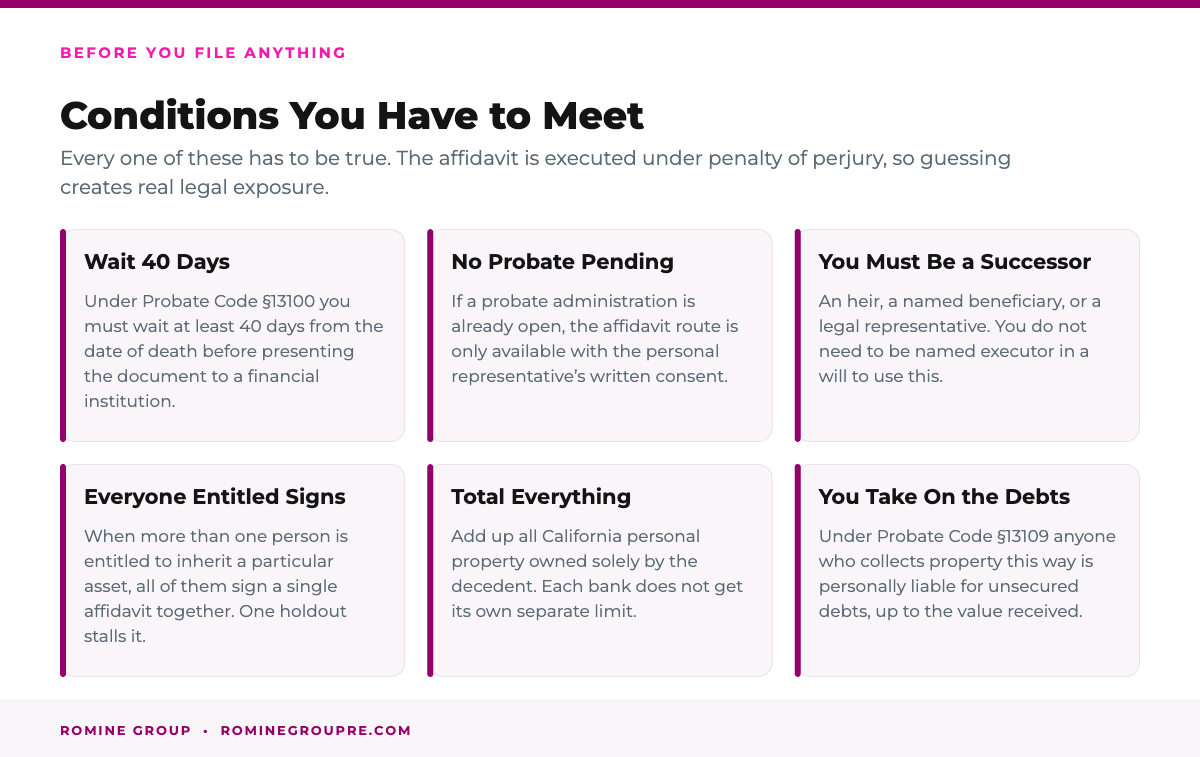
To sign, you must be entitled to the property as a successor, meaning an heir, a named beneficiary, or a legal representative. Where the decedent had a will, the named beneficiaries sign. Without a will, California’s intestate succession laws decide who qualifies. When more than one person is entitled to inherit a particular asset, all of them have to sign a single affidavit together. One holdout sibling can stall the whole thing.
Gather a certified copy of the death certificate, government-issued photo ID for each successor, and documentation showing the decedent owned the property. Several county public law libraries publish free step-by-step guides for exactly this process.
What Other Conditions Must Be Met Before You File?
This process only applies when no probate administration is pending in California. With a probate already open, the affidavit route requires written consent from the personal representative. Under Probate Code section 13100, you also have to wait at least 40 days after the date of death before presenting the document to a financial institution. Banks won’t budge on that.
Creditors matter here too. Under California Probate Code section 13109, anyone who collects property using a small estate affidavit is personally liable for the decedent’s unsecured debts, up to the fair market value of the property received. The affidavit is executed under penalty of perjury, so guessing at values creates real legal exposure.
How to Use a Small Estate Affidavit to Transfer Property
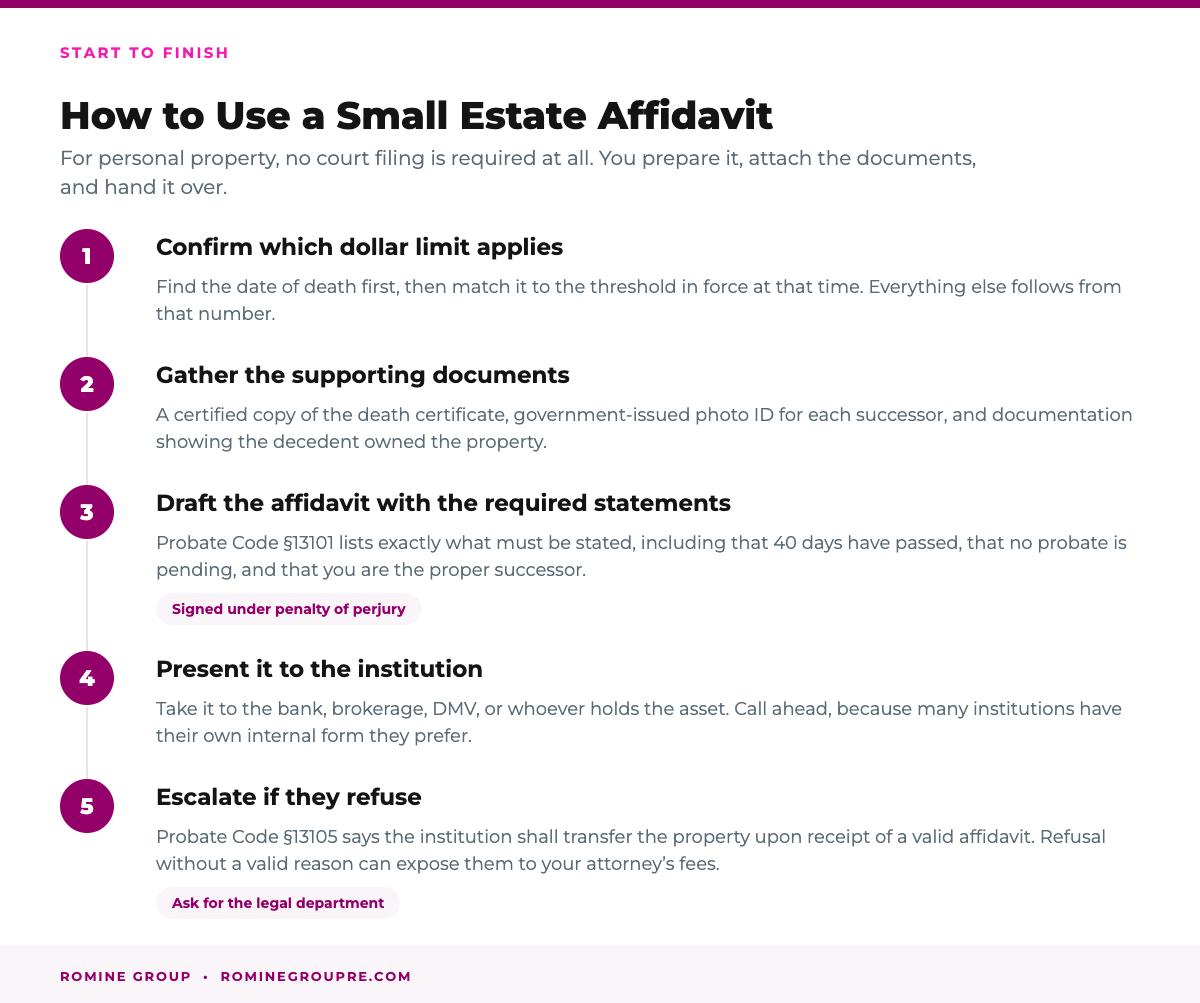
Confirm eligibility first by pinning down the correct dollar limit for the date of death. Then gather the death certificate, your ID, and proof the decedent owned the property you’re claiming. Your affidavit has to include every statement required by Probate Code section 13101: confirmation that 40 days have passed, that no probate is pending, that you’re the proper successor, and a penalty-of-perjury clause.
Take the completed affidavit, the death certificate, and your identification to the banks, brokerages, DMV, or other institutions holding the assets. Institutions are required to release assets within a reasonable time once they have proper documentation. Many also keep their own internal forms they’d rather you use, so calling ahead saves a wasted trip.
The Romine Group Team often meets families mid-process on exactly this: heirs who need to understand their transfer options before deciding whether to keep or sell inherited property. If there’s a house in the estate, our guide to inheriting a house with a mortgage covers what the loan does while you sort the paperwork. Property tax is the other piece, and how Prop 19 changes inherited property explains what happens to the assessment once title moves.
What Happens If a Bank Refuses the Affidavit?
A bank may reject an affidavit that’s incomplete, inconsistent with account records, signed by the wrong person, or missing required attachments. Before assuming the process failed, check whether the bank keeps its own internal form. Many have a specific one-pager. If a teller or manager still refuses, point them to California Probate Code section 13105, which states that the institution shall transfer property to the successor upon receipt of a valid affidavit. Refusal without a valid reason can expose the institution to liability for your attorney’s fees if you end up in court.
If resistance continues, California law lets you bring a court action to compel the transfer and have the institution reimburse your attorney’s fees and costs. Ask to escalate to a manager, then to their legal department. Most institutions back down once they understand the statute. Complying costs them less than litigating.
When Is a Small Estate Affidavit the Wrong Tool?
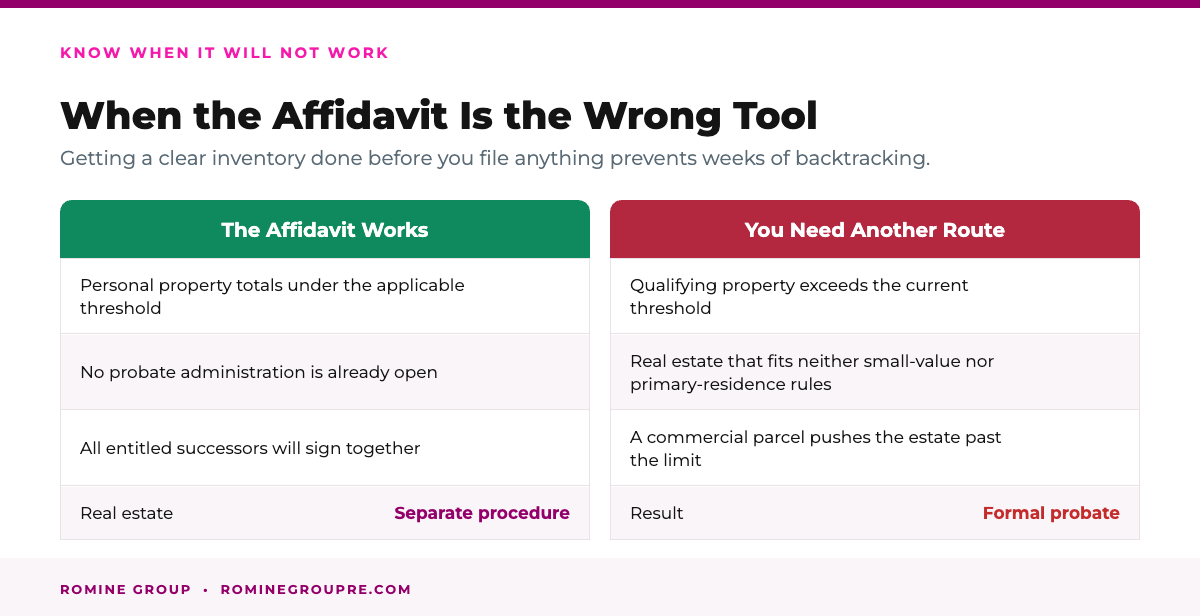
Two situations push you into full probate at the Superior Court. Total qualifying personal property above the current threshold. Or real estate that doesn’t fit the small value or primary residence exemption. An estate with a living trust skips this entire conversation, which is why setting one up early saves heirs so much time and court cost. If the house was supposed to be in the trust and never got retitled, that has its own fix, covered in our guide to the Heggstad petition.
Families start down the affidavit path all the time, then realize the decedent also held a commercial parcel or a second lot that pushes the total well past any simplified threshold. Ag land does this constantly in this part of the state, where a few acres attached to a modest house can quietly triple the estate’s value. Get a clear inventory done before filing anything. A simple title search early saves weeks of backtracking.
Timing pressure is the other complication. A mortgage three months behind with an auction date already set doesn’t wait for estate paperwork. A quick sale clears the auction threat and buys room to handle the affidavit with no clock running. Our guide on selling a house in foreclosure in California lays out those deadlines. We buy across the Valley, including cash home buyers in Fresno, a company that buys homes in Bakersfield, and plenty of estates in Visalia and Selma.
Frequently Asked Questions
Can I Find a California Small Estate Affidavit Form for Free?
Yes, free forms come from several legitimate sources. The California Courts self-help website walks through the process and links to the relevant resources, and many county Superior Courts publish their own local templates at no cost. Your county’s public law library is another solid option, with law librarians who can point you to the right form without charging you a dime.
Does a Small Estate Affidavit Need to Be Filed With the Court?
For personal property, no court filing is required. You prepare the affidavit, attach the supporting documents, and present it directly to the institution holding the assets. That small-value route does involve the county recorder’s office, so the answer depends on which type of asset you’re transferring. When in doubt, your county Superior Court’s self-help center can clarify which process applies.
How Much Does It Cost to Use a Small Estate Affidavit?
Preparing the affidavit costs nothing if you use a free county form. Notarization, where required, runs a small flat fee. Most families finish the personal property process for well under a few hundred dollars, a fraction of what formal probate would cost.
How Long Does It Take to Complete One?
The mandatory 40-day waiting period after the date of death drives the timeline. Once that window closes, collecting documents and presenting the affidavit can move fast, often within days when the institution accepts it on first submission. Having everything organized before you walk in makes the rest go smoother. You can check out other frequent questions or reach out to Romine Group if the estate includes a house and you’re not sure what to do with it.
More California Selling Guides
- Selling a House Left Out of a California Trust
- How Prop 19 Changes Inherited Property in a California Trust
- Inheriting a House With a Mortgage in California
- Selling a House in Foreclosure in California
Inherited a California Property and Not Sure What Comes Next?
Whether the estate is going through probate, a trust, or a simple affidavit, we can tell you what the house is worth and what a direct sale would look like. We buy California homes exactly as they sit, contents and all, and we work with heirs and successor trustees every week. Tell us about the property below. No pressure, no obligation, and no fee for the conversation.
"*" indicates required fields
Prefer to talk it through first? Contact Romine Group and we will walk the situation with you before you commit to anything. You can also read how Romine Group buys homes to see exactly what the process looks like.