

Nobody sits at a kitchen table in the days after a funeral thinking about mortgage servicers. The letter arrives anyway, sometimes inside two weeks of the death, addressed to the estate of someone you loved. It states the loan balance, and depending on how it’s written, it can read like a demand. Heirs across the Central Valley get that letter and panic. Most of them don’t need to worry about losing the home.
What Happens When You Inherit a House With a Mortgage in California?
People walk in carrying one of two pictures. Either the original borrower is gone so the loan died with them, or the whole balance just came due and the bank is about to knock. Both pictures of the inherited home are wrong.

When a homeowner passes and a mortgaged home transfers to an heir in California, the mortgage doesn’t disappear. Deciding how to handle the existing loan falls to the heir, and that decision is yours to make at a reasonable pace. Death of the original borrower alone cannot trigger the lender’s right to call the loan due. The Garn-St. Germain Depository Institutions Act of 1982 is a federal law that explicitly prohibits lenders from enforcing due-on-sale clauses when property passes to an heir. You have real breathing room to work out your next move.
Residential mortgages typically include a due-on-sale clause, which lets a lender demand full repayment the moment a property transfers to someone new. The Garn-St. Germain Act blocks that enforcement in several family and estate situations. That leaves you room to keep the home and continue under the original loan terms, interest rate included.
The most common version of this call involves an heir who has been making two mortgage payments for the better part of a year, terrified that stopping would trigger foreclosure. Nobody told them about Garn-St. Germain. The garage is still full of a parent’s belongings, which stacks emotional weight on top of the financial strain. Once someone walks them through their actual rights under federal law, the pressure changes shape entirely. The options were sitting there the whole time.
As an heir, notify the lender as soon as you can and provide proof of inheritance, a trust document or a probate order. That single step opens the conversation and ends the uncertainty.
What to Know If You Inherit a Home With No Mortgage in California
Clear title is its own kind of complication. No loan balance means no monthly payment pressure, which sounds like a gift. The ownership questions don’t go anywhere, though.
If the home was placed in a revocable living trust, it bypasses probate. The successor trustee can transfer ownership to beneficiaries immediately or on the trust’s terms. That’s the cleanest path, and it’s the one estate-planning attorneys push hard, because a probate proceeding in Tulare County or Fresno County can drag on for a year or more. California’s probate threshold of $750,000 for the period from April 1, 2025 through March 31, 2028 still catches many estates holding real property when the home wasn’t in a living trust. Our guide to the small estate affidavit covers the simplified routes that exist below that line.
Even with no mortgage, you’re still carrying property taxes, homeowner’s insurance, and whatever deferred maintenance the prior owner let pile up. Under California’s Proposition 19, keeping the existing property tax rate requires the heir to use the home as their primary residence. Convert it to a rental or sell it and the property gets reassessed at current market value, which raises the tax bill. We cover that in detail in our guide to how Prop 19 changes inherited property in a California trust.
Loan Types That Affect an Inherited Property
Take a minute on this one, because the type of mortgage left behind changes what you’re walking into.

An heir who inherits the family home can generally take over the existing mortgage and keep making the same payments on the same terms, with no lender accelerating the loan or forcing a refinance. That holds whether the loan is conventional, FHA, or VA, since all three follow similar federal protections under Garn-St. Germain.
Reverse mortgages are a different animal entirely. Instead of the homeowner paying the lender, the lender pays the homeowner, drawing down the home’s equity. The loan gets repaid when the borrower dies, sells, or moves out. Most reverse mortgages are FHA-insured Home Equity Conversion Mortgages, or HECMs. When the last borrower on a HECM dies, the clock starts moving fast.
HUD guidance generally gives heirs about 30 days after the borrower’s death to notify the servicer of their intentions, then up to six months to complete a sale or payoff. Servicers can grant two 90-day extensions, pushing the effective deadline to 12 months, though only when heirs show active marketing with a signed listing agreement and an MLS number. Get that listing live fast.
One protection worth knowing. On a federally insured HECM, heirs can satisfy the loan by paying the lesser of the full loan balance or 95 percent of the home’s current appraised value. So even when the balance has grown past what the home is worth, heirs aren’t necessarily stuck.
What Are Your Options When You Inherit a Mortgaged Property?
This is the situation that repeats. A three-bedroom house with eighteen years left on a fixed-rate mortgage. A parent who passed suddenly. Two siblings out of state, one who wants to sell, and nobody has touched the place since it happened. Nobody knows where to start, and the home sits.

An heir’s practical options with a regular mortgage come down to three. Keep the home and continue the mortgage. Refinance it into your own name. Or sell the home and pay off the loan from the proceeds. Renting it out is on the table too, though Proposition 19’s reassessment rules kick in the moment it stops being your primary residence.
Keeping the home makes sense when the existing mortgage rate is good. Refinancing makes sense when you want the loan in your own name or need to pull equity. Selling outright is often the most straightforward path when siblings are involved, or when holding the property stops making financial sense.
The median days on market in California was 43 days as of June 2026, so a traditional listing is realistic. Rather skip the listing process? How Romine Group buys homes is worth a look. We buy directly from heirs without the prep work, the showings, or the uncertainty, which spares you coordinating repairs and walking strangers through a house you’re still grieving. We work across the Valley, from cash home buyers in Fresno to a cash for houses company in Tulare, and out to Bakersfield and Clovis.
What If the Mortgage Is More Than the Home Is Worth?
Sometimes a parent bought near a peak and the loan balance still sits above current value. Know this clearly: you’re not personally obligated to cover a deficiency between what the home is worth and what’s owed. Inheriting a property doesn’t mean inheriting the debt.

California is a non-deficiency state for most purchase money mortgages, so a lender typically can’t come after you personally for the difference between the sale price and the balance. Refinanced loans and home equity lines follow more complex rules, which can turn what felt like a simple short sale into a quiet personal liability problem. If the original loan was refinanced at any point, get a real estate attorney involved before you proceed.
Two realistic paths exist in an underwater situation. A short sale, where the lender agrees to accept less than the full balance at closing. Or a deed in lieu of foreclosure, where you hand the deed to the lender in exchange for release from the obligation. Continued contact with the servicer almost always produces a better outcome than going silent and letting things drift toward foreclosure. If a sale date is already set, our guide on selling a house in foreclosure in California walks through the time you actually have.
Walking away is an option too. The property stays with the estate, the lender forecloses, and your personal credit and assets stay separate. A real estate attorney can map out which path costs the estate the least.
How Multiple Heirs and Siblings Split an Inherited Home
What happens when one sibling wants to sell and another refuses? Co-inheriting a house is one of the most reliable ways to fracture a family, and that split is usually where it starts.
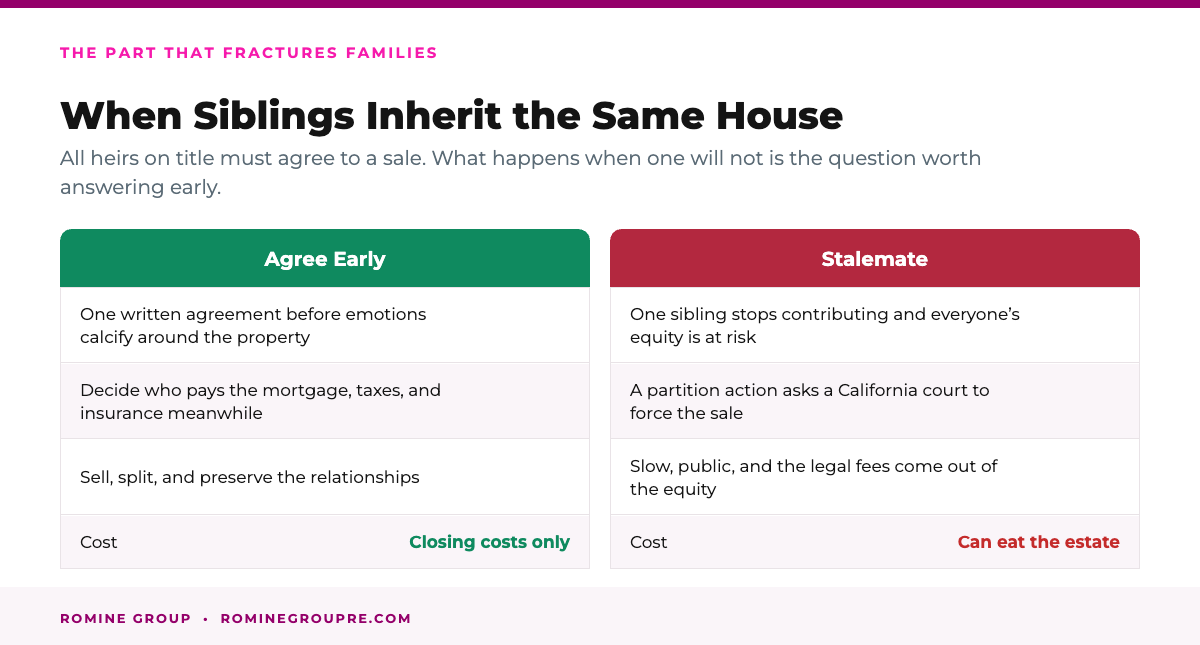
Most often, when multiple heirs are involved, everyone decides to sell the house and divide the assets. Joint ownership of real property gets complicated fast. One sibling stops contributing to the mortgage and suddenly everyone’s credit and equity is exposed. One wants to rent it, another wants to move in, and a third lives two time zones away and wants cash now. The idea that everyone agrees on a plan rarely survives contact with an actual attorney meeting.
An agreement reached early, before emotions calcify around the property, is the cleanest resolution. Every heir on the title has to agree to a sale. If one refuses, the others can file a partition action in California court, which forces a sale. That process is slow and expensive, and it can stretch long enough that legal fees eat into the equity everyone was fighting over.
If you’re the heir managing this while the others are scattered across time zones, working with an experienced buyer simplifies it. We handle multi-heir situations regularly and can close quickly once everyone is aligned.
How Inheriting a House Affects Your Taxes in California
I heard I’ll owe a huge tax bill if I sell. That concern comes up constantly, and most sellers owe far less than they expect.
Inheriting a home in California comes with a step-up in basis, which cuts capital gains taxes if you sell. The cost basis adjusts to fair market value at the date of the owner’s death. So if a parent bought a home in Lindsay in 1988 for $180,000 and it’s worth $900,000 today, your cost basis resets to $900,000 at the date of death. Sell soon after for that amount and you owe no capital gains tax on the appreciation.
Inherited property automatically qualifies for long-term capital gains treatment at the federal level, no matter how long you hold it after inheriting. Federal long-term rates are 0, 15, or 20 percent depending on income. California adds its own layer, taxing capital gains as ordinary income at rates up to 13.3 percent for the highest earners. That matters for higher-income heirs who hold a property for years before selling.
California has no state inheritance tax, and the stepped-up cost basis frequently minimizes capital gains exposure for heirs who sell quickly. A separate withholding step at closing surprises a lot of sellers, and we cover it in our guide to California real estate withholding and Form 593. Get a CPA involved before you sell, not after.
Scams That Target Heirs and How to Protect Yourself
Heirs are among the most targeted groups in California real estate fraud. Inherited properties draw attention because scammers assume those homes carry real equity and that heirs aren’t watching them closely. Law enforcement agencies around California report a sharp increase in fraud involving identity theft and the sale of vacant property.

The most common schemes continue to run like this. Someone contacts you claiming to be a foreclosure prevention service and charges upfront fees to negotiate with your lender. Foreclosure consultants are prohibited by law from collecting money before performing services in California, so an upfront fee demand is a red flag. Another version involves operators who pressure grieving heirs into signing over title fast, often for a fraction of market value, by manufacturing urgency.
Verify anyone who approaches you about the property. Real buyers don’t need you to sign anything before you’ve reviewed it with an attorney. Legitimate companies are transparent about the process, put everything in writing, and never push you to act before you’re ready. Read about the Romine Group Team and check us out before you share a single detail about the property.
The California Department of Real Estate maintains licensing records. Cross-check any buyer or consultant through the DRE license lookup. The California Attorney General’s office also publishes guidance on foreclosure rescue scams worth reading if someone has already approached you.
Your Rights and Next Steps as a Property Heir in California

Heirs recognized as successors in interest under federal mortgage servicing rules are entitled to loan information directly from the servicer, even without formally assuming the loan. You can keep making payments on the existing mortgage without being pushed into a new loan application first.
You have to file a Change of Ownership with the county recorder’s office to complete the title transfer. Your county recorder can confirm current requirements and filing fees, so call before assuming anything about cost. After that, contact the mortgage servicer in writing, identify yourself as a successor in interest, and request all loan documents.
The worst version of this arrives three months behind on an inherited mortgage with an auction date already set. Fear keeps the heir from answering the servicer’s calls, and nobody realizes the sale is six weeks out. That situation is still salvageable. Get the servicer on the phone the same day, confirm successor status, and open a direct sale process that stops the foreclosure clock. What kills these is another week of waiting. If the property also needs work, our guide on selling a house as-is in California covers how condition gets priced into a fast sale.
Even on a tight timeline you have more options than a foreclosure sale. Call the servicer. Get an attorney if the situation is complex. Talk to a buyer who knows California’s inherited-property process. We buy in Porterville, Reedley and Visalia regularly, and the inherited-mortgage conversation is one we have most weeks.
Frequently Asked Questions
I Inherited a House With a Mortgage. What Should I Do Now?
Start by notifying the mortgage servicer in writing that you’re a successor in interest, and provide documentation of your inheritance, a trust document or a court order. Request a complete loan statement so you know the balance, the current rate, and the payment history. From there you can weigh whether to keep the home, refinance, rent, or sell, because federal law protects you from having the loan called due simply because the borrower died.
What Taxes Do You Pay When You Inherit a House in California?
California imposes no state inheritance tax. Your bigger consideration is capital gains. The stepped-up basis rule resets your cost basis to the home’s fair market value at the date of death. Sell shortly after inheriting and that often wipes out most or all of the taxable gain. California taxes any remaining capital gains as ordinary income, so a conversation with a CPA before you sell is worth the time.
Can I Take Over My Dad’s Mortgage If He Dies?
Yes, in most cases. The Garn-St. Germain Depository Institutions Act of 1982 (12 U.S.C. 1701j-3) prevents lenders from calling a loan due when residential property transfers to a relative because of the borrower’s death. You can keep making payments on the existing terms without being forced into a new loan at today’s rates. Notify the servicer of the death and your status as heir, and ask to be recognized as a successor in interest.
Do Children Inherit Their Parents’ Mortgages?
Children don’t personally inherit the debt the way they’d inherit a bank account. The mortgage stays attached to the property, not to you as an individual. You can keep the home and continue the payments. You can sell the home and pay off the loan from the proceeds. Or you can walk away and let the property go back to the lender if the numbers don’t work. Your personal assets and credit aren’t at risk simply because the mortgage existed. You can check out other frequent questions or reach out to Romine Group for a straight read on the numbers first.
More California Selling Guides
- How Prop 19 Changes Inherited Property in a California Trust
- Using a Small Estate Affidavit to Skip Probate in California
- Selling a House Left Out of a California Trust
- California Real Estate Withholding and Form 593
Inherited a California House With a Mortgage on It?
We buy inherited homes throughout the Central Valley exactly as they sit, contents and all, and we work with heirs, successor trustees, and siblings in three different time zones every week. Tell us about the property below and we’ll get you a fair cash offer. No pressure, no obligation, and no fee for the conversation.
"*" indicates required fields
Prefer to talk it through first? Contact Romine Group and we’ll go through the situation with you before you commit to anything. You can also read how Romine Group buys homes to see exactly what the process looks like.