

Pour a cup of coffee and let’s talk about your situation. Plenty of California sellers have a room addition on the property that never got signed off, a converted garage out back, or a granny flat dad built in 1987 when nobody was checking. Now they want to sell. They’re nervous. They don’t know whether they’re breaking a law, killing their sale, or sitting on a clock. This is one of the most common situations in California real estate, and workable paths through it do exist. Handle it wrong, though, and it costs you buyers, value, and time you may not have.
Our team works with these properties constantly and buys homes throughout the Central Valley. Sellers who come out of it in the best shape are the ones who understood their options before signing a listing agreement. What follows lays out the whole issue plainly.
How Common Is This, Really?
Three siblings splitting an estate want the house sold and the money divided cleanly. Nobody wants a complicated escrow. Then the buyer’s inspector flags the issue: a garage turned into a bedroom suite in the nineties, complete with a mini-split and new flooring, and zero permits on record. The sale nearly falls apart.
That pattern is not rare. Across older neighborhoods in Visalia, Porterville, Selma and the older core of Bakersfield, unpermitted work is baked into the housing stock. Sellers discover it constantly, usually on work done by whoever owned the place before them.
California’s median home sale price sat around $777,566 in June 2026, and homes were spending a median of 43 days on the market. When a single property represents that much money, an undisclosed permit issue can unwind a sale fast. The financial stakes make it worth knowing exactly what you’re working with before you list.
Part of what makes this so common is the age of California’s residential inventory. A significant share of the state’s housing was built before 1980, when permitting infrastructure was far less rigorous. Building departments were smaller. Inspections were less systematic. Plenty of contractors worked with the understanding that residential jobs in established neighborhoods rarely got scrutinized. A homeowner who pulled a permit for the framing of an addition sometimes never called for the electrical or plumbing inspections, figuring the project was close enough to done. Decades later that becomes a disclosure problem for whoever is selling.
The issue cuts across price points too. It isn’t only older working-class neighborhoods. Higher-value properties in Clovis, foothill homes east of Porterville, and custom builds on acreage all carry unpermitted work in their histories. Dollar amounts tied to the permit issue don’t scale with the home’s value. The consequences of mishandling it absolutely do.
What Is Unpermitted Work and Why Does It Matter in California?
Sellers push back at this point. It passed inspection when I bought it. It’s been there thirty years, who’s going to care? Both statements feel logical. Both miss how California’s building and zoning system actually works.

Under California law, ignorance is not a defense. Building and zoning code violations run with the land. They attach to the property itself, not just to whoever performed the construction. So even if the previous owner built a second kitchen in the garage before you moved in, you inherit the problem. The debt doesn’t disappear between sales.
Why does it matter practically? Buyers and their agents search permit records during due diligence. Appraisers compare the county assessor’s square footage against what’s physically standing. Lenders check whether they’re financing a structure the city has actually approved. Any gap between what’s permitted and what exists becomes a negotiating chip, a financing obstacle, or a legal liability, depending on how it gets handled.
Unpermitted work raises a real safety question too, one that goes past paperwork. A bedroom added without electrical permits could have wiring that never passed inspection. A load-bearing wall modified without a structural engineer’s sign-off creates genuine risk over time. Permit requirements exist because inspectors catch what contractors and homeowners overlook. The National Fire Protection Association has documented residential electrical fires traced directly to wiring installed without inspection, the kind of work a permit process would have flagged before it got sealed inside a wall.
Buyers care about that safety dimension in a way they don’t care about pure paperwork compliance. A buyer who understands that an unpermitted addition might hold ungrounded wiring or undersized joists is running a different risk calculation than one who just sees a line on a form. Being able to explain what the work involved, and what verifying or correcting it would take, goes a long way toward keeping a transaction together.
What Counts as Unpermitted Work in California?
A thousand square feet of converted living space is the dramatic version. Unpermitted work comes in all sizes, though, and some of the small ones surprise sellers just as much.
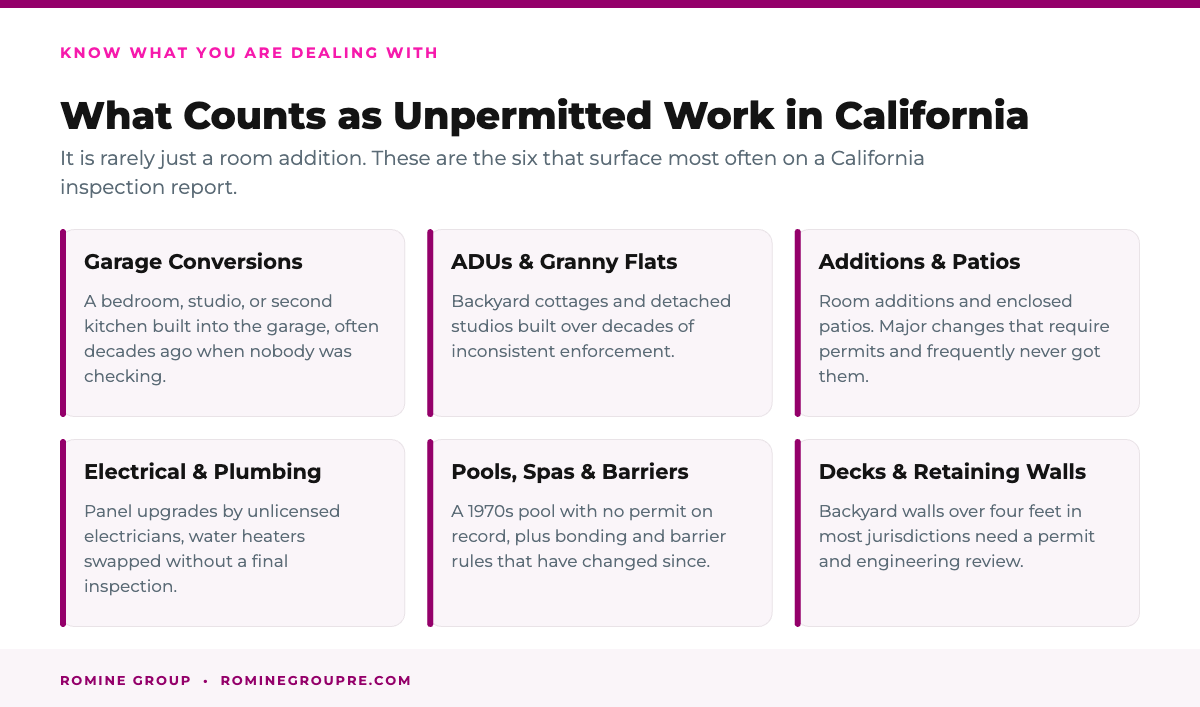
Room additions are the classic. Converting garages, enclosing patios, adding bedrooms or bathrooms. Those are major changes that require permits and often skip them. Past that, plenty of smaller jobs qualify too. Electrical panel upgrades done by unlicensed electricians. Water heater swaps with no final inspection. Backyard deck additions. Certain plumbing reconfigurations. All unpermitted work if nobody pulled and finaled the proper permits.
ADUs and granny flats are especially common here. Backyard cottages, detached studios, and converted garages went up across Valley neighborhoods over decades of inconsistent enforcement. Many sellers have no idea those units are missing from their permit records. Building departments in Lemoore, Hanford and Tulare see this constantly in their older residential districts, where informal construction ran in families. You can pull your own permit history from your city or county portal before a buyer’s agent does it for you.
Unpermitted work shows up all over the state’s housing stock. Garage conversions, view decks, ADU additions tucked behind main houses. The same patterns repeat in Tulare County, Kings County, Fresno County and Kern County. We regularly work with sellers who need cash home buyers in Fresno precisely because a permit issue killed their financing. The scale of the work matters less than whether anyone inspected and closed it out.
A permitted project runs three stages: permit issuance, inspections during construction, and a final sign-off. Missing the final inspection is one of the most common problems, and it’s easy to overlook when you’re just relieved the project is done. A contractor pulled the permit, did the work, and never called for the final. Technically that’s unpermitted work in the city’s records, even when the job was otherwise done right.
Farm-adjacent properties carry their own version of this. A shop building that grew into a second dwelling. A well house wired for a window unit. Packing-shed space converted into a bunk room for seasonal crews. None of that work required a permit in the owner’s mind at the time, and none of it shows up in county records now. Sellers with acreage in Tulare County or Kings County should pull their permit history early. Rural property accumulates more unpermitted structures than a tract home ever will, and unpermitted square footage compounds quietly over decades.
Swimming pools and spas are another category sellers overlook. A pool installed in the 1970s may have no permit on record. The pool itself has sat there fifty years without incident. Electrical bonding and barrier requirements, meanwhile, have changed significantly under current code. Sellers get blindsided when a buyer’s inspector notes that the pool equipment lacks a permit or the barrier fails current safety standards. Retaining walls above a certain height, typically four feet in most California jurisdictions, also require permits and engineering review. Backyard walls built informally during a landscaping project turn up as unpermitted work at closing all the time.
Unpermitted Work vs. Open Permits vs. Code Violations: What Is the Difference?
Mixing these three up is one of the most expensive mistakes a seller can make. Each one requires a completely different response.
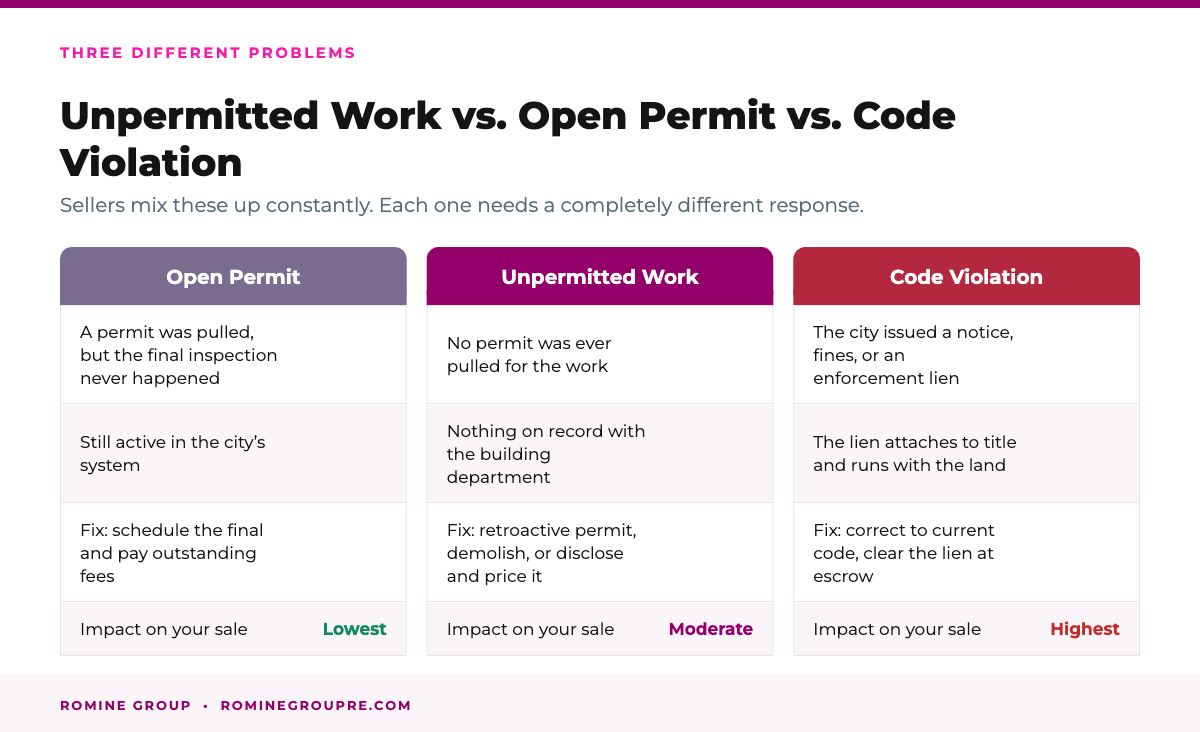
An open permit means somebody pulled a permit for the work and the final inspection never happened. That permit is still technically active in the city’s system. Closing it out often just means scheduling a final inspection and paying outstanding fees. Compare that to unpermitted work, where nobody pulled a permit at all, and the path to resolution looks different from the start.
A code violation is a separate category. It gets complicated when unpermitted work triggers one. If the city finds unpermitted construction during an inspection or after a complaint, it can issue fines, require corrections, and place a code enforcement lien on the property. Resolving that may mean bringing the work up to current code before the lien comes off. A code lien on title has to be cleared before a conventional sale closes, and escrow officers flag it immediately.
That lien stays on the title until somebody handles it. For any conventional sale, it must come off before selling. A cash buyer may be willing to absorb it with a price adjustment, though don’t count on that being easy to negotiate.
Practically speaking, open permits are the easiest to resolve. Unpermitted work needs a deliberate strategy. Code violations with liens are the most urgent and the most disruptive, and they tend to surface at the worst possible moment, during escrow, when everyone is already committed.
One scenario deserves separate mention: a property with all three issues at once. Somebody who inherited a house might find three problems layered on one property. An open permit from a kitchen remodel the previous owner started. An unpermitted garage conversion never submitted to the building department at all. And a code enforcement lien from a complaint filed years ago about that same garage unit. Each requires its own resolution path, and they don’t move on the same timeline. Sorting out which problem is which, and in what order to address them, is exactly the strategic work an experienced agent and a real estate attorney can map out. Do it before you list, and ideally before you price it. Inherited properties carry their own layer of complexity, and our guide on what happens to an inherited home with a mortgage still on it covers the money side of that.
How to Find Out If Your Home Has Unpermitted Work in California
Look this up before you list, not after a buyer’s inspector flags it.

Your county assessor’s office keeps records of taxable square footage and improvement history. Your city’s building department keeps permit records, searchable online in most jurisdictions. Tulare County, Fresno County, Kings County and Kern County all run their own portals, and the incorporated cities inside them run separate ones. Assessor records and building department records often tell two different stories. The gap between them is where unpermitted work hides.
A licensed inspector or contractor walking the property can spot work that looks inconsistent with properly permitted construction. Walls that don’t line up with structural logic. Electrical subpanels with no permit sticker. Plumbing that doesn’t match city records. A pre-sale inspection on the property earns back its few hundred dollars for this reason alone.
Something many sellers overlook: the county assessor may have already added an unpermitted addition’s square footage to the property’s assessed value, especially if it’s stood for decades. Which means you may have been paying property taxes on it for years. That doesn’t make it permitted. It does document how long the structure has existed, and that matters under California’s newer ADU amnesty rules.
When pulling permit records, search the current address and any prior address format the property may have carried. California addresses get renumbered now and then, particularly in cities that annexed surrounding land or reorganized street grids. A permit pulled in 1978 under a slightly different address format may not surface in a basic search, which means you could miss work that was actually done right. If your city uses a parcel number system, searching by APN rather than street address returns a more complete history.
Check with your homeowner’s insurance carrier too. Some insurers have flagged unpermitted structures during policy renewals, especially since aerial imaging became standard in underwriting. If your insurer ever asked about a structure on the property or declined to cover a specific building, that’s an issue worth chasing before a buyer’s inspector puts it in writing.
Not sure where to start? How Romine Group buys homes includes helping sellers sort through what their property records actually show and which options fit the situation.
What California Law Says You Must Disclose When Selling
Sellers often assume they can skip disclosure when a prior owner did the work and they never really knew about it. California doesn’t read it that way.
The law is unambiguous. Sellers must disclose all known material facts about their property that could affect its value or desirability, unpermitted improvements included. Known is the operative word. If you know, you disclose. If you genuinely don’t know, nobody expects forensic investigation from you, though you can’t look the other way once somebody tells you.
Sellers are required by California Civil Code 1102 to disclose known unpermitted additions or alterations on the Transfer Disclosure Statement (TDS). That form asks specific questions about room additions, structural modifications, and alterations. Covering similar ground, the Seller Property Questionnaire (SPQ) asks even more detailed questions about permits and code violations.
Under AB 968, effective July 2024, anyone who bought the property within the last 18 months must disclose all work done since taking title, copies of permits included. It applies to contracts over $500 in improvement value, so it catches nearly everything.
California’s disclosure requirements are broad and leave little room for omission. If you know about improvements, additions, or renovations that never got properly permitted, detail them in your seller disclosure documents. It makes no difference whether the unpermitted work happened on your watch or before it.
Selling as-is does not excuse you from disclosure. It only limits repair obligations. Two different things, and confusing them is one of the most common misconceptions sellers walk in with. We covered that distinction in more depth in our guide to selling a house as-is in California.
One disclosure question comes up constantly. Do you have to disclose work a contractor told you was permitted, when you later learn it wasn’t? Yes. The disclosure requirement attaches to what you know now, not to what you believed then. Correct the record as soon as the issue surfaces, in writing, and let your agent deliver an amended TDS. A late disclosure is survivable. Withholding one is not.
A practical note on the disclosure language itself: vague is worse than specific. Writing “some work may not have been permitted” on the TDS protects you far less than the specific version. Try this instead. “Garage was converted to living space approximately 1992. No permit on record with the City of X. Buyer to investigate and assume responsibility for any permit resolution.” The more specific your disclosure, the harder it becomes for a buyer to later claim they didn’t understand what they were buying. Your agent and attorney can help draft language that’s both accurate and appropriately protective. Experienced agents have watched vague disclosures backfire at closing.
What Are the Legal and Financial Risks of Not Disclosing Unpermitted Work?
Disclosure isn’t a formality you complete and file. A buyer who discovers undisclosed unpermitted work after closing has real legal remedies, and California courts take this seriously.
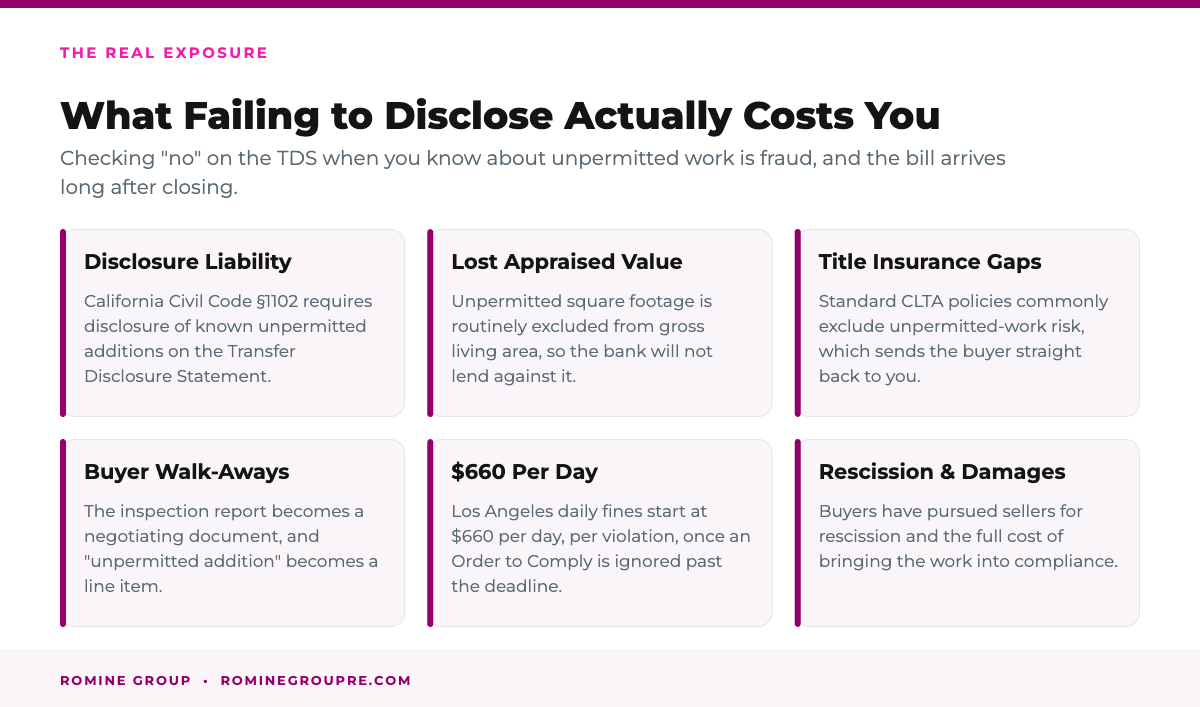
Checking no on the TDS when you know about unpermitted work constitutes fraud. It can produce lawsuits long after closing. Buyers have successfully pursued sellers for rescission of the sale and for damages covering the cost of bringing the work into compliance. Post-closing litigation is expensive and slow, and it almost always costs more than proper disclosure would have. The cover-up is the expensive part.
When a seller carries unpermitted work into escrow, the potential loss shows up in several places. Disclosure liability under California Civil Code 1102. Lost appraised value, because unpermitted square footage routinely gets excluded from gross living area. Title insurance exclusions on standard CLTA policies. Buyer walk-aways after inspection. Retroactive permit costs once a Notice of Violation opens.
The title insurance angle doesn’t get enough attention. Standard CLTA policies commonly exclude unpermitted-work risk. If a buyer later files a claim involving the unpermitted structure, they may find the policy doesn’t cover it, which sends them straight back to the seller.
Code enforcement works similarly across most California cities. A neighbor complaint, an aerial survey discrepancy, or the appraisal report itself can trigger an Order to Comply. Ignore the deadline and daily fines start running, and in some jurisdictions those fines reach into the hundreds of dollars per day per violation. It accrues faster than sellers expect.
Litigation risk extends past your immediate buyer as well. If that buyer later sells and their buyer discovers the undisclosed work, California case law has supported claims tracing liability back through multiple transactions. An original seller who failed to disclose can end up named in litigation years and two sales later. Extreme, yes, and it has happened. That’s why the disclosure conversation is worth having carefully with your attorney before you sign anything.
How Unpermitted Work Affects Your Home’s Value and Marketability
Picture a permitted main house with a garage converted into a full studio unit. Without the permit, the appraiser can’t count it in gross living area. On paper the home is hundreds of square feet smaller than what the seller has been marketing. That gap is where the money goes.
When an appraiser identifies an unpermitted addition during a bank valuation, that square footage gets disqualified from official gross living area under GSE guidelines. It counts as zero in the appraiser’s calculation, and the bank won’t lend against it. For a seller who priced off total actual square footage, that’s a direct hit to appraised value.
Legal ADUs add 20 to 30 percent more property value than unpermitted units. In a market where the statewide median sits in the high six figures, that gap is real money. A permitted ADU expands your buyer pool to investors and multi-generational families. An unpermitted version of the same space shrinks the pool down to cash buyers willing to carry the risk. The California Department of Housing and Community Development ADU resources are the clearest official starting point on what a legal unit requires.
Pricing a California home with unpermitted work is less about discounting and more about pricing the resolution. Take the permitted comps. Subtract what legalizing the space would cost. Then subtract something for the buyer’s risk and their time. That’s your number. Sellers who instead pick a round discount off the top land either too high, which stalls the property, or too low, which hands their margin to the buyer.
Marketability is the other side of the coin. Financed buyers, which is most buyers, face lender scrutiny that unpermitted work rarely survives. A buyer who loves the property may simply not get the loan approved once the appraiser documents the issue.
Properties with disclosed unpermitted work sit longer than comparable permitted ones even when priced correctly, because the eligible buyer pool is smaller. Sellers who price as though the unpermitted work doesn’t exist tend to relist after a failed escrow. That adds time, resets market perception, and often forces a price reduction bigger than an accurate starting price would have cost. We buy throughout the Valley, so whether you need a company that buys homes in Bakersfield or a buyer closer to home, the permit question gets priced the same way. Getting the price right from the start, honestly accounting for the permit issue, is almost always the faster path to closing.
How California Buyers, Lenders, and Inspectors React to Unpermitted Work
Does it really matter who your buyer is? The reaction varies quite a bit, and knowing that ahead of time changes your pricing strategy.
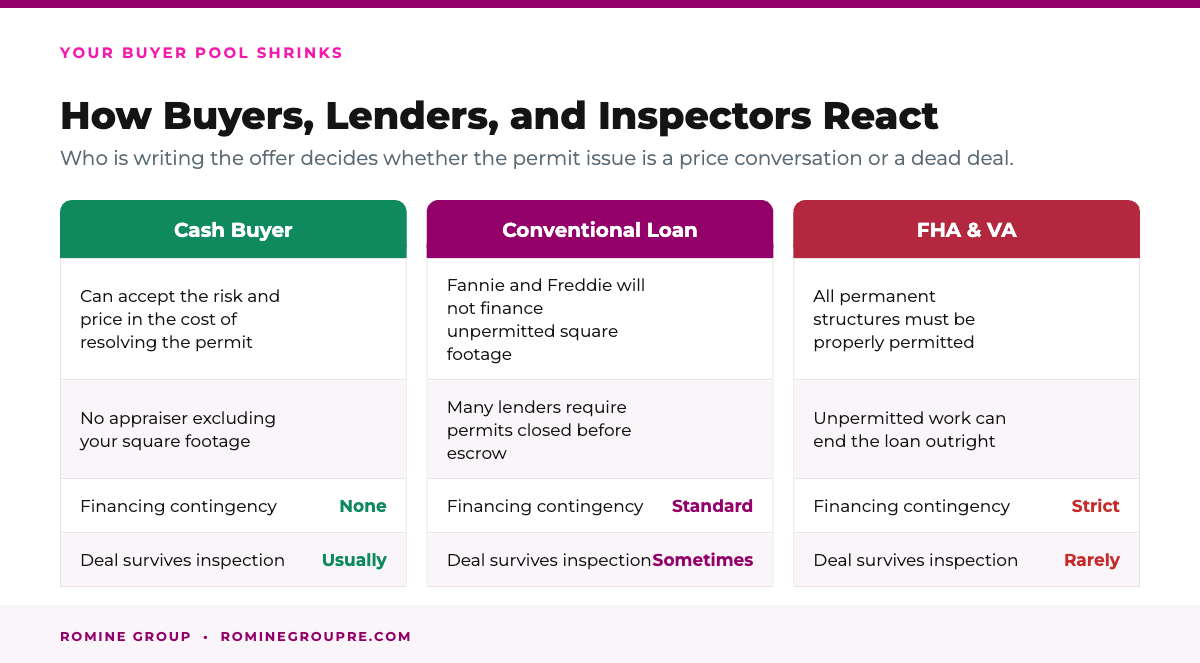
Cash buyers are the most flexible. They can accept the risk, price in the permit resolution cost, and move. Cash buyers have been a consistent presence in California, and sellers with complicated properties tend to need them specifically.
Conventional loans from Fannie Mae and Freddie Mac generally mean the lender won’t finance unpermitted square footage, and many require it permitted before close of escrow. FHA and VA loans typically require every permanent structure to be properly permitted, and unpermitted work can kill the loan outright. An FHA buyer who falls for a Valley house with an unpermitted addition may lose financing the moment the appraiser documents it.
Home inspectors flag unpermitted work when they can spot it. A finished space with mismatched electrical, no permit sticker on the panel, or plumbing that doesn’t match city records lands in the report. Buyers and their agents treat that report as a negotiating document, and unpermitted addition becomes a line item for a price reduction or repair credits.
Standard CLTA title insurance policies commonly exclude unpermitted-work risk. The ALTA Homeowner’s Policy can cover more, though not automatically. Your transaction coordinator or real estate attorney can confirm that the title policy on offer actually covers what the buyer needs.
One nuance worth knowing: some conventional lenders will proceed on a property with unpermitted work if the appraiser notes it as contributory value rather than a defect, and the underwriter accepts that characterization. Nothing about that is guaranteed. It varies by lender, by loan program, and by the nature of the work. A mortgage broker who regularly handles California properties can sometimes name lenders with more flexible underwriting for these situations. Worth asking early rather than assuming all conventional financing is off the table.
What Happens If You Rent Out an Unpermitted Unit in California?
Are you currently collecting rent from a unit nobody ever permitted?
This is where sellers realize they’ve been compounding a problem without knowing it. Renting out an unpermitted unit creates tenant rights obligations under California law regardless of permit status. A tenant in an unpermitted space holds the same habitability rights as any other tenant. Landlords can be held liable for substandard conditions on the property whether or not anyone inspected the unit.
If the unit is truly substandard, a tenant may be able to withhold rent or pursue remedies through local ordinances. Some cities have rent control protections that apply even to unpermitted units, depending on how long the tenancy has run. Getting legal advice from a California real estate attorney before trying to remove a tenant from an unpermitted unit is not optional.
From a sale standpoint, an occupied unpermitted unit is harder to sell than a vacant one. Lenders won’t count the rental income in an appraisal if the unit isn’t permitted, and a tenant in place limits which buyers can even tour the property. The unit may create habitability liability you have to disclose. Sellers collecting rent from an unpermitted space need all of that in the exit strategy, not just the permit question.
California cities with strong tenant protections have just-cause eviction requirements that apply regardless of a unit’s permit status. A landlord who wants to clear an unpermitted unit before selling can’t simply terminate a month-to-month tenancy without meeting the applicable just-cause standard. Relocation assistance requirements under local ordinances can run into thousands of dollars per tenant in some places. Understand those obligations before you settle on a strategy. The cost of displacing a tenant may decide whether it makes more sense to sell with the tenant in place or to clear the unit first.
How to Retroactively Permit Work in California and What It Costs
A detached studio behind the main house, inherited from a parent, sitting there for decades fully furnished and completely absent from the city’s records. That’s a common shape for this problem. Often the unit qualifies for amnesty and the permit process runs a few months rather than the nightmare the seller expected.
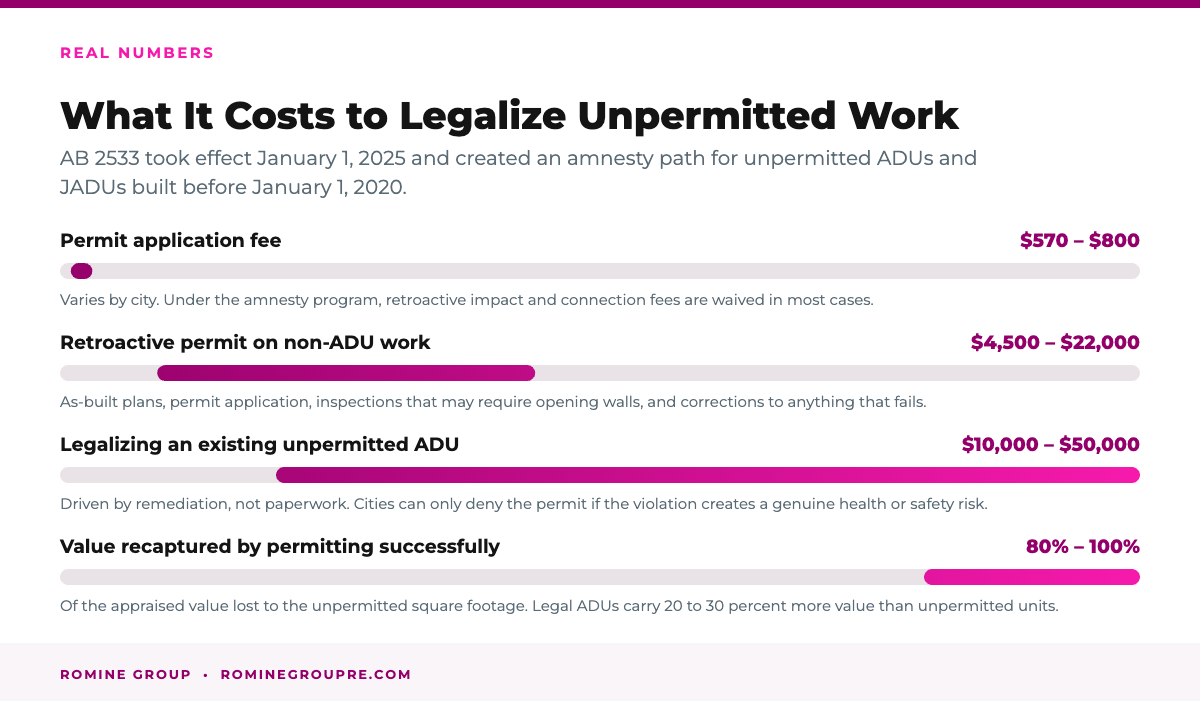
California Assembly Bill 2533, enacted in September 2024 and effective January 1, 2025, establishes an amnesty program for unpermitted ADUs and Junior Accessory Dwelling Units (JADUs) constructed before January 1, 2020. The bill prohibits cities from denying permits for unpermitted ADUs based solely on code violations. Cities can only deny an application when violations on the property create genuine health or safety risks.
Under the program, owners are exempt from retroactive impact fees, connection fees, or capacity charges in most cases. The application fee varies by city, with permit application fees running from $570 to $800 depending on the jurisdiction. The bigger cost driver is the remediation work itself. Expect to spend somewhere between $10,000 and $50,000 legalizing an existing unpermitted ADU, depending on how much work it takes to reach safety standards.
Non-ADU unpermitted work follows a different process. You’ll need as-built plans from a licensed architect or draftsperson, plus a permit application filed with the building department. Then come inspections, which may require opening walls to verify structural and electrical work. Then corrections to anything that fails. Typical total investment for retroactive permitting runs from $4,500 to $22,000 depending on scope.
The honest calculus is simple. Retrofitting is worth it when the permitted value gain exceeds the cost of the work. It isn’t always the right move. The answer depends on your timeline, your property, and what the market will pay once the work is finaled.
Timelines depend heavily on your jurisdiction. A smaller Valley city with a manageable building department backlog might turn around a retroactive permit application in six to eight weeks. Larger jurisdictions that process enormous permit volume run longer, particularly on projects needing plan check review from multiple departments. Fresno, Bakersfield and the county offices each keep their own processing timelines and fee schedules. If your sale timeline is tight, call the building department directly and ask about current processing times before committing to the retroactive permit path.
Should You Permit, Demolish, or Sell As-Is?
Sellers want one thing here. Just tell me which option is cheapest and fastest. Each path carries tradeoffs that depend on what kind of unpermitted work you have, how much time you can spend, and who your likely buyer is.
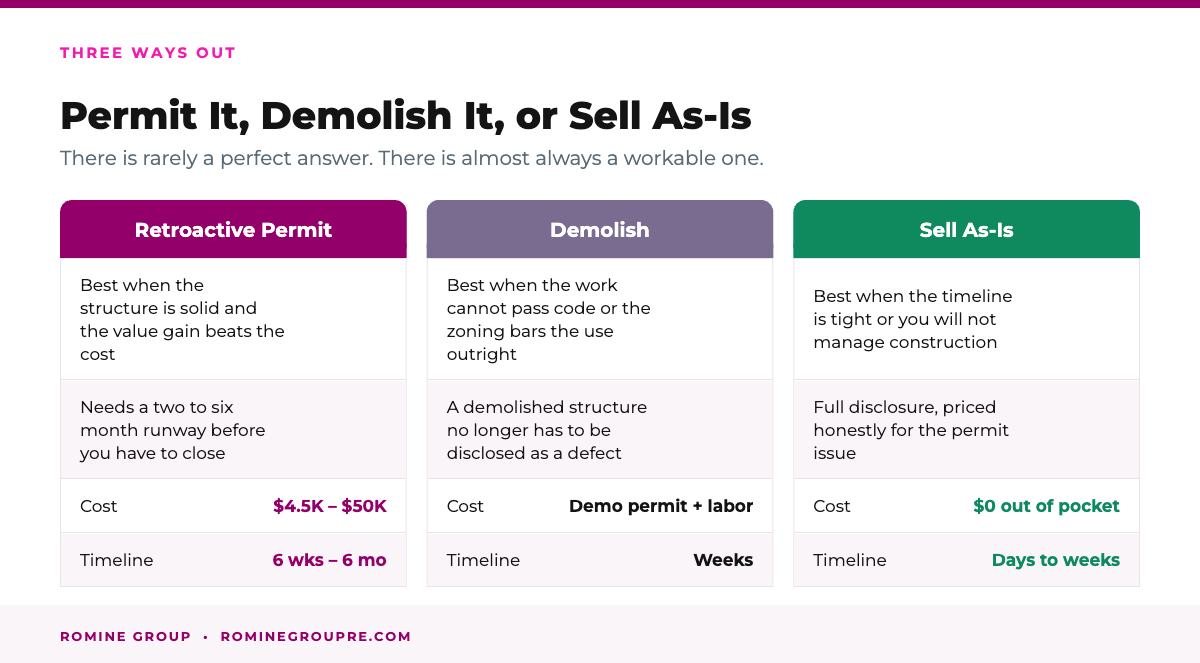
Retroactive permitting makes the most sense when the structure is solid, remediation cost is reasonable against the value gain, and you have a two to six month runway before you need to close. Successful retroactive permitting recaptures 80 to 100 percent of the value lost in the appraisal. That’s a strong return when the numbers work.
Demolition is the right answer when the structure can’t pass code, remediation cost is prohibitive, or California zoning won’t allow the use at all. If the work isn’t worth saving, the cleanest path is removal under a demolition permit. That’s usually the call for substandard garage conversions, illegal second units in non-conforming zones, or work that created structural problems. A demolished structure is no longer an unpermitted defect on the property.
Selling as-is with everything on the table is the fastest and cleanest option from a transaction standpoint, especially on a tight timeline or when you don’t want to manage construction. Price the property accurately for the unpermitted work, put everything on paper, and let the right buyer make an informed decision. Cash investors and experienced buyers who understand what they’re taking on suit this kind of sale well.
Sometimes this decision comes down to a contractor’s read rather than a financial model. Before committing to retroactive permitting, have a licensed contractor walk the unpermitted space. Ask three questions. Will the work likely pass inspection as-is, what corrections would be required, and what do those corrections cost? That assessment runs a few hundred dollars and can save you from a permit process that stalls mid-inspection and leaves you worse off than when you started.
The Romine Group Team regularly helps sellers think through which path fits. No single answer fits every property or every homeowner.
What Are Your Options for Selling a House With Unpermitted Work in California?
Most people in this situation have more options than they realize. Here they are the way we’d lay them out at your kitchen table.

Listing on the MLS with full disclosure and adjusted pricing is the most common route. You disclose the unpermitted work on the TDS. Then you price the property for what a buyer will realistically pay given the permit issue. Then you market to buyers who can pay cash, or who are willing to get the work permitted before or after close. Some California buyers hunt for these properties specifically, because they see upside in resolving the permit and capturing the value.
Selling to a cash buyer or investor closes faster and skips most of the financing complications. Buyers of unpermitted properties may ask for a price reduction covering the cost and risk of legalizing the space. Or the seller ends up limited to cash-only buyers because conventional mortgage lenders won’t finance the unpermitted square footage. Cash offers move quicker and don’t get derailed by appraisals or lender conditions. If you want to sell your home for cash in Tulare or anywhere else in the Central Valley, that’s the route most sellers with a permit issue take.
Owner financing is a creative option that doesn’t come up often but works in the right situation. If you’re willing to carry a note, the buyer sidesteps the conventional lender issue entirely, and the sale proceeds with full disclosure at an agreed price. It pairs naturally with selling your house without a realtor in California, since both routes put you in control of the terms.
For ADUs and granny flats specifically, AB 2533 creates an amnesty program for unpermitted ADUs and JADUs built before January 1, 2020. It requires cities to approve legalization permits when units meet basic health and safety standards. Qualifying under that program before you list turns an unpermitted liability into a permitted asset.
Whatever route you take, the paperwork trail matters. Keep copies of every permit application, every inspector’s note, every correction and sign-off. That documentation protects you in a conventional sale, a cash transaction, or a dispute down the road.
Listing on the MLS with a disclosed permit issue makes your marketing language matter as much as your price. Buyers and their agents read listing descriptions closely. A property described honestly as having an unpermitted unit with amnesty potential attracts a different and more qualified buyer than one described vaguely as having a bonus room. Agents who specialize in these properties know how to frame the opportunity accurately, which generates more serious inquiries and fewer wasted showings with buyers who would have walked once they read the inspection report.
Real-World Example: Selling a California Property With Unpermitted Work and a Code Lien
What does this look like when everything goes wrong at once? Fair question. The full collision of unpermitted work plus a code lien plus a seller on a deadline turns up regularly, and walking through the shape of it is instructive.
Start with an inherited property and siblings living out of state who want a clean exit. The garage was converted to a unit thirty years ago and rented continuously ever since. The main home holds two decades of holiday decorations, tools, and furniture. Nobody wants to manage a cleanout from three different time zones.
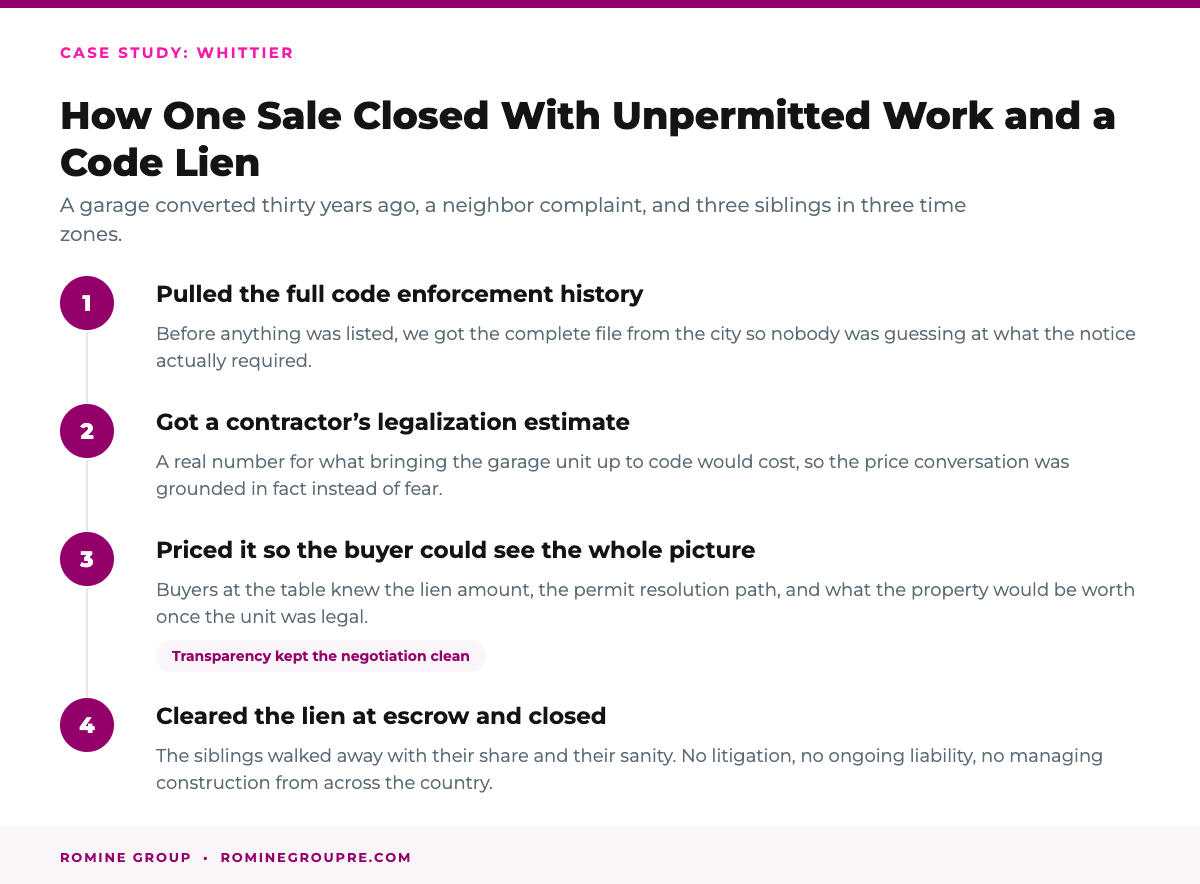
Then the city issues a code enforcement notice on the garage unit after a neighbor complaint, and that notice grows into a lien on the title. No conventional lender will touch the property until the lien is resolved. Three options exist. Spend several months resolving the permit and the lien before selling. Sell as-is to a cash buyer at a price reflecting those risks. Or pull a demolition permit, remove the garage unit, and sell at a price reflecting the loss of that structure.
The cash sale usually wins in this shape. The lien gets negotiated and addressed at escrow. Whatever price they agree on reflects the unpermitted unit and the cost the buyer absorbs to legalize or demolish it. The family walks away with their share and their sanity. No litigation, no ongoing liability, nobody managing construction from across the country. If the pressure behind the sale is financial rather than logistical, our guide on selling a house in foreclosure in California covers how those deadlines stack up against a permit problem.
Preparation is what makes that work. Pull the full code enforcement history from the city before listing. Get a contractor’s estimate for what legalization would cost. Price the property so a buyer sees exactly what they’re taking on. Buyers who come to the table knowing the lien amount, the permit resolution path, and what the property is worth once the unit is legal negotiate cleanly. That transparency prevents the last-minute surprises that collapse sales in the final week of escrow.
That’s the thing about selling with unpermitted work. A perfect answer is rare. A workable one is almost always there, as long as you know what you’re dealing with before the buyer’s inspector tells you first.
Frequently Asked Questions
What Happens If You Buy a House With Unpermitted Additions in California?
Buying a property with unpermitted additions means taking on any code violations attached to it, because in California those violations run with the land. Your lender may not finance the unpermitted square footage, and your appraiser will likely exclude it from gross living area. Going in with full information and a clear strategy, whether that’s budgeting for retroactive permitting or negotiating a price reduction, puts you in a much better position than discovering the issue after closing.
Do Sellers Need to Disclose Unpermitted Work?
Yes, without exception. California Civil Code 1102 requires sellers to disclose known unpermitted additions and alterations on the Transfer Disclosure Statement. It applies even when a previous owner did the work, as long as you’re aware of it. Skipping the disclosure isn’t a loophole. It’s fraud, and it leaves you exposed to post-closing lawsuits for damages or rescission.
Do Home Appraisers Look for Unpermitted Work?
Appraisers do look, and most of them find it. Under standard appraisal guidelines, any space lacking permit records gets excluded from official gross living area, which lowers the appraised value directly. With FHA or VA financing the stakes climb higher, because unpermitted permanent structures can trigger a hard stop on the loan until the issue is resolved. Sellers who know about unpermitted work before listing avoid the worst version of this, which is an escrow that collapses mid-transaction.
How Long Are You Liable for a House After You Sell It?
Your liability doesn’t end at closing. If you knowingly failed to disclose unpermitted work or other material defects, a buyer has legal grounds to pursue you after the sale closes, potentially for the full cost of remediation or damages. California’s statutes of limitations for fraud and negligent misrepresentation claims can extend years past the closing date. Your best protection is complete, accurate disclosure on the TDS and SPQ before the sale closes. Still have questions before you list? You can check out other frequent questions or reach out to Romine Group directly.
More California Selling Guides
- Selling a House As-Is in California
- California Real Estate Withholding and Form 593
- Selling Your House Without a Realtor in California
- Selling a House in Foreclosure in California
Get a Cash Offer on Your California House, Unpermitted Work and All
No permits, no repairs, no cleanout, no problem. We buy houses throughout the Central Valley exactly as they sit, garage conversion and all, and we handle the permit question on our side of the closing table. Tell us about the property below and we’ll get you a fair cash offer. No pressure, no obligation, and no fee for the conversation.
"*" indicates required fields
Prefer to talk it through first? Contact Romine Group and we’ll go through the situation with you before you commit to anything. You can also read how Romine Group buys homes to see exactly what the process looks like.