

Your hospital stay lasted four days. Six weeks later the invoice showed up looking like a mortgage payment. Now a collection agency is calling, and somewhere in the back of your mind sits the question: can these people actually take my house?
Can a Hospital Actually Force You to Sell Your Home?
Almost certainly not. California law makes it harder than most homeowners assume. That word almost is worth understanding, though, because the path from an unpaid hospital bill to a lien on your property is real. Title searches turn these up regularly. A forced home sale at the end of that path is the rare part.
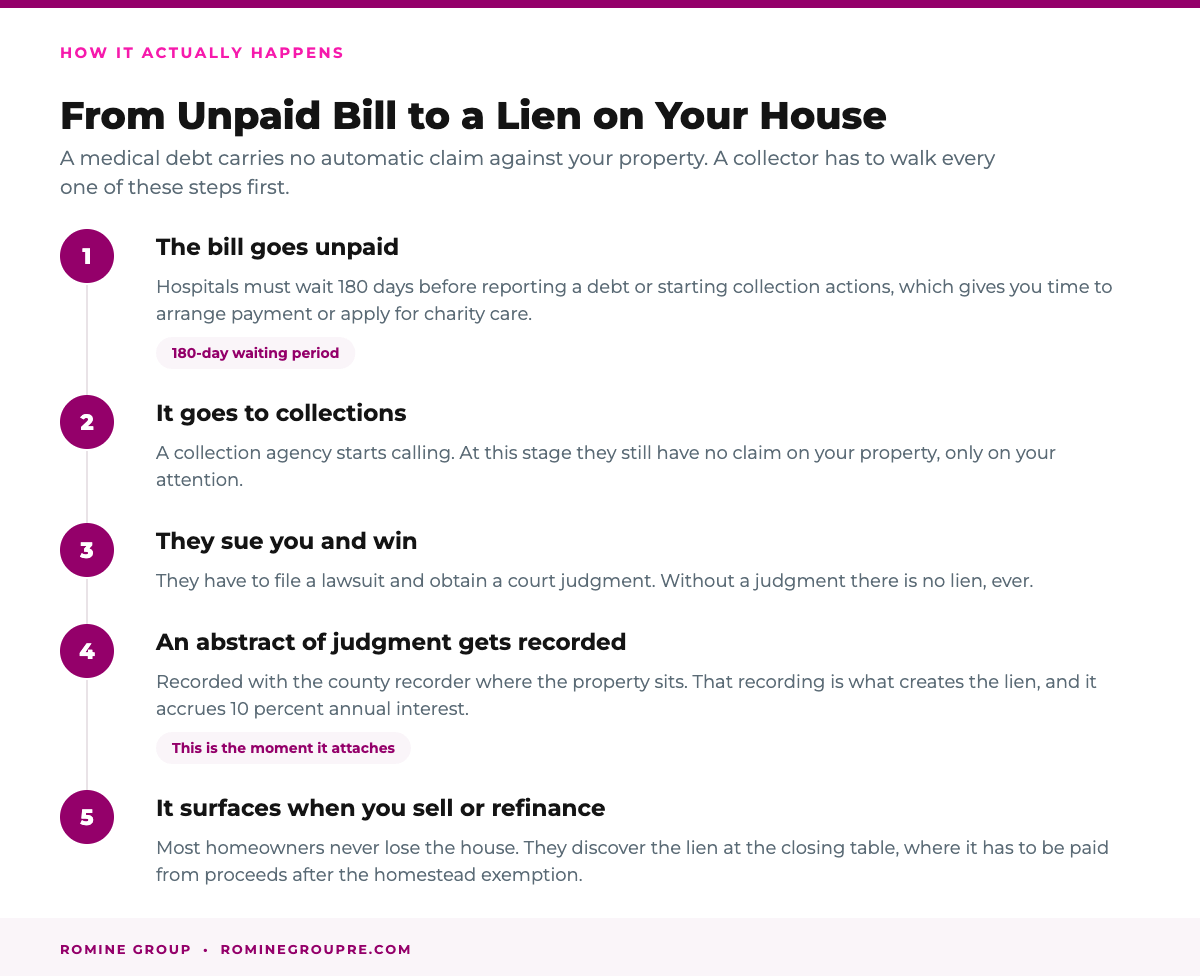
Medical debt on its own carries no automatic claim against your property. A hospital or collection agency cannot decide to slap a lien on your Visalia bungalow or your Clovis duplex because a bill went unpaid. They have to sue you first, win a court judgment, and then record it with the county recorder where your property sits.
When a creditor wins a lawsuit in California, they can place a judgment lien on your property. The lien attaches to the real estate and makes it nearly impossible to sell or refinance until the debt is paid off in full.
Understand that a lien is not the loss of your home. Those are very different things, and most homeowners who end up with a judgment lien never lose the property. What a judgment leaves behind is a cloud on title that has to be cleared the moment they try to sell or refinance. Plenty of people never see it coming until they’re already sitting at the closing table.
What Is a Medical Debt Lien and How Does It Work in California?
A judgment lien is a legal claim against your property, created after a creditor wins in court. It doesn’t let the creditor seize the property. It does guarantee they get paid when you sell or refinance. So it sits there, accruing interest, waiting.
Recording an abstract of judgment with the recorder where the property sits is what creates a judgment lien on California real estate. Once recorded, the lien accrues 10 percent annual interest with no payment schedule attached. Don’t ignore one hoping it goes away.
This is the version that surprises people most. An heir inherits a property, lists it, and only during escrow learns that a medical judgment lien was recorded against the deceased family member’s estate years earlier. Now the transaction pauses while the title company sorts out lien priority. Liens don’t announce themselves. That’s the lesson. They wait.
The California Homestead Exemption and What It Covers
The homestead exemption exists so a judgment debtor still has somewhere to live even while owing money to creditors. It shields a portion of home equity from being taken to satisfy a judgment lien. The protection is automatic, so you don’t have to file anything for the basic version. Filing a Declaration of Homestead with your county recorder adds a layer on top, and it matters most if you ever sell voluntarily while a lien is on record.
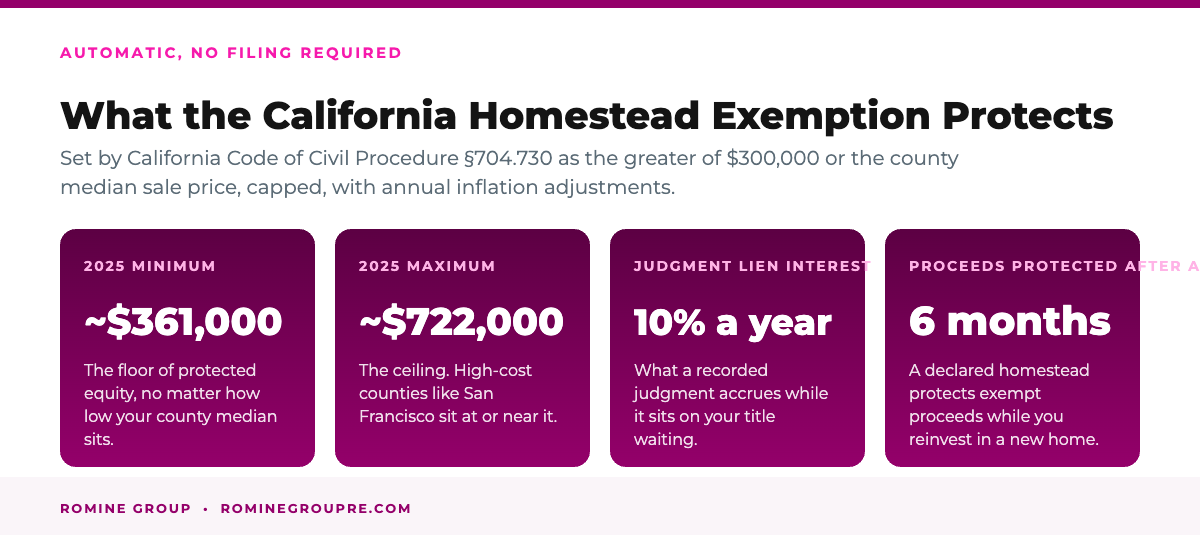
California Code of Civil Procedure 704.730 defines the homestead exemption as the greater of $300,000 or the county median sale price, up to $600,000, with mandatory inflation adjustments. As of 2025 the automatic exemption ranges from roughly $361,000 to $722,000 depending on your county’s median home price. Homeowners in expensive coastal counties get more protection than those in Tulare, Kings, Fresno and Kern, where median prices sit well below the statewide figure.
That still leaves Valley owners with substantial protection. On a typical Reedley or Porterville property, the exemption often exceeds the entire equity position, which means there is nothing left for a judgment creditor to reach even in theory. That arithmetic is why a judgment creditor almost never gets that far here.
The exemption works best against unsecured creditors: credit card companies, medical debt collectors, and personal loan lenders holding civil judgments. Where it doesn’t help is mortgage foreclosure, because falling behind on the mortgage still lets the lender foreclose. Unpaid property taxes are the other gap, since those create a tax lien the exemption won’t block. If a mortgage is the real pressure rather than the medical bill, our guide on selling a house in foreclosure in California covers that timeline.
A declared homestead only protects exempt equity when a home is sold voluntarily, with proceeds protected for six months during which you can reinvest in a new home.
How California Law Protects Your Home From Medical Debt Collectors
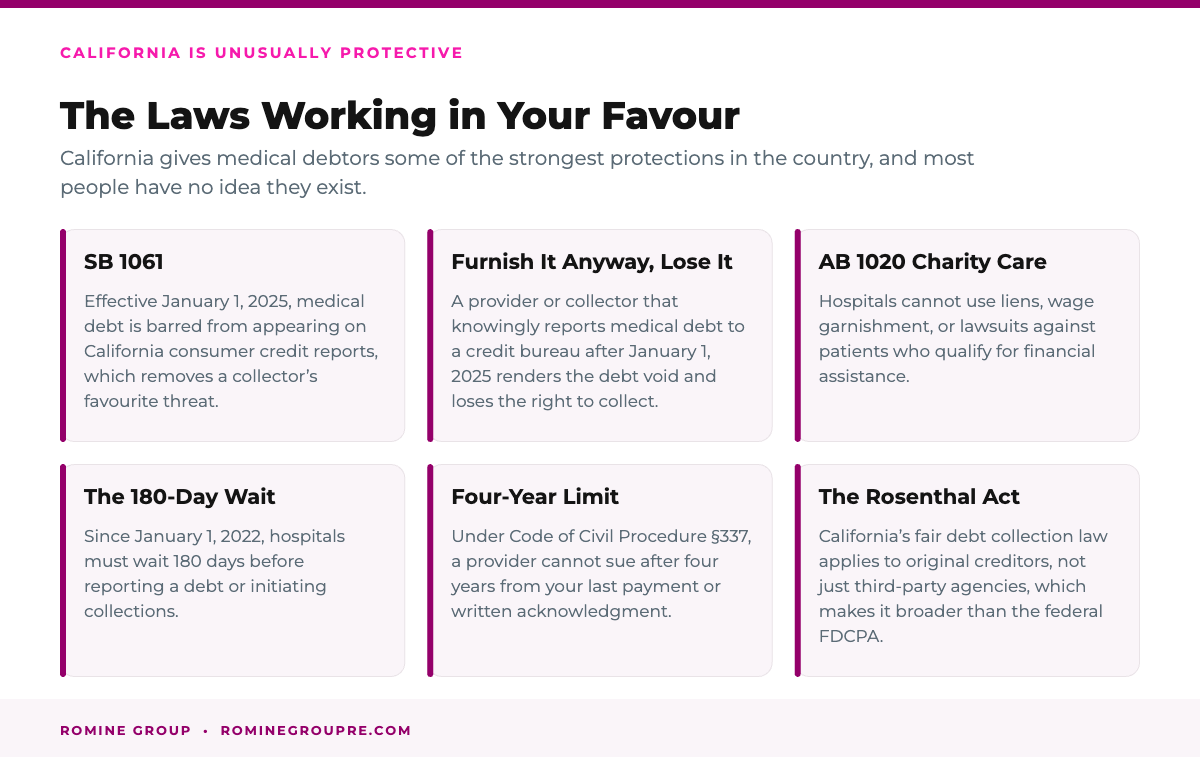
California’s homestead exemption shields a significant chunk of equity in a debtor’s primary residence from forced sale by a judgment creditor. Even with a valid judgment lien recorded, the creditor cannot force a sale unless the debtor’s equity exceeds the exemption amount. For most California homeowners that protection is enormous.
The state layers on more. A four-year statute of limitations protects you from most medical debt lawsuits. A requirement that hospitals offer financial assistance to lower-income patients. Credit and collection tactics limited through the Rosenthal Fair Debt Collection Practices Act. And a cap on post-judgment interest for medical bills that runs lower than other consumer debt. That last detail is worth knowing before you negotiate anything.
Senate Bill 1061, effective January 1, 2025, prohibits medical debt from appearing on consumer credit reports in California. Debt collectors lost the credit report threat they used to lean on hardest, which removed their strongest source of leverage.
Under AB 1020, hospitals are also barred from extraordinary collection actions, liens and wage garnishment and lawsuits included, against patients who qualify for financial assistance. A household with moderate income should ask the hospital’s billing department about charity care before the debt reaches collections. Once collections has it, you’re in a different process entirely.
When Can a Creditor Force the Sale of Your California Home?
Creditors forcing a sale is very rare. A creditor has to sue you, win, and get a court order for a judgment lien against the property, committing real legal fees before seeing a dime. Winning the lawsuit is only the start of a long and expensive road for them.
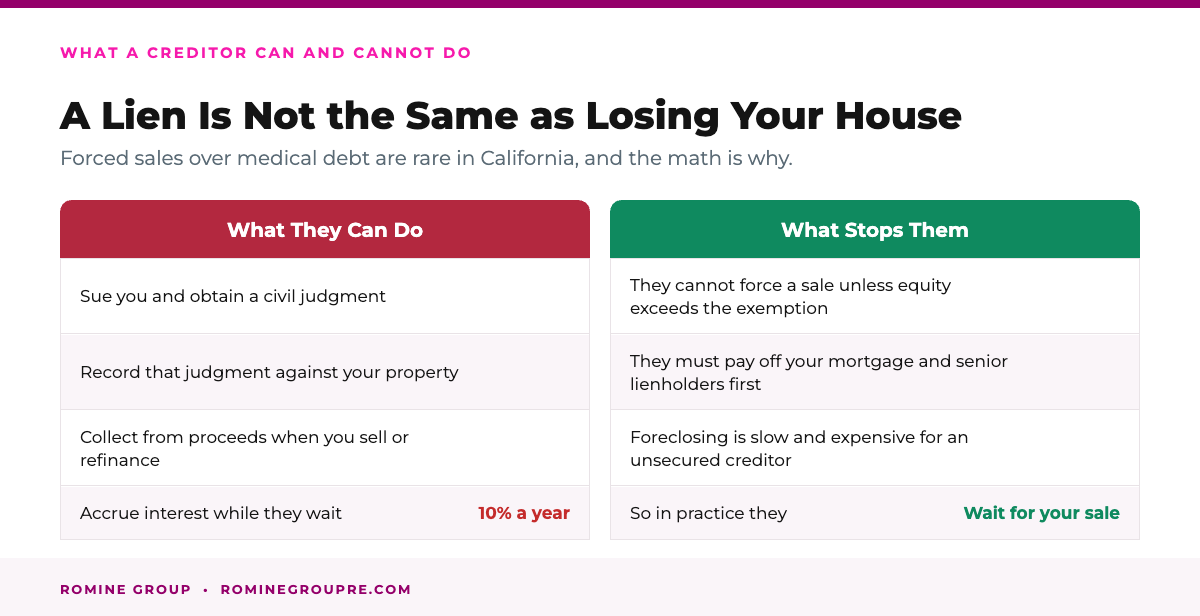
Under California law, a creditor can only force the sale of your home when the value exceeds the homestead exemption. Past that, they’d have to foreclose and pay off the mortgage company and every other lienholder before paying themselves. In a state where the typical home carries a substantial mortgage balance, that math rarely favors the creditor. Which is why most of them never try.
Collection agencies want money. What they don’t want is managing a foreclosure proceeding, paying off your lender, absorbing your homestead exemption, and hoping something is left at the end.
Even when a creditor can’t force a sale, the judgment lien stays on the property. Sell voluntarily and the lien has to be paid from proceeds after the homestead exemption applies. That’s where homeowners actually feel it. Not a seizure. A lien settled at closing.
Your Rights Under California Consumer Protection Laws
The statute of limitations on medical debt in California is four years, running from the date of your last payment or written acknowledgment of the debt, under Code of Civil Procedure 337. After four years a medical provider can’t sue to collect. Once a debt is time-barred, collection agencies can still call, and they will, often aggressively. They’ve lost the legal ability to win a court judgment, though, which means they’ve lost the ability to create a lien.
Effective January 1, 2022, hospitals must wait 180 days before reporting debts or starting collection actions. That window gives patients time to arrange payments, apply for financial assistance, or dispute charges.
Report medical debt to a credit reporting agency after January 1, 2025 and the consequence is severe. A healthcare provider or debt collector who knowingly does it causes the debt to become legally void, completely eliminated, with no legal right left to collect. That’s one of the strongest consumer protections in the country, and most Californians have never heard of it.
Working through a debt problem and a property decision at the same time? The Romine Group Team understands how liens and outstanding debts interact with a home sale. We’re not attorneys. We have walked plenty of Valley homeowners through situations where a financial problem and a property decision landed in the same month. If the debt picture is bigger than one hospital bill, our guide on selling your house during bankruptcy in California covers how the order of operations changes.
How to Report Illegal Debt Collection Practices in California
Consumers hold protections under both the federal Fair Debt Collection Practices Act and the California Fair Debt Collection Practices Act against abusive collection tactics. California’s version, the Rosenthal Act, reaches original creditors too, not just third-party collection agencies. That makes it broader than the federal law.
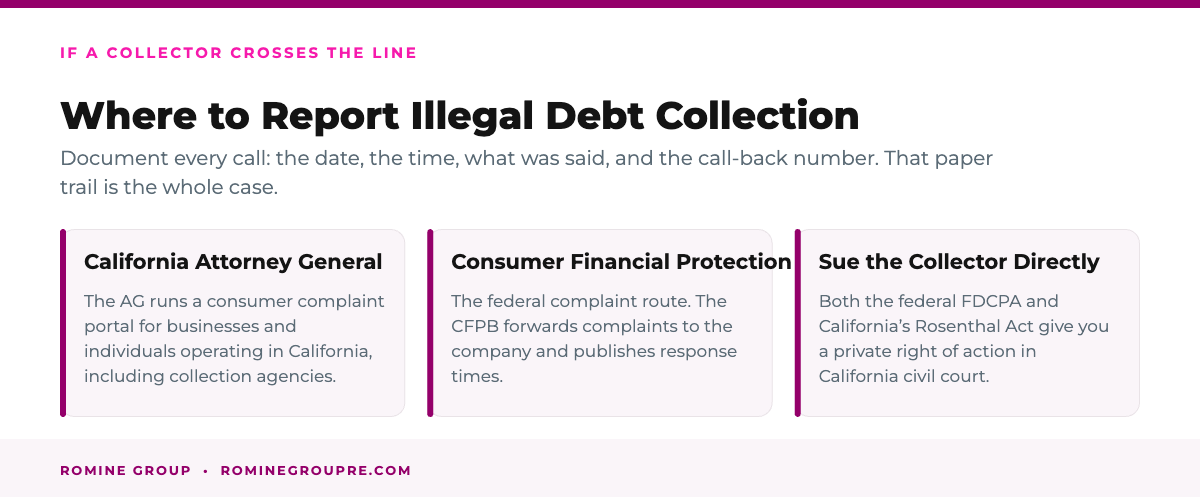
Broke those rules? You can file a complaint with the California Attorney General’s consumer complaint portal, with the Consumer Financial Protection Bureau, or sue the collector directly in California civil court.
Document every call. Date, time, what was said, any call-back number. That paper trail is often the difference between a dismissed complaint and a real recovery.
Steps California Homeowners Can Take to Protect Their Property
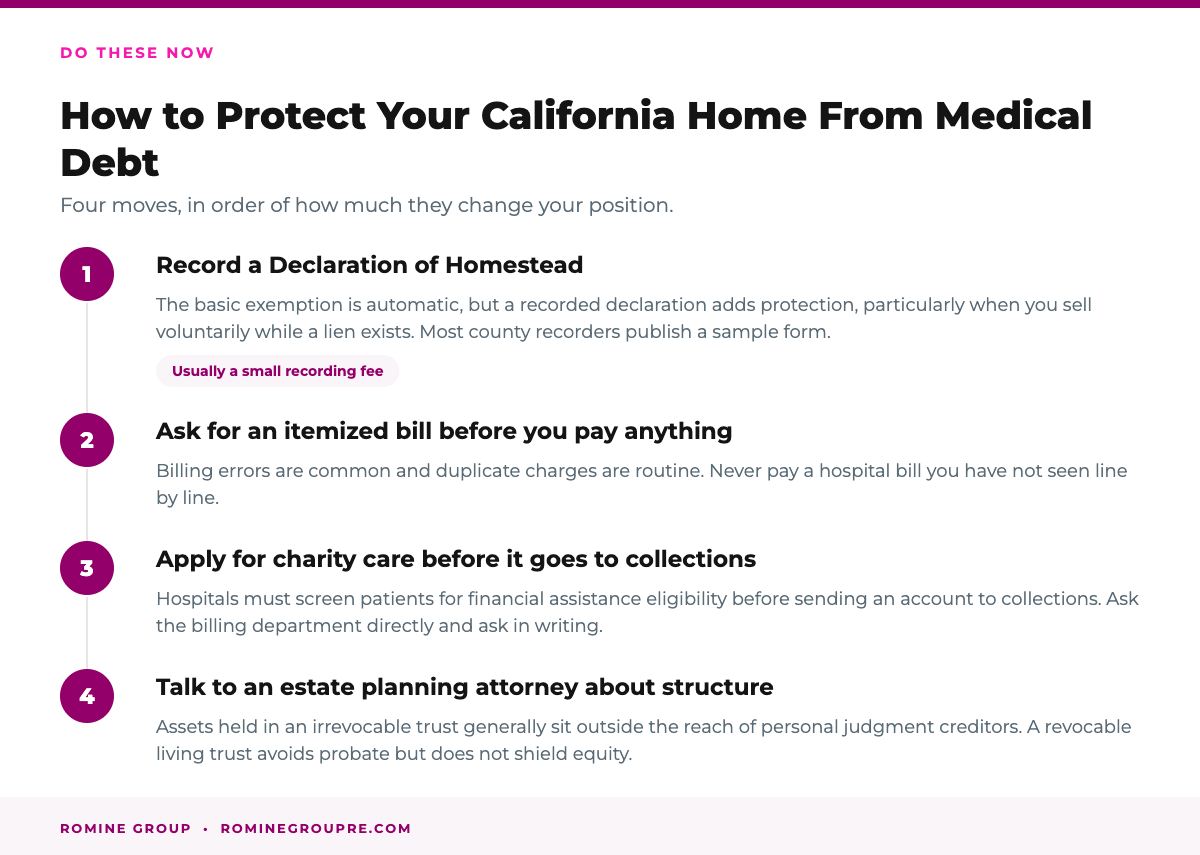
The most immediate step any California homeowner can take is filing a Declaration of Homestead with the county recorder. The declaration puts everyone on notice that your residence is your homestead, which forces creditors to work around that protection when they come after your assets. Most county recorder offices post sample declarations on their websites, Tulare and Fresno included.
Request an itemized statement from any hospital or medical provider before you pay anything. Billing errors are common. Hospitals must screen patients for charity care eligibility before sending accounts to collections, so if your income is moderate, ask about financial assistance directly, and ask early.
An estate plan adds another layer. Assets held inside an irrevocable trust generally sit outside the reach of personal judgment creditors. A revocable living trust helps heirs avoid probate but does nothing to shield equity from creditors. That distinction is worth spelling out clearly with an estate planning attorney.
Sitting on equity and needing to sell before the debt grows? We can move quickly on a direct sale. No listing, no open houses, no waiting on a buyer’s lender. A direct sale closes the gap and stops interest from accruing on a recorded judgment lien. If the property also needs work, our guide on selling a house as-is in California explains how condition gets priced. We buy throughout the Central Valley, from cash home buyers in Fresno to a cash for houses company in Tulare. You can read how Romine Group buys homes before you pick up the phone.
Frequently Asked Questions
How Do I Protect My House From Medical Debt?
Filing a Declaration of Homestead with your county recorder is a strong first step, because it protects your equity up to the state exemption limit from judgment creditors. Past that, respond promptly to bills, request itemized statements, and apply for charity care or financial assistance before accounts reach collections. If an existing lien complicates your situation, or you’re weighing a sale, a local resource like the Romine Group Team can help you see how the debt and the property interact.
What Happens If I Do Not Pay My Medical Bills in California?
Unpaid medical bills can lead to a lawsuit, a court judgment, and a lien recorded against your property. The debt also keeps accruing interest once a judgment lands, so the payment owed grows. California’s four-year statute of limitations means that if no lawsuit is filed within four years of your last payment or written acknowledgment, the collector loses the right to sue at all. Ignoring bills doesn’t restart or pause that clock. Making a payment or signing anything related to the debt can.
Can You Lose Your House Over Unpaid Medical Bills?
Possible in theory, uncommon in California. A creditor has to win a lawsuit, record a judgment lien, then show that your home’s equity exceeds both your mortgage balance and your homestead exemption before pursuing a forced sale. Given California home prices and the state’s homestead protections, most homeowners are insulated from actually losing the property. The realistic risk is a lien that has to be paid at closing whenever you sell or refinance.
How Long Before a Medical Debt Becomes Uncollectible in California?
Under Code of Civil Procedure 337, medical debt in California becomes time-barred four years from the date of your last payment or written acknowledgment of the debt. After that, a collector can no longer sue you for a judgment, which means they lose the ability to create a lien against your property. Collection agencies may still call asking for payment. They have no legal path to force collection through the courts. Be careful not to restart the clock by making even a small payment or signing a document that acknowledges the debt. You can check out other frequent questions or reach out to Romine Group if a lien is already on your title.
More California Selling Guides
- Selling a House in Foreclosure in California
- Selling Your House During Bankruptcy in California
- Inheriting a House With a Mortgage in California
- Selling a House As-Is in California
Medical Debt Turning Into a Property Problem?
If the bills have grown into something affecting your title, your plans, or your sleep, you do not have to figure it out alone. We buy California houses with liens, judgments, and back debt attached, and we sort all of it out inside escrow. Tell us about the property below and we will get you a fair cash offer. No pressure, no obligation, and no fee for the conversation.
"*" indicates required fields
Prefer to talk it through first? Contact Romine Group and we will walk the situation with you before you commit to anything. You can also read how Romine Group buys homes to see exactly what the process looks like.