
Closing on a house in California and walking away with less money than expected is jarring. Not because of market conditions. Not because of agent commissions. Because a chunk of your proceeds got held by escrow and sent straight to the state. That’s the California real estate withholding system, and most sellers meet it at the worst possible moment, sitting at the closing table with movers already booked.
Form 593 is the California Real Estate Withholding Statement, required by the Franchise Tax Board. When real property sells in California, the buyer or escrow must withhold a portion of the proceeds and remit it to the FTB as a prepayment of the seller’s California income tax. Knowing how that works before you list changes the whole conversation.
What Is Form 593 and Who Needs to File It?
A landlord goes into escrow on a rental fourplex held for 20 years. Days before closing, escrow tells him tens of thousands of dollars from the sale is going to the state before he ever sees it. Nobody warned him. That call comes in constantly.
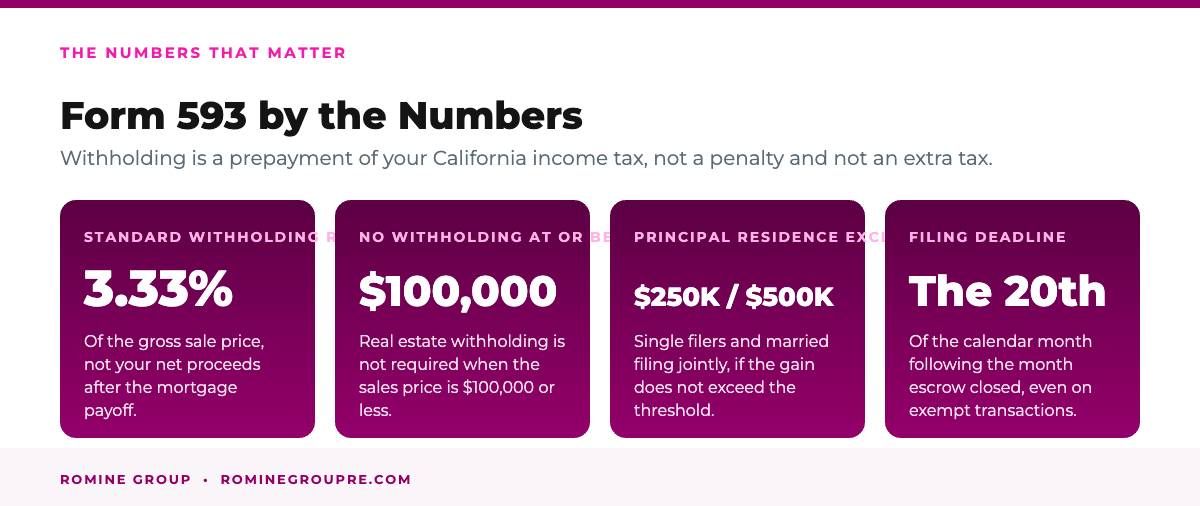
Under California law, withholding of tax at source is required on any disposition, sale, or transfer of California real property. The amount equals 3 1/3 percent of the sales price. The one alternative is an election to use a withholding calculation based on the gain required to be recognized from the sale. This is not a penalty. It’s a prepayment system, where the state collects what it thinks you might owe before you file your annual return rather than after.
All remitters are required to complete the applicable parts of Form 593 and submit Sides 1 through 3 to the Franchise Tax Board regardless of the transaction. Even a transaction qualifying for a full exemption still needs the form completed and filed. Skipping the filing isn’t an option.
The form captures the seller’s identifying information, the property details, the sale price, any exemptions claimed, and the withholding amount. Married couples or registered domestic partners who intend to file a joint California return can appear on a single form, though the FTB assumes equal ownership unless separate forms show the actual split. That detail trips people up constantly when spouses hold unequal ownership interests, which happens more than you’d think.
This is the misunderstanding that costs the most. A seller with a small remaining mortgage assumes withholding applies only to profit. It doesn’t. Escrow hands over a Form 593 calculated off the full sale price, and the number lands hard. Understanding that distinction before you’re at the closing table can shape how you structure the sale.
Who counts as a seller for Form 593 purposes? The definition is broad. The term seller includes the seller or any other transferor of real property. That sweeps in individuals, corporations, partnerships, LLCs, trusts, and estates. If you’re receiving proceeds from the transfer of California real estate, you’re a seller for Form 593 purposes.
Who Is Responsible for Withholding on California Real Estate Sales?
So who’s actually on the hook if the money never reaches the FTB?
Withholding is the responsibility of the buyer or transferee, though it may be performed by the real estate escrow person on the buyer’s behalf. That’s the default structure. The buyer carries the legal obligation, and in practice the escrow company executes it.
A Real Estate Escrow Person, or REEP, is anyone involved in closing the real estate transaction. Any attorney, escrow company, title company, Qualified Intermediary, or anyone else who receives and disburses payment for the sale of real property. The REEP assembles the form, manages the timing, and gets the money to the state.
Remitters assemble the completed Form 593, attach Form 593-V as the payment voucher, and submit everything to the Franchise Tax Board. Before closing, the seller’s job is signing the form and making sure the information on it is accurate. Signing under penalty of perjury is not a small thing, especially on the exemption sections, where errors draw the most scrutiny.
Sellers sometimes ask whether they can waive the withholding process or have the buyer skip it. They can’t. The legal obligation sits with the buyer and the escrow company, and no agreement between the parties overrides what the Revenue and Taxation Code requires. Having the right team around you matters here, and the Romine Group Team works with sellers regularly to get compliance issues flagged before closing day.
What Are the Exemptions From Real Estate Withholding?
The exemption most sellers miss is the one sitting right in front of them. Someone settling a parent’s estate on a house they themselves lived in years earlier assumes withholding will take a big piece of the proceeds. Often it doesn’t, because the property qualifies under the principal residence exemption. A CPA catching that before escrow finalizes the closing paperwork is worth what the CPA costs.
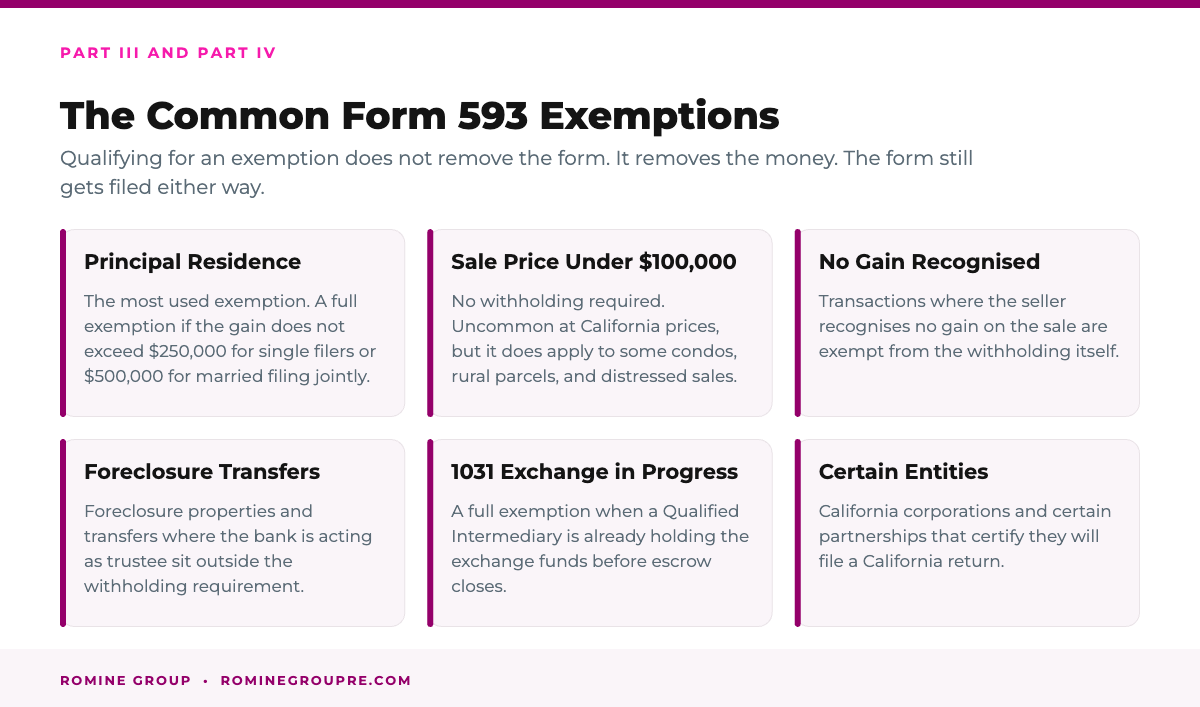
Part III and Part IV of Form 593 list real exemptions, and several apply commonly. The most used is the principal residence exclusion. Sellers of a principal residence can claim a full exemption when the gain doesn’t exceed $250,000 for single filers or $500,000 for those married filing jointly.
Real estate withholding isn’t required when the sales price is $100,000 or less. With the statewide median home selling for $777,566 in June 2026, a property at that threshold is uncommon. It still applies to some condos, rural parcels, and distressed sales.
Other exemptions cover transactions where the seller recognizes no gain, installment sales structured properly, and situations where the seller is a California corporation or certain partnerships that certify they’ll file a California return. Foreclosure properties and transfers where the bank acts as trustee are also excluded from withholding requirements. If a foreclosure is driving your timeline, our guide on selling a house in foreclosure in California covers the clock you’re working against.
For exempt transactions, the seller submits the completed Form 593 to the escrow company before closing. Escrow then files it with the FTB by the 20th-of-the-following-month deadline. Claiming an exemption doesn’t eliminate the paperwork. It changes what the form says and what escrow does with the proceeds.
One point sellers get confused about: qualifying for an exemption doesn’t excuse you from filing a California income tax return after the sale. Qualifying for an exemption from withholding, or being withheld upon, does not relieve you of your obligation to file a California income tax return and pay any tax due on the sale. The form and the tax return are two separate requirements. Handling one doesn’t satisfy the other.
How to Calculate the Correct Withholding Amount
A wrong withholding number creates a paperwork problem that follows you for months, and it delays money you’re counting on after closing.
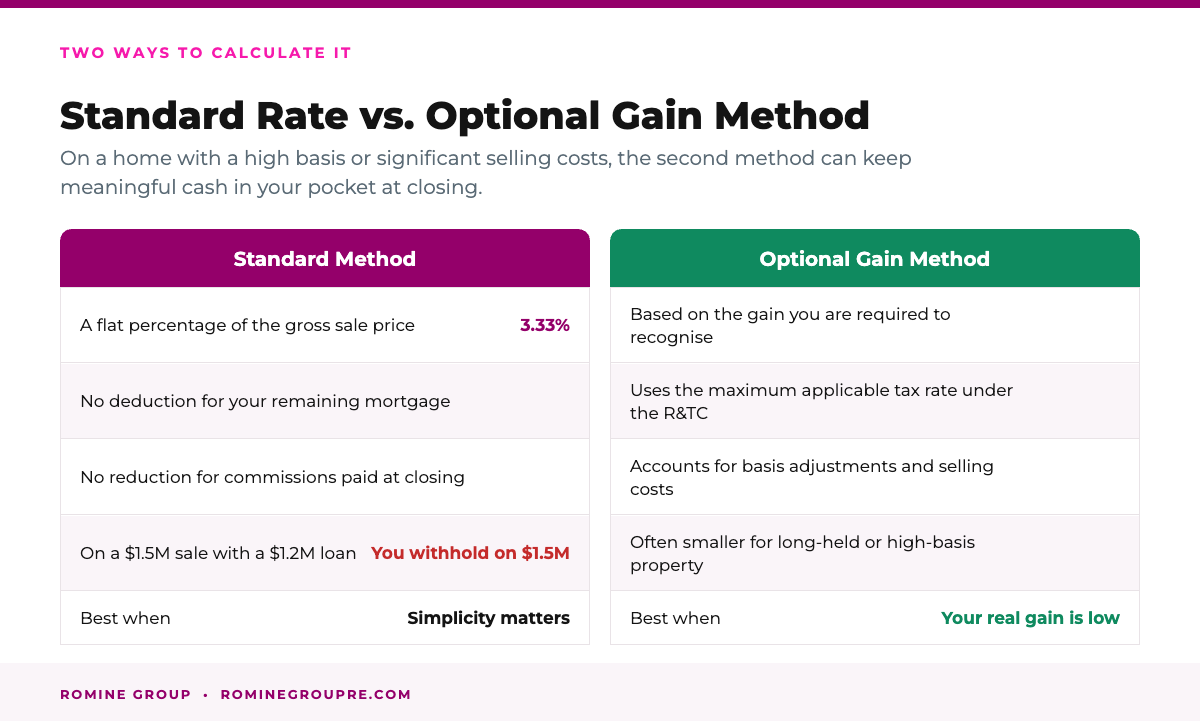
Two methods exist for calculating withholding on California Form 593. The first is the standard method, a flat percentage of the gross sale price. The standard FTB rate is 3.33 percent of the gross sales price. That’s it. No deductions for your remaining mortgage, no reductions for commissions coming out of closing.
The rate calculates off the gross sale price, not net proceeds after paying off your mortgage. On a $1,500,000 sale carrying a $1,200,000 mortgage, escrow withholds a percentage of $1,500,000, not $300,000. That distinction shocks sellers who own property with heavy debt against it.
Valley sellers feel this differently than coastal ones. A $350,000 house in Reedley or Tulare produces a smaller absolute withholding than a coastal sale, and it’s far more likely to clear the principal residence exclusion outright. Median prices across Tulare, Kings, Fresno and Kern counties run well below the statewide figure. More Central Valley sellers land inside that $250,000 or $500,000 gain threshold than sellers almost anywhere else in the state.
The other route is the optional gain calculation. Sellers may elect an alternative withholding calculation based on the gain required to be recognized from the sale, using the maximum applicable tax rate under the relevant Revenue and Taxation Code sections. That approach often produces a smaller withholding amount for sellers with significant deductible expenses, large basis adjustments, or depreciation recapture considerations that shrink their actual taxable gain.
Talk with a CPA before choosing a method. The standard percentage is simpler. On a home with a high basis or heavy selling costs, though, the optional gain method can mean keeping meaningful cash through closing instead of waiting months for a refund.
The amount withheld isn’t a tax payment that disappears. It’s a credit against whatever you actually owe on the gain. When you file your California income tax return, you report the sale and enter the withholding amount on the appropriate line. If your actual liability comes in under what was withheld, you get the difference back. If it comes in higher, you owe more.
How Does a 1031 Exchange Affect Real Property Withholding?
A 1031 exchange looks like an automatic escape hatch from Form 593. It isn’t quite that simple.
Properly structured, a like-kind exchange can qualify the seller for a withholding exemption, and timing is everything. The exemption applies when a Qualified Intermediary is already holding the exchange funds before escrow closes on the relinquished property. A Qualified Intermediary already holding funds where the exchange is underway before the close of escrow qualifies for a full withholding exemption on Form 593.
What does underway mean in practice? Before the property closes, the seller must have a signed exchange agreement with the Qualified Intermediary in place. Walking into escrow after the fact and deciding to do a 1031 won’t give you the withholding exemption retroactively.
Effective January 1, 2022, a Qualified Intermediary’s withholding obligation is limited to available funds. That applies where the QI doesn’t receive sufficient funds from escrow, or where the QI disbursed funds to complete an exchange under IRC Section 1031. That cash-poor transaction rule matters on large exchanges. Funds get deployed into a replacement property before the withholding amount technically comes due, which leaves the QI off the hook for money it never held.
For sellers in high-appreciation markets, 1031 exchanges are worth exploring, because deferred tax exposure on a long-held rental can be enormous. The Form 593 exemption for exchange transactions is not self-executing, though. You certify it on the form under penalty of perjury, and the FTB has authority to audit the escrow documents to verify the claim.
If the exchange fails or only partially completes, withholding may come due on the portion that doesn’t qualify. Your Qualified Intermediary, your CPA, and your escrow officer all need to be coordinating. A dropped ball from any one of them creates real liability.
What Happens When a Trust Is Listed on a Property Title?
When a trust is the seller of record on a property title, Form 593 doesn’t go away. It just gets filled out differently.
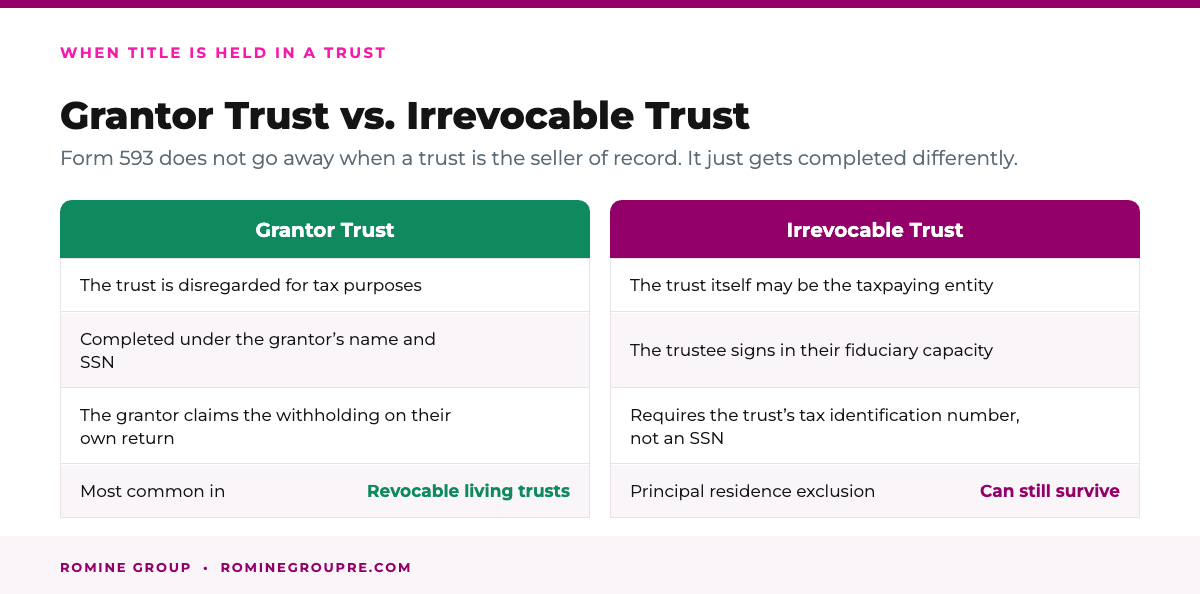
If the property sits in a grantor trust, the kind most people set up for estate planning, the trust is disregarded for tax purposes. Form 593 gets completed under the grantor’s name and Social Security number, and the grantor claims the withholding on their individual return. That’s the most common trust scenario in California real estate sales, because revocable living trusts are everywhere among homeowners who have done basic estate planning.
When the grantor is deceased and the trust has become irrevocable, the analysis changes. The trustee manages affairs on behalf of the trust, while the trust itself may be the taxpaying entity. The trustee signs Form 593 in a fiduciary capacity, which is a different role than signing as an individual seller. They’ll need the trust’s tax identification number, not a personal Social Security number.
Does the principal residence exemption survive the owner’s death when a trust is selling? It can. The property can qualify under the seller’s or decedent’s principal residence under IRC Section 121. The decedent’s last use of the property as a principal residence is recognized even without regard to the two-year time period. That matters for heirs selling a property a deceased parent occupied long-term where the trust technically held the deed.
Trustees selling California real estate who don’t know Form 593 sometimes skip the withholding question, assuming estate and trust sales run under different rules. They don’t. Every transfer of California real property triggers the Form 593 obligation, full stop, regardless of how title was held. If the property was never properly retitled into the trust in the first place, that’s a separate problem, and our guide to the Heggstad petition covers the fix.
What Foreign Sellers Must Know About California Withholding
Beyond the state obligation under Form 593, sellers who aren’t US persons face a second layer of federal withholding under the Foreign Investment in Real Property Tax Act, known as FIRPTA.
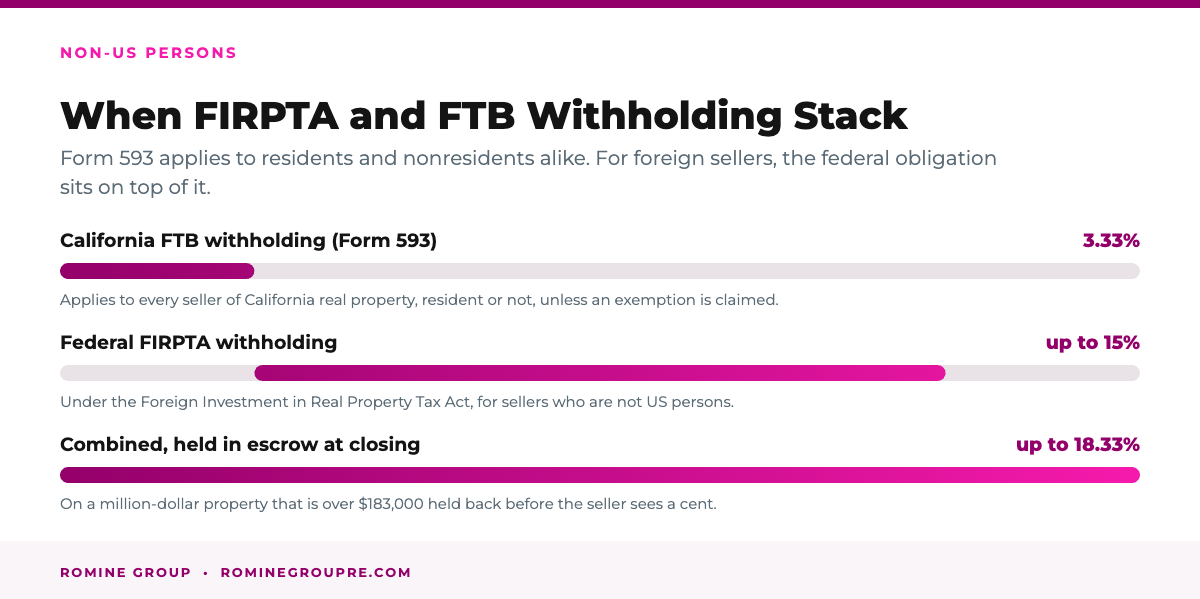
Unlike FIRPTA, the California FTB withholding rule under Form 593 applies to resident sellers as well as nonresidents. Worth repeating: Form 593 applies whether you live in California or not. For foreign sellers, both requirements stack on top of each other, which leaves two separate withholding obligations to navigate at the same closing.
On transactions where FIRPTA and FTB withholding both apply, the seller can face combined withholding of up to 18.33 percent of the gross sales price held in escrow at closing. On a million-dollar property that’s over $183,000 held back before the seller sees a cent. Understanding that before you list is not optional.
Foreign sellers need their tax identification number sorted before closing. An Individual Taxpayer Identification Number, or ITIN, is required for all non-US persons before filing US federal and state tax returns. Without a valid ITIN or federal Employer Identification Number in place, the withholding credit can’t be properly applied to your account, which delays any refund owed to you.
If a property is held in a foreign trust or LLC, FIRPTA withholding still applies even when the beneficial owner lives in California. Entity structure doesn’t shield a foreign person from withholding. Foreign sellers should work with a California-licensed real estate attorney and a tax professional experienced in cross-border transactions well before any purchase agreement gets signed.
How Escrow Officers Handle Form 593 at the Close of Sale
Escrow officers are the unsung professionals in California real estate, and on Form 593 they carry real legal responsibility.
From the moment escrow opens, a competent escrow officer identifies the withholding obligation and starts gathering what’s needed. The seller’s tax identification number, the form of title, and any exemption documentation the seller intends to claim. The form has to be signed by the seller before closing. Not at closing. Not after.
Ask your escrow officer early which withholding method they’ve entered on the draft. Escrow defaults to the standard 3.33 percent unless somebody tells them a gain calculation is coming. Once the estimated settlement statement is built around that number, changing it late creates friction nobody needs. A five-minute question in week one saves a scramble in the final week.
What Are the Deadlines and Payment Rules?
This deadline isn’t negotiable, and it arrives faster than most sellers realize.
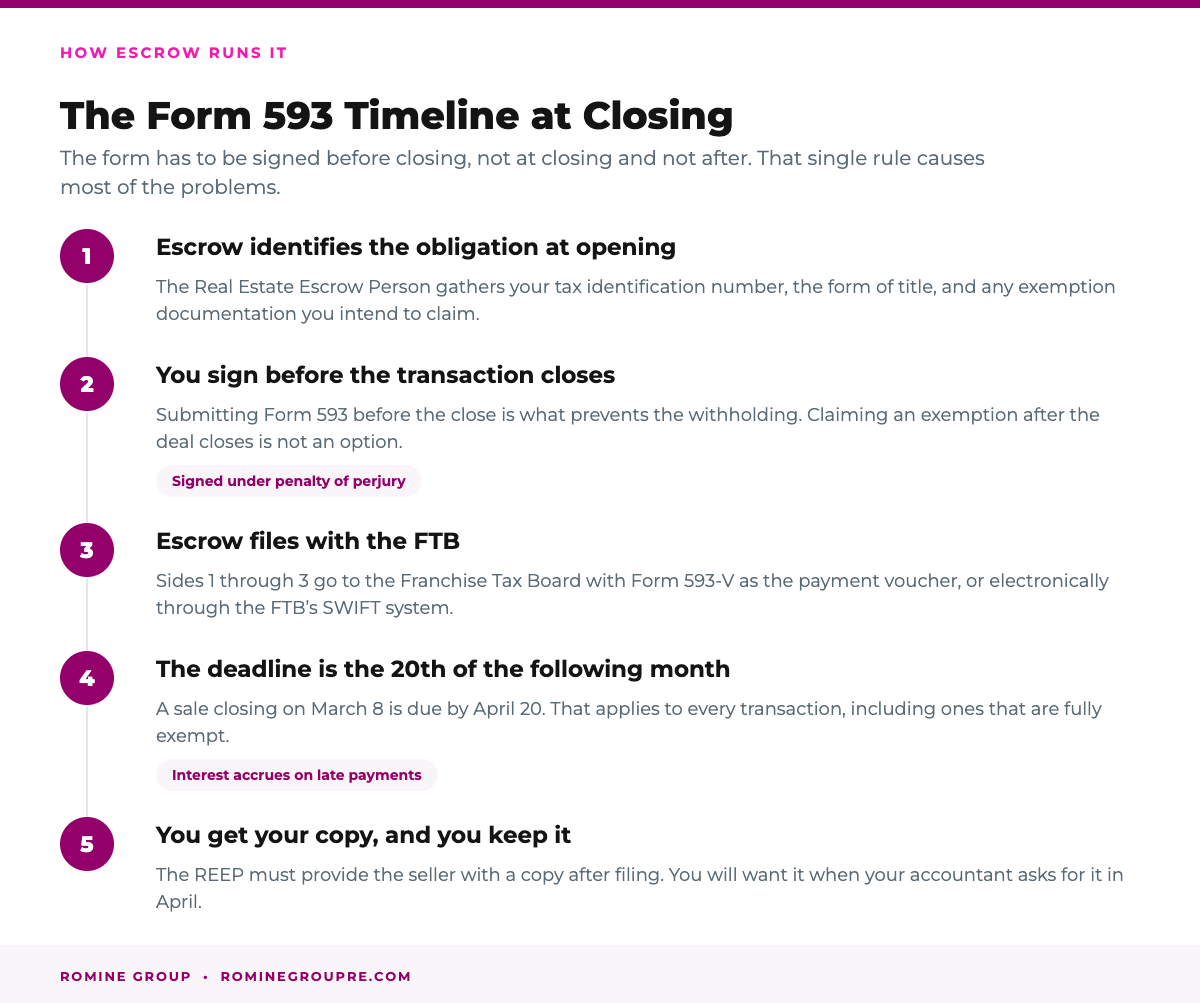
The seller or transferor must submit Form 593 before the close of the real estate transaction to prevent withholding on the transaction. Try to claim an exemption after the sale closes and the form won’t save you. After the transaction has closed, amounts withheld may be recovered only by claiming the withholding as a credit on the appropriate year’s tax return.
Filing is due the 20th day of the calendar month following the month escrow closed. A sale closing on March 8 is due by April 20. That’s a tight window, and it applies to every transaction, fully exempt ones included. Some assume that because no money is going out, no form needs filing. Wrong. The form still goes to the FTB confirming the exemption claim.
For installment sales, where the buyer pays the seller over time rather than all at once, the withholding obligation doesn’t end at closing. The buyer withholds 3 1/3 percent of the principal portion of each installment payment and files a current-year Form 593 and Form 593-V with each remittance. Every payment triggers a separate filing obligation, and each one is due on the 20th of the following month. Interest accrues on late payments.
Residents use Form 540 and attach their copy of Form 593 when filing their California income tax return. Nonresidents and part-year residents file Form 540NR instead. The withholding flows through to your annual return as a credit against your actual tax bill. File accurately and anything over what you owe comes back to you.
Where to Submit Form 593 and How to Fix Errors
A skeptical seller might reasonably say they’ve been selling real estate in California for thirty years and nobody ever made them think about this. Fair. Prior transactions had an escrow officer handling all of it in the background, and the machinery stayed invisible. Once you understand it, you see why good professionals around you matter.
The mailing address for paper submissions is Withholding Services and Compliance, Franchise Tax Board, PO Box 942867, Sacramento, CA 94267-0651. Electronic submission through the FTB’s Secure Web Internet File Transfer system is faster, and most title and escrow companies use it, though electronic filers still mail the payment and Form 593-V separately.
Mistakes happen. A sale price gets transposed. An ownership percentage gets recorded wrong. An exemption box stays unchecked when it should have been checked. If the information submitted is incorrect, an amended Form 593 must be filed with the FTB. The FTB’s withholding pages walk through the amendment process, and that’s your first stop before assuming an error self-corrects.
Plenty discover an error only when they file the annual tax return and the withholding credit doesn’t match what they expected. That discrepancy triggers a conversation with the FTB that takes time to resolve. Catching errors before they leave escrow is far easier than correcting them months later from another state.
Electronic signatures are valid for Form 593 purposes. Most California transactions now use digital signing, so getting the form executed is straightforward. The technology isn’t what causes problems. It’s sellers who were never properly prepared for what the form says.
What Are the Penalties for Failing to Withhold or File?
Some sellers read the exemption list, decide they probably qualify, and assume the whole Form 593 process can be set aside. That’s the misunderstanding that leads to real financial consequences.
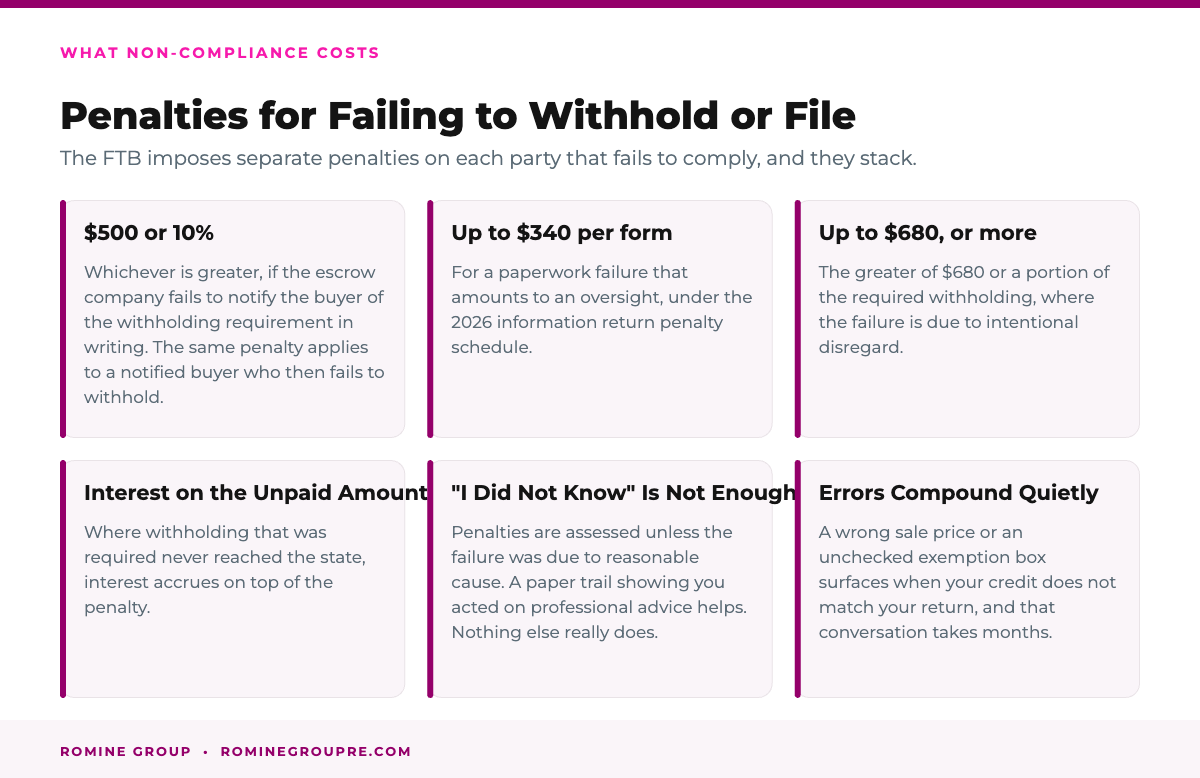
Each party who drops the ball draws a separate penalty. The FTB imposes separate penalties on each party that fails to comply, and they stack.
If a REEP fails to notify the buyer about the withholding requirement in writing, the penalty is $500 or 10 percent of the required withholding, whichever is greater. If the buyer gets notified and still doesn’t withhold, the same penalty applies to the buyer. Both parties carry penalty exposure, which is why experienced escrow officers take this seriously.
Missing the filing deadline carries its own price. The penalty runs up to $340 per Form 593 when the failure is an oversight. Intentional disregard runs to the greater of $680 or a portion of the required withholding. For taxable years beginning on or after January 1, 2026, the penalties related to failure to file information returns increased.
When required withholding never reaches the state, interest accrues on the unpaid amount. Penalties will be assessed unless it’s shown that the failure to notify, withhold, or timely furnish returns was due to reasonable cause. I didn’t know does not usually satisfy reasonable cause. A paper trail showing you acted in good faith on professional advice can help, and that requires having professional advice to begin with.
The compounding version of this problem is worth naming. An estate property sits through two expired listings over eight months, traditional buyers walk after inspection because a garage was converted without permits, and carrying costs mount while a year-end tax deadline closes in. Then a Form 593 calculation error surfaces in the draft paperwork. Any one of those is manageable. Stacked together they cost real money. If a permit issue is stalling your sale, our guide on selling a house with unpermitted work in California covers the options. And selling a house as-is in California covers how condition gets priced.
Sellers who land in trouble after a sale closes can contact the Franchise Tax Board’s Withholding Services and Compliance section directly. Approaching them with a complete file helps. The FTB isn’t always inflexible when there’s a genuine effort to resolve a problem in good faith. That conversation goes better when you start it proactively rather than waiting for a notice.
California homes sold at a median price of $777,566 in June 2026, with median days on market sitting at 43 days. At that price the standard withholding represents nearly $26,000 held back at closing. Understanding your obligations and your exemptions isn’t just tax housekeeping. It’s a real dollar amount you either protect or lose. We buy across the Valley, including cash home buyers in Fresno, a company that buys homes in Bakersfield, and plenty of sales in Visalia and Hanford. How Romine Group buys homes includes flagging this before it becomes a problem.
Frequently Asked Questions
What Is Form 593 and Who Is Required to File It?
Form 593 is California’s Real Estate Withholding Statement, used to report and remit a prepayment of state income tax on property sales. Any seller or transferor of California real property needs this form completed before escrow closes, whether or not withholding is actually owed. Your escrow officer handles the submission, and the seller signs it and stands behind the information under penalty of perjury.
Who Is Responsible for Filling Out Form 593?
The legal obligation to withhold falls on the buyer, though in practice the Real Estate Escrow Person, usually your escrow or title company, handles the form on the buyer’s behalf. As the seller you’re responsible for providing accurate information, signing the form, and submitting any exemption certifications before closing. If an error occurs, both the REEP and the buyer can face penalties, so everyone has an interest in getting it right.
Who Is Exempt From Filing Form 593?
Nobody is fully exempt from the filing itself, because the form gets submitted even on exempt transactions. What changes is whether money gets withheld. Common full exemptions include the principal residence exclusion where your gain falls within the $250,000 or $500,000 threshold. Also situations where you recognize no taxable gain, foreclosure transfers, sales at $100,000 or under, and transactions where a Qualified Intermediary already holds exchange funds. Your CPA can walk Part III and Part IV of the form with you to identify which boxes apply.
How Do You Complete California Form 593?
Your escrow officer will typically prepare the form and walk you through it. You’ll review your personal identifying information, the property details, and the withholding calculation method being used. If you’re claiming an exemption, you certify it under penalty of perjury in the applicable section. If you’re using the optional gain method instead of the standard 3.33 percent rate, your CPA should calculate the correct alternative amount before you sign. The completed form goes to escrow before closing, and your copy stays with your tax records for the year of sale. You can check out other frequent questions or reach out to Romine Group to talk through where you stand.
More California Selling Guides
- Selling a House With Unpermitted Work in California
- Selling a House As-Is in California
- Inheriting a House With a Mortgage in California
- How Prop 19 Changes Inherited Property in a California Trust
Want a Sale Where Nothing Surprises You at Closing?
We handle Form 593, the liens, and the paperwork on our side of the table, and we tell you the number you will actually walk away with before you commit to anything. We buy California houses in any condition and close in as little as one to three weeks. Tell us about the property below. No pressure, no obligation, and no fee for the conversation.
"*" indicates required fields
Prefer to talk it through first? Contact Romine Group and we will walk the situation with you before you commit to anything. You can also read how Romine Group buys homes to see exactly what the process looks like.