

A widow who has just moved her mother into assisted living calls with one question. Do I really need to pay an agent to do this? It’s the right question, and the answer is rarely a straight yes or no. It never is.
California rewards sellers who know what they’re doing and punishes the ones who don’t. So before you stick a yard sign in the ground, read the whole thing.
What Is FSBO and How Does It Work in California?
The idea sounds clean. Skip the listing agent, sell the house yourself, pocket the commission. Sellers picture a tidy transaction. Post a few photos, field some buyer calls, hand over keys at closing. What usually shows up instead is a pile of disclosure forms and an inbox full of unqualified inquiries. Then comes a negotiation across the kitchen table with a buyer’s agent who does this every single day and has seen every amateur mistake in the book.
FSBO, short for “for sale by owner,” means you act as your own listing agent at every step. You set the price, handle the marketing, manage showings, respond to offers, negotiate terms, coordinate the escrow, and get every legally required document delivered on time. FSBO sellers here carry some of the heaviest disclosure obligations in the country. Those obligations don’t disappear because you skipped the agent.
California has some of the most extensive home-selling disclosure laws in the United States, and FSBO sellers are legally required to hand the buyer every required form even without a Realtor. Getting them wrong isn’t embarrassing. It’s a liability that follows you past closing.
Buyers shopping FSBO listings often assume they can negotiate harder because no listing agent is there to push back. Sometimes they’re right. A seller who isn’t sure of their home’s value, hasn’t seen a comparative market analysis, and doesn’t know escrow procedure is at a real disadvantage the moment a seasoned buyer walks in.
FSBO does work. It works best when the seller is organized, realistic about price, willing to learn the paperwork, and clear-eyed about the hours involved. If that sounds like you, keep reading.
What Is Your California Home Worth Right Now?
Sellers sometimes assume the market will carry whatever number goes on the listing. That confidence is understandable after years of watching California home values climb. Pricing on gut feeling is still one of the fastest ways to leave money on the table, or to sit unsold for months while your competition moves.
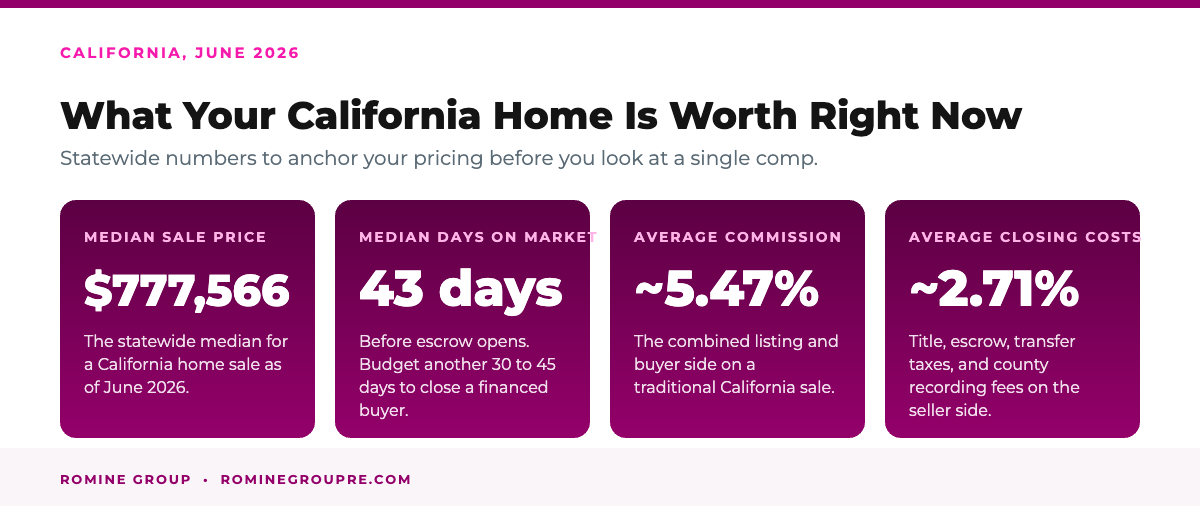
The statewide median home price in April 2025 hit a new all-time high of $910,160. Reassuring number, and it hides enormous local swings. A bungalow in Fresno and a three-bedroom on the coast are both California homes, and their markets share almost nothing. Central Valley pricing follows its own rhythm, and the buyer pool for a Valley property looks nothing like a coastal one.
That gap matters more than sellers expect. Visalia, Tulare, Hanford and Reedley each have their own price floors, days-on-market rhythms, and buyer pools. A three-bedroom in Lindsay does not price off Tulare County averages, let alone statewide ones. Pull your comps from your own town and your own school boundary, not from a state number.
To price your home without a real estate agent, run your own comparative market analysis. A CMA looks at recently sold homes within roughly a mile of yours, matched on square footage, bedroom count, lot size, and condition. Zillow and Redfin give you a starting point, though the raw sales data matters far more than the automated estimate. Those algorithms don’t know your neighbor’s house sat vacant eight months before it sold, or that yours backs onto an open field.
Three pricing mistakes come up again and again. Pricing to what you need out of the sale instead of what the market will bear. Failing to adjust for deferred maintenance. Anchoring to a Zestimate without checking actual closed sales. Closed sales are the only real data. Pending sales show you where the market is heading. Active listings just show you your competition.
Want a professional read on your number without signing a listing agreement? Romine Group covers the whole Central Valley and will give you a frank assessment of what your home is worth today. No strings attached.
How Much Money Can You Save by Selling Without a Realtor?
Miscalculating your net proceeds is the costly mistake most sellers never see coming. People focus on the gross offer price and forget to subtract what they’re actually paying out of it.
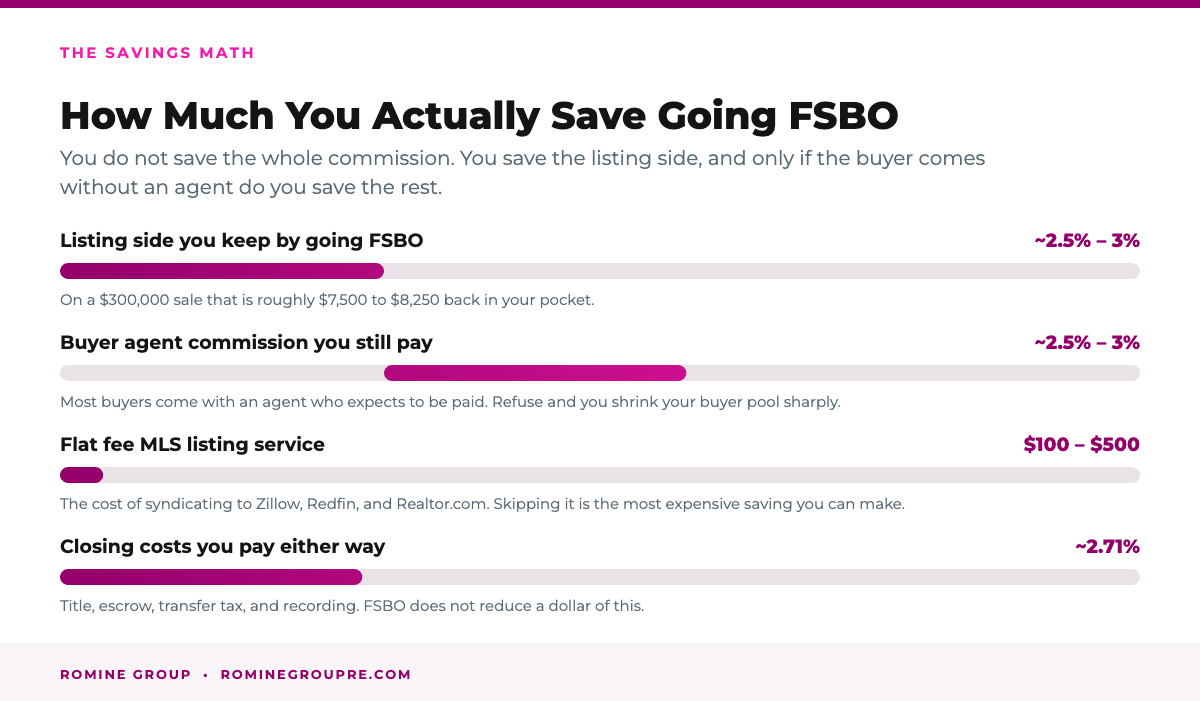
When selling a home in California, sellers may pay an average of 5.47% in real estate commission, which breaks down into a 2.73% listing agent commission and a 2.74% buyer’s agent commission. On a home near the statewide median, that’s over $40,000 walking out the door at closing. Going FSBO cuts the listing side out of that equation. The buyer’s agent portion is a separate conversation now.
Following the March 2024 National Association of Realtors settlement, sellers no longer have to offer a commission to the buyer’s agent through the MLS. That changes the math. You can offer a buyer’s agent fee to pull in more showings, or decline and let buyers cover their own agent costs. Both paths have trade-offs.
Commission isn’t the end of it. Escrow fees, title insurance, transfer taxes, agreed-upon concessions, and any HOA transfer fees all come out before you see a dollar. Sellers in California typically pay a similar percentage of the home’s purchase price in closing costs on top of whatever commission gets paid. Budget for that before you get attached to the gross number.
Here is the honest FSBO savings math. You keep roughly 2.5 to 3 percent by dropping the listing agent. In exchange you take on your own time, your own risk, and the chance of a pricing or paperwork error. On a $700,000 house that’s a potential savings of $17,500 to $21,000. Whether the work and the exposure are worth it depends on your situation.
Pros and Cons of Selling a House by Owner in California
FSBO works for some sellers and fails badly for others. The difference usually comes down to preparation, not confidence.
Pros of going FSBO:
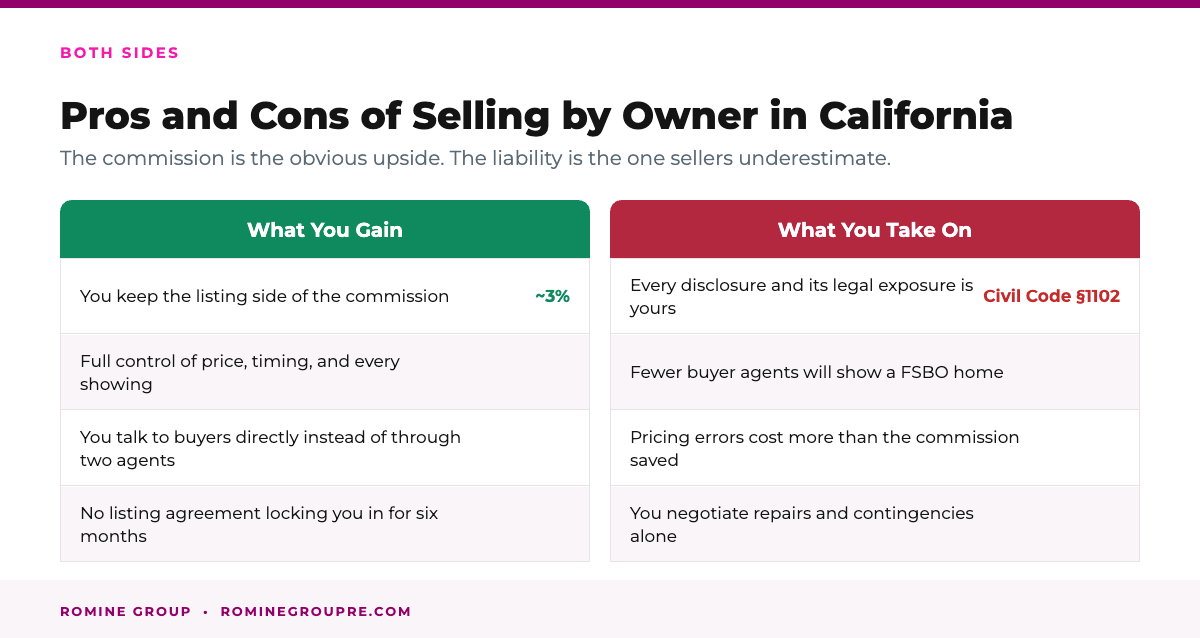
Keeping the listing commission is the obvious one. You control every showing, every conversation with buyers, and every call on what to accept or counter. An owner selling a home they know well can talk about the schools, the walk to Mooney Grove Park, or which streets flood in a wet winter in a way no agent will match. That local knowledge matters to buyers choosing between two similar homes.
Timing is the other advantage. Nobody’s schedule gates your review of an offer or your counter. The transaction moves as fast as you move.
Cons of going FSBO:
Buyers working with seasoned agents know there’s no listing agent to split commission with, and plenty will use that as leverage. Without a buffer in the room, emotions run hot. Sellers take lowball offers personally. Offers fall apart over issues a good agent would have smoothed over in a phone call.
Disclosure errors generate the most legal risk after closing. Selling real estate without a licensed real estate broker does not exempt you from California’s strict disclosure obligations. The law imposes non-delegable duties on sellers of residential property to disclose known material facts, and failing to do so exposes you to liability for fraud, misrepresentation, rescission, or damages.
Pricing without a formal comparative market analysis tends to go sideways too. Sellers overestimate, sit on the market too long, then chase the market down with reductions. Every buyer watching reads that as desperation.
How to Price Your Home Correctly Without an Agent
Overpricing by $75,000 on day one costs more than a seller expects. The usual pattern runs ninety days and two price cuts, and the home closes below the number the market had been signaling from the start. Getting the price right on day one is what protects you from that.
Pull closed sales from the past three to six months in your zip code. Prioritize homes matching yours in square footage within about 10 percent, same bedroom and bathroom count, similar lot size. Then adjust the comps where the properties differ. Finished garage versus unfinished. Renovated kitchen versus dated. Pool versus no pool. Brokers call these adjustments comps, and you can run them yourself using county assessor records and Redfin’s sale history.
Don’t price off your neighbor’s active listing. They haven’t sold. Their price tells you what they hope to get and nothing else. Closed sales tell you what buyers actually paid.
One more check: look at the list-to-sale price ratio in your specific city. The median number of days it took to sell a California single-family home was 24 days in June 2025, and the statewide sales-price-to-list-price ratio sat nearly at asking price in June 2025. Most homes are closing very close to list. Price correctly from the start and you shouldn’t have much to negotiate away.
Go too high and you train buyers to wait for the cut. Price at or just under market and you create competition. In tight Valley submarkets, a well-priced home often draws multiple offers inside the first weekend.
How to Market and List Your FSBO Home in California
Photos are not an afterthought. Two identically priced homes hit the market the same week. One was shot by a professional, the other on a phone in bad light. The first sells in four days. The second sits six weeks. Whatever buyers see online is the real first showing.
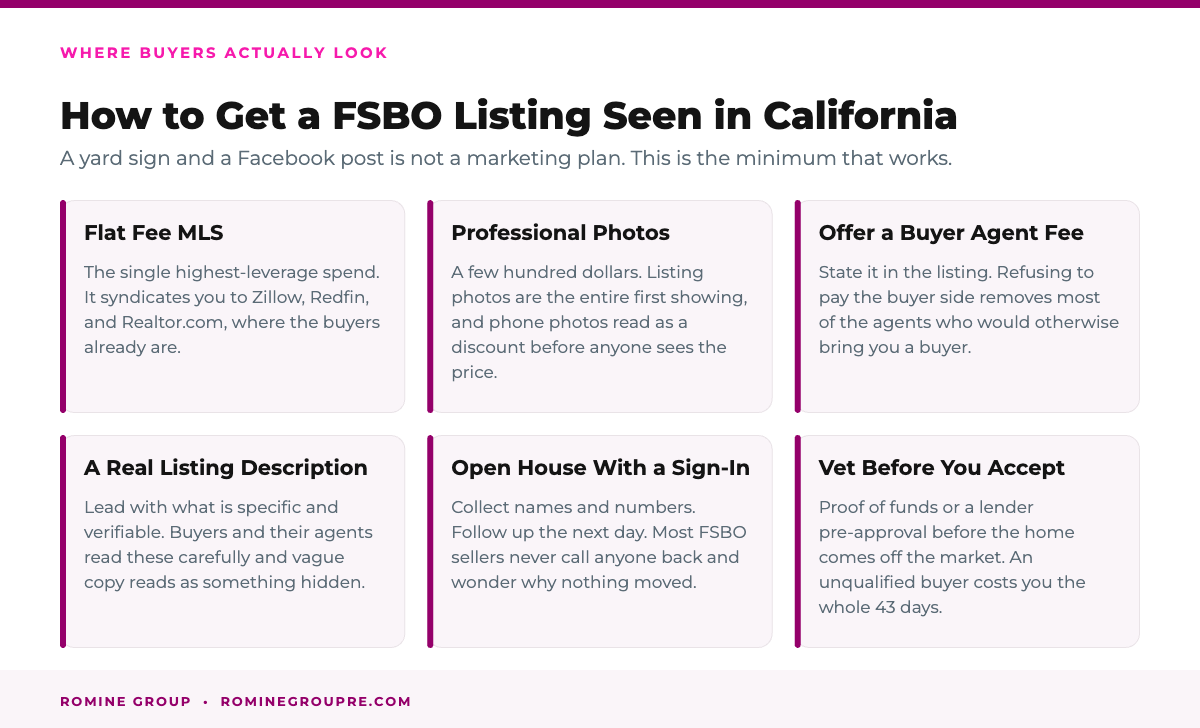
Without a real estate agent, your property won’t land on the Multiple Listing Service automatically. The MLS is the database feeding Zillow, Redfin, Realtor.com, and every other major portal. To get on it, FSBO sellers in California use a flat fee MLS service. You pay once, usually a few hundred dollars, to get the property listed. California sellers must use a flat fee MLS listing service to appear on the MLS, which then syndicates to Zillow, Redfin, Realtor.com, and all the major portals, usually inside 24 hours.
Professional photography is non-negotiable. Hire a real estate photographer. A few hundred dollars comes back several times over in buyer interest. A Sierra view or a backyard of mature oaks has to show up in the photos.
Beyond the MLS, post on Craigslist, neighborhood Facebook groups, and Nextdoor. Put a real yard sign out front, not a generic FSBO placard but something clean and readable with your phone number on it. Open houses still work across much of California, especially in older neighborhoods with steady foot traffic.
Put together a one-page property sheet buyers can carry out: square footage, bedroom and bathroom count, recent upgrades, HOA details if they apply, and typical utility costs. Buyers decide faster when the facts are in their hand.
What Paperwork Do You Need to Sell by Owner in California?
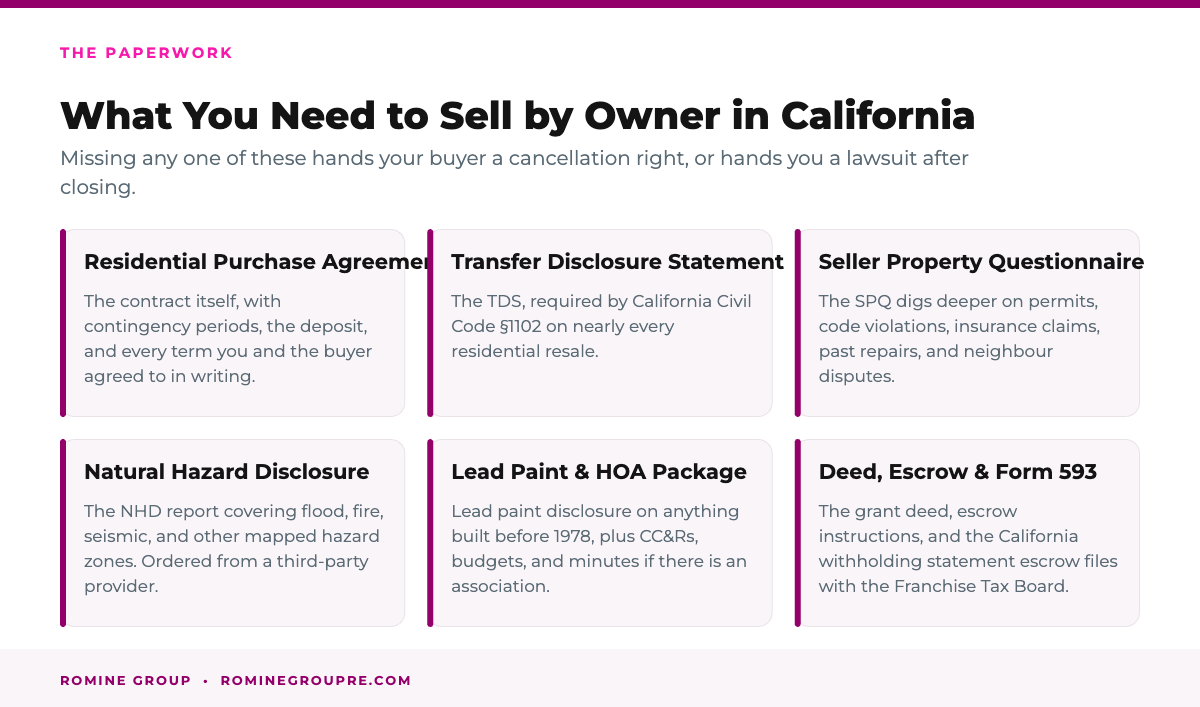
Three days before escrow is supposed to close is a bad time to learn the Natural Hazard Disclosure report never reached the buyer. That buyer has a right to cancel, and they will use it. Paperwork failures kill more FSBO transactions than market pricing does.
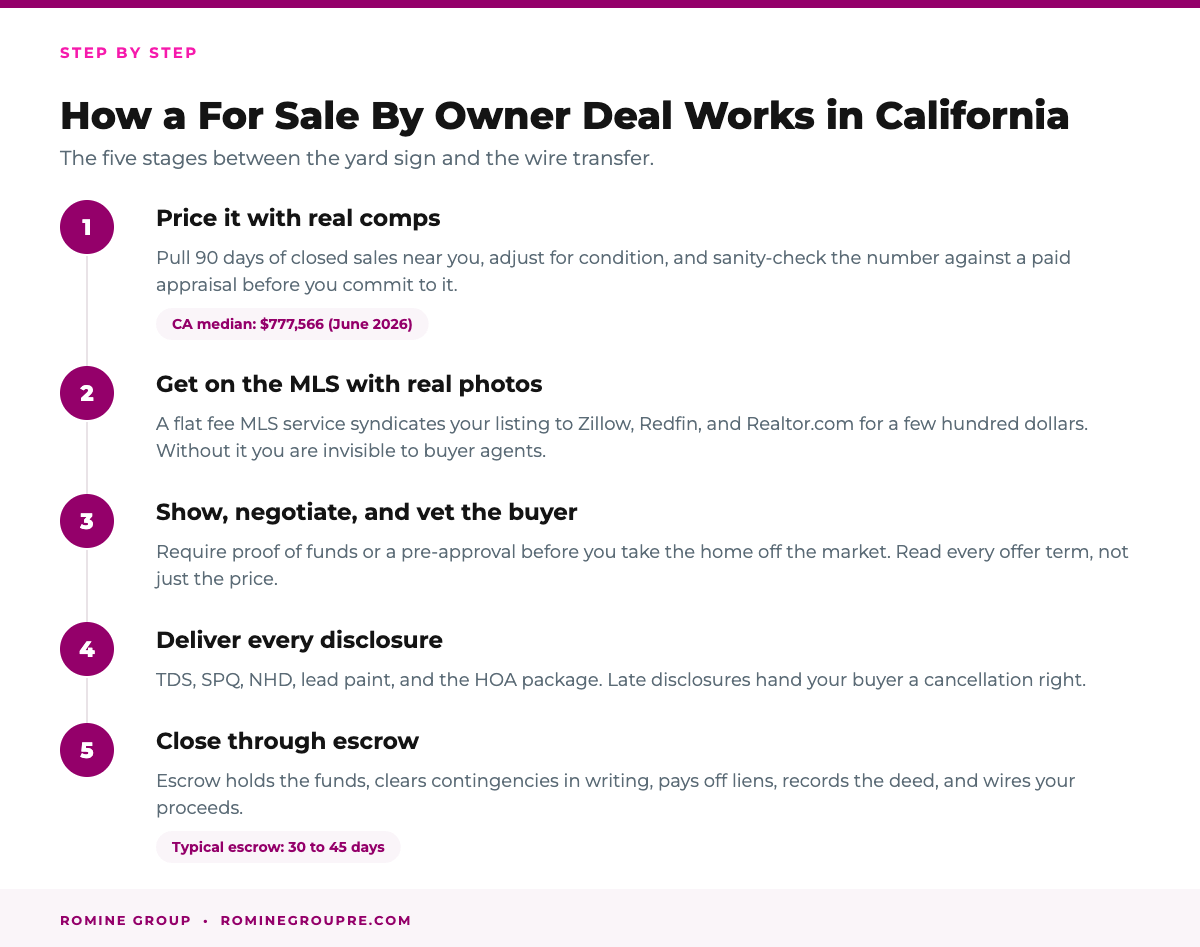
California’s required paperwork isn’t optional, and each form has a job. Most California residential transactions involve the Transfer Disclosure Statement (TDS), the Seller Property Questionnaire (SPQ), the Natural Hazard Disclosure (NHD), and other property-specific disclosures. The TDS is the most important document in the stack. Under Civil Code 1102.3, the seller must deliver a completed Transfer Disclosure Statement to the buyer as soon as practicable before transfer of title.
The SPQ digs deeper than the TDS, asking about lawsuits, permits, boundary disputes, and neighborhood conditions. The NHD covers whether the property sits in a flood zone, fire hazard area, earthquake fault zone, or other mapped risk area. That one carries real weight in Tulare, Kings, Fresno and Kern counties, where flood mapping and fire zones both come into play. For homes built before 1978, a lead-based paint disclosure is federally required.
If your property is in an HOA, the law requires you to give the buyer the CC&Rs, bylaws, rules and regulations, current budget, and the association’s financial statements. That package takes time to assemble, so order it early from your HOA management company.
For the purchase contract, most California FSBO sellers use the California Residential Purchase Agreement, the standard form from the California Association of Realtors. An attorney will review it for a flat fee. Given what’s at stake, that’s money well spent.
Escrow instructions, the grant deed, and any agreed-upon contingency waivers finish the package. Your escrow officer handles most of the closing coordination. Assembling the documents is on you.
What Happens at Closing When You Sell Without a Realtor?
Who runs the closing when no agent is coordinating it?
Escrow does. In California, nearly every residential real estate transaction closes through an escrow company or a title company acting as escrow holder. The escrow officer holds the deposit, collects the documents, confirms each contingency has been met or waived, coordinates the payoff on your existing mortgage, and disburses funds once things line up. Your job is to stay responsive and get them what they ask for fast. A slow seller is the number one reason escrow drags past the scheduled close date.
From accepted offer to closing, expect four to six weeks with a financed buyer, longer if the appraisal or underwriting stalls. Cash buyers close faster. Direct buyers like Romine Group can close in a week or two when you need to move, and you can see exactly how Romine Group buys homes from offer to closing day.
You’ll sign the grant deed and the escrow instructions, confirm the final settlement statement, and wire any funds owed if the payoff and fees exceed your sale proceeds. On closing day the deed records with the county and funds release. At that point it isn’t yours.
Sellers consistently underestimate the final settlement statement. Read every line before you sign. Escrow fees, title insurance, prorated property taxes, HOA transfer fees, and any negotiated credits all appear there. If a number doesn’t match what you agreed to, stop and ask. Escrow officers are thorough, and they work from the instructions they were given, and those instructions can carry typos. Catching a discrepancy before you sign is free. Catching it afterward is expensive.
Common Mistakes FSBO Sellers Make in California
Buyers who come through FSBO listings skew investor-adjacent and highly seasoned. They know most FSBO sellers have never negotiated a real estate contract. That asymmetry costs sellers more than the commission would have.
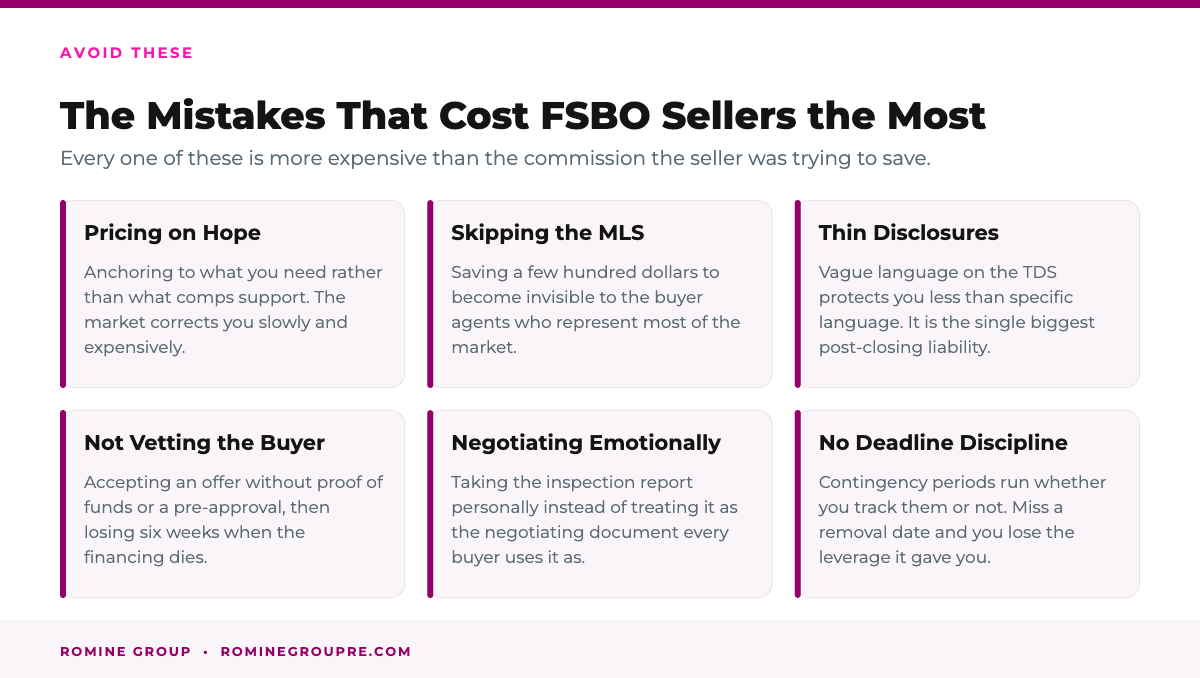
Skipping a disclosure form, even by accident, is the most legally dangerous mistake on this list. California courts have held that sellers have an affirmative duty to disclose all material facts known to them that a buyer could not reasonably discover. You can’t leave out a leaky roof and hope nobody notices. You disclose it. Period. The same goes for construction nobody permitted, which has its own tangle of rules. Read our guide on selling a house with unpermitted work in California before you fill out the TDS.
Accepting an unqualified buyer runs a close second. A buyer who can’t produce proof of funds for cash or a current pre-approval letter for financing isn’t a real offer. They’re a placeholder. Taking your property off the market for someone who can’t close costs you time. In a market where the median days on the market was 43 days as of June 2026, time is money.
Sellers negotiate hard on the offer and then miscalculate net proceeds anyway. They subtract the mortgage payoff and assume the rest is theirs. In practice escrow fees, title insurance, prorated taxes, and HOA fees all chip at that number first. Withholding is another line people miss entirely, and our breakdown of California real estate withholding and Form 593 explains when the state takes a cut at closing.
One more pattern worth flagging. FSBO sellers often skip the follow-up after a showing. Agents do it automatically. Running it yourself, send a message inside 24 hours and ask for feedback. If someone is wavering, a short warm note can be the difference between an offer and silence.
Should You Sell Your House Without a Realtor in California?
The first question worth answering is what’s driving the sale. The answer shapes everything after it.
Want maximum control over timing and no specific price to hit? Then selling the home yourself is worth considering. If you’re selling because you’re in financial distress, on a tight clock, or sitting on deferred maintenance you don’t want to fund? The calculus shifts hard. Managing disclosures, showings, negotiation, and escrow coordination while also managing a financial emergency is a lot to carry. If a foreclosure clock is running, read how to sell a house in foreclosure in California first, because the deadlines there override everything else.
Taxes add another layer. Federal law lets qualified sellers exclude up to $250,000 (single) or $500,000 (married filing jointly) of gain if the home was your primary residence for at least two of the past five years. The exclusion carries over for state purposes too, so most primary residence sellers owe no income tax on gain up to that threshold. Your tax professional can confirm whether you qualify and figure what’s owed above it.
Investment properties, vacation homes, anything that wasn’t your primary residence: the full gain is taxable at both the federal and state level. Talk to a CPA before you close.
FSBO saves money when you execute well and costs money when you don’t. For a seller who’s organized, comfortable with paperwork, and able to handle buyers directly without getting rattled, it can be the right move. For everyone else, the commission may be money well spent.
Alternatives to Selling Without a Realtor in California
Not every situation splits neatly into hire an agent or go full FSBO.
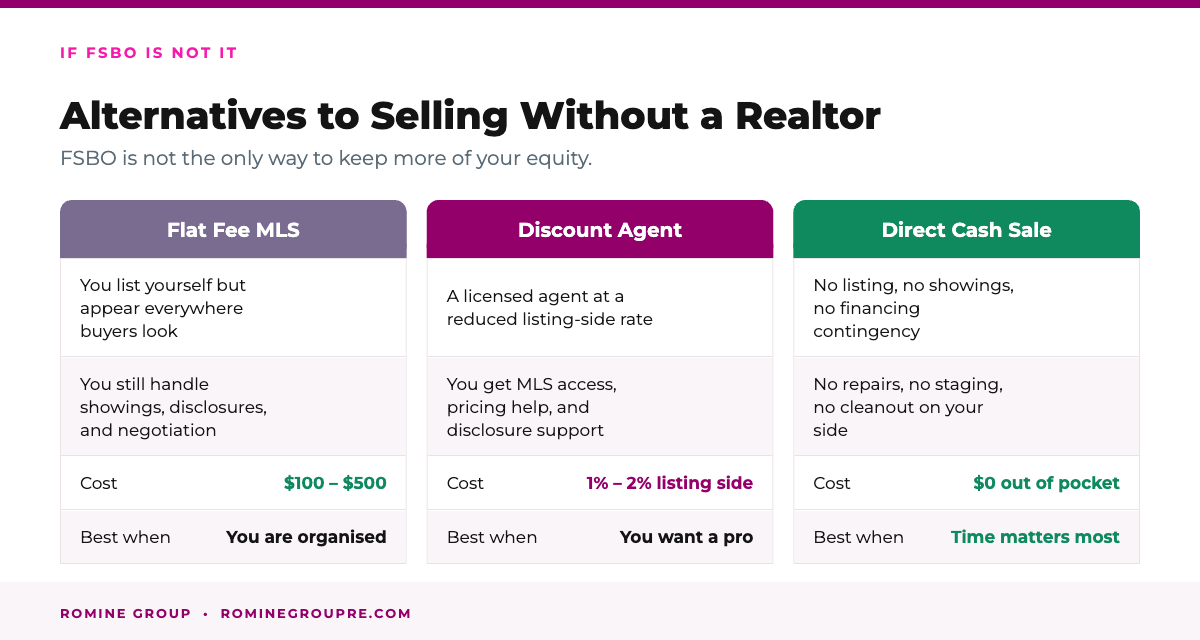
Flat fee MLS services put you on the Multiple Listing Service for a few hundred dollars with no full listing commission. You still handle showings and negotiations. For a seller comfortable with those parts who just needs the exposure, that middle ground makes sense.
Discount brokerages give you full-service support at a reduced rate, around 1.5 percent on the listing side instead of the standard 2.5 to 3 percent. You keep the professional marketing, the negotiation support, and the document management at a lower cost. On a higher-value property the savings are real even at a reduced rate, which means the math on discount brokerages gets more compelling as your price point climbs.
Selling directly to a cash buyer bypasses the open market. No showings, no contingencies, no appraisals, no waiting on a lender. An offer lands, a buyer and seller negotiate it, you close. That path fits sellers who need speed, who have a property in rough shape, or who want to skip the disruption of a traditional listing. The same logic applies whether you’re looking for cash home buyers in Fresno or a way to sell your house fast for cash in Bakersfield. It also fits the seller whose listing has already expired twice, where retail buyers keep walking after the inspection report lands. Condition scares off more retail buyers than price does. If the condition is the real issue, our guide on selling a house as-is in California walks through what changes.
Romine Group buys direct throughout the Valley. If you want to know what your property would bring as-is, without repairs or showings, you can sell your home for cash in California on your own schedule. Selling starts with one conversation, and a no-pressure offer costs you nothing.
How to Find a Better Real Estate Agent at a Lower Rate
Sellers may pay a significant amount in real estate commission in California, and that number is negotiable. It’s been moving since the 2024 NAR settlement changed how buyer’s agent compensation gets disclosed and structured. Plenty of sellers can negotiate the listing commission before signing anything at all.
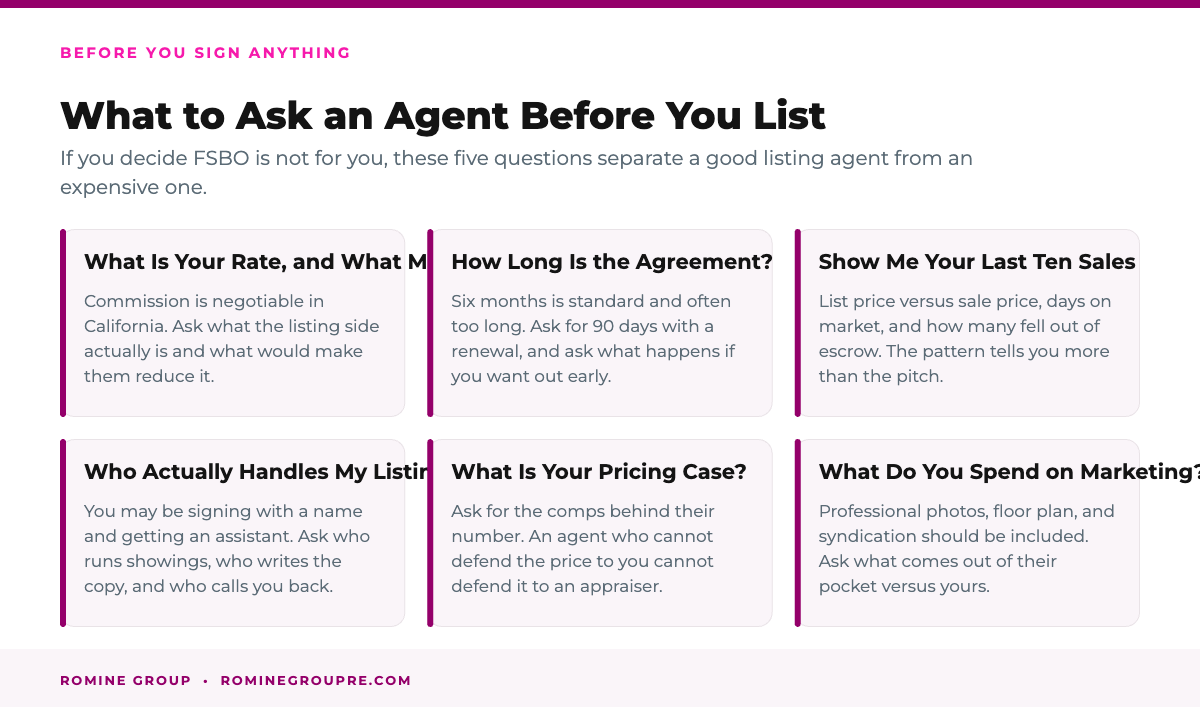
Interview at least three listing agents before you sign with any agent. Ask each one directly: what is your commission, what’s included, and what happens if the property doesn’t sell? The answers tell you how they operate. An agent who won’t negotiate their own fee probably won’t negotiate hard on yours.
Discount brokerages in California list homes for 1 percent or a little more on the listing side. Full-service agents at traditional brokerages in slower markets will come down to 2 to 2.5 percent if you ask directly and your home is well-priced and sale-ready.
After the NAR settlement took effect in August 2024, buyer-agent compensation is no longer advertised through the MLS and has to be agreed to in writing between buyer and agent before touring. So you have real leverage on the buyer’s agent side too. You aren’t obligated to offer any particular amount. Some sellers offer a flat dollar figure, others one to two percent. What you offer should reflect your local market and how fast you want the property gone.
A well-connected local agent who knows Tulare County or the Kings County market doesn’t need the same rate as one working a bidding war in a coastal metro. Match the fee to the work, and don’t be shy about that conversation.
Frequently Asked Questions
What Do I Need to Do If I Sell My House Without a Realtor?
You take on everything a listing agent normally handles: pricing research, marketing, scheduling showings, negotiating offers, and managing all the paperwork. In California that paperwork includes the Transfer Disclosure Statement, the Seller Property Questionnaire, a Natural Hazard Disclosure, and additional forms depending on your property’s location and features. An escrow company handles the closing mechanics, and many FSBO sellers also hire a real estate attorney to review the purchase contract before signing.
How Much Does a Real Estate Agent Make on a $300,000 House?
At a combined commission rate around 5 to 5.5 percent, total commission on a $300,000 sale runs roughly $15,000 to $16,500. That amount usually splits between the listing brokerage and the buyer’s brokerage, and each agent then splits their share with a sponsoring broker. Going FSBO means you keep the listing side of that split, which on a $300,000 sale lands somewhere in the range of $7,500 to $8,250.
Is Selling Your House Without a Realtor a Good Idea?
It depends on your situation, your comfort with paperwork and negotiation, and how much time you can give the process. Sellers who are organized, realistic about price, and willing to learn California’s disclosure requirements can absolutely make it work. For sellers under financial or time pressure, or with a property that has complications, a direct sale or a lower-commission agent usually makes more sense than going fully solo.
How Do I Avoid Capital Gains Tax in California When Selling My House?
Federal law lets qualified sellers exclude up to $250,000 (single) or $500,000 (married filing jointly) of gain if the home was your primary residence for at least two of the past five years. California conforms to the same federal exclusion, so if you qualify, gain up to that threshold is excluded at both the state and federal level. Any gain above the exclusion is taxed as ordinary income in California. Work the numbers with a CPA before you close, especially if your home has appreciated well past the exclusion threshold.
If you’ve read this far you already know more about the FSBO process in California than most sellers who attempt it. That knowledge matters. Want to talk through your own situation? FSBO, a direct cash offer, or just a realistic sense of what your property is worth, reach out to Romine Group whenever you’re ready. No pressure, no obligation, just straight answers. You can also read other FAQ’s here before you decide.
More California Selling Guides
- Selling a House As-Is in California
- California Real Estate Withholding and Form 593
- Selling a House With Unpermitted Work in California
- Selling a House in Foreclosure in California
Skip the Listing Entirely and Get a Cash Offer
Going FSBO saves the listing commission, but it does not save you the showings, the disclosures, or the buyer who backs out at day 38. If you would rather have a firm number and a closing date, tell us about your California house below. Fair cash offer, no pressure, no obligation, and no fee for the conversation.
"*" indicates required fields
Prefer to talk it through first? Contact Romine Group and we will walk the situation with you before you commit to anything. You can also read how Romine Group buys homes to see exactly what the process looks like.