

Your parents bought that house in 1978. The property taxes on it reflect a world that no longer exists. Their assessed value might sit at $180,000 on a home worth several times that today. You always assumed the low tax base would pass down to you when the time came. Prop 19 changed that assumption, and most California families don’t find out until they’re already at a kitchen table sorting paperwork and grieving.
Proposition 19 passed in November 2020 and took effect February 16, 2021. What it did to inherited property inside a trust, how the exclusions work, and what happens when they don’t apply is something every California homeowner with kids needs to understand now. Before the estate attorney gets involved, not after the funeral.
How Prop 19 Changed Inherited Property Tax Rules in California
A parent paying a couple thousand dollars a year in property taxes can leave a child facing several times that on the same house. That property tax gap is the new law in action.
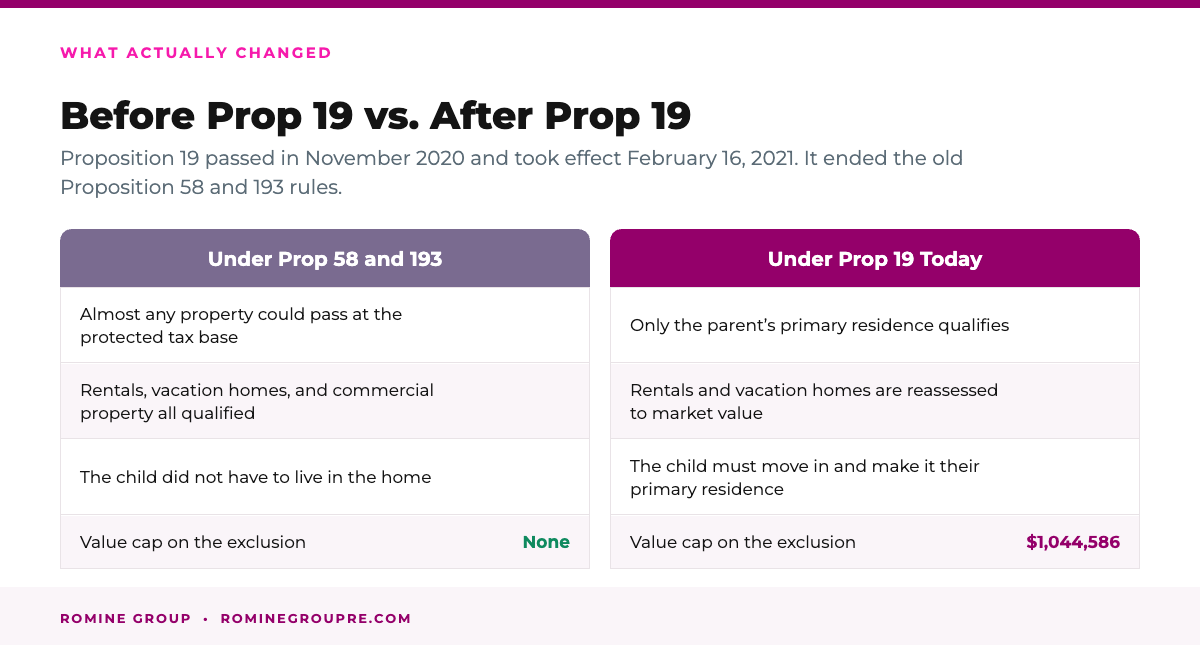
California voters approved Proposition 19 in November 2020, and by 2025 the effects were well documented across California counties, estate planning offices, and a lot of hard family conversations about inherited property. The change ended the old Proposition 58 and 193 rules, which let parents pass almost any property to their children at the original protected tax base under Proposition 13. Rental homes, mountain cabins, commercial investments, the family home. All of it passed down with the low assessment intact. That era is over.
Your children can no longer automatically inherit your low property tax base. What remains is a narrow exclusion with strict conditions, and missing any one of them triggers a full reassessment.
The pattern shows up constantly. A young couple inherits a parent’s bungalow, lists it twice with two different agents, and watches six months pass with no offers. Budgeting for updates gets hard once the property tax bill has already tripled after the transfer. Eventually they sell it directly and move on. The reassessment doesn’t wait for anyone to figure things out.
For many California families this was the biggest change to property tax law since Proposition 13 passed in 1978. The confusion costs families real tax money. In June 2026, California homes sold at a median price of $777,566, up 2.0 percent year over year. At those levels, a reassessment from a decades-old base to current market value can push annual property taxes from a few thousand dollars into the tens of thousands. Without a plan, the home becomes unaffordable to keep.
What Is the Parent-Child Exclusion Under Prop 19?
Sit with someone who just lost a parent and you hear the same line constantly. The house is in a trust, so we’re protected, right? The trust is half the answer. What you do with the property after the transfer decides whether the exclusion holds.
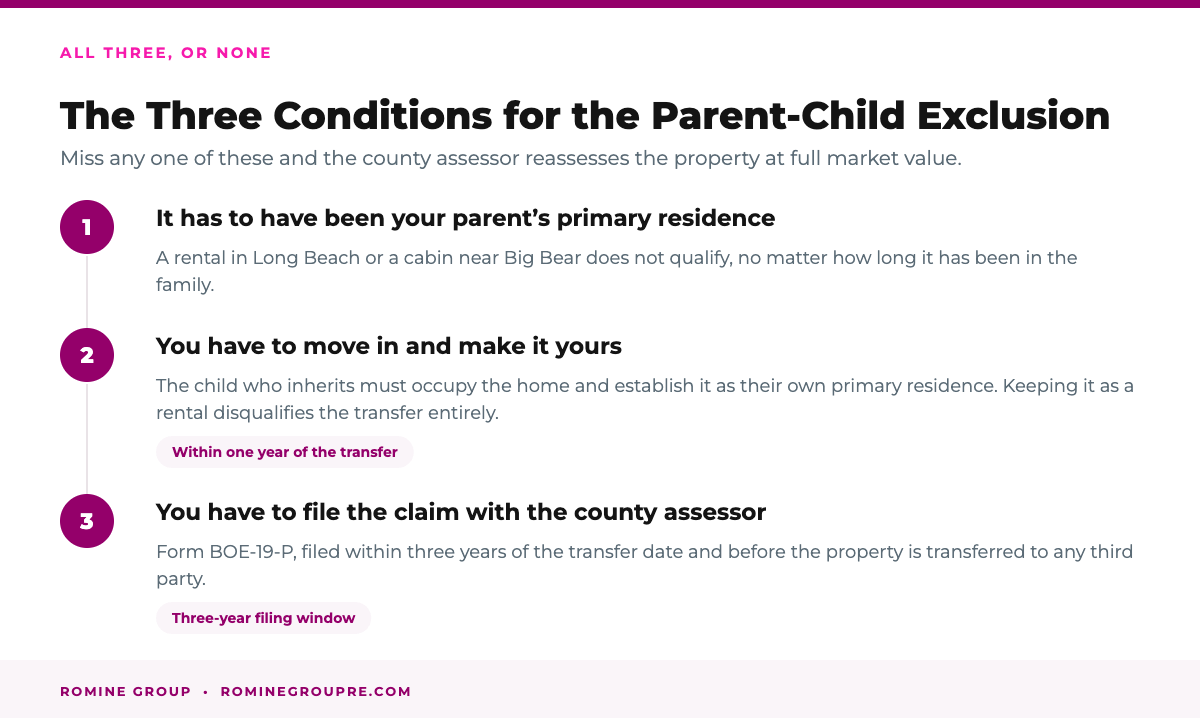
Current law narrowed parent-child transfer exclusions so inherited homes typically get reassessed to current market value unless the child moves in and files correctly within one year. The exclusion does exist. It comes with a strict list of requirements that have to be met in order, and skipping one step disqualifies the whole claim.
First, the inherited property must have been the parent’s primary residence at the time of transfer. A rental in Selma or a cabin up in the Sierra doesn’t qualify, even after decades in the family. Second, the child who inherits has to move into that home and establish it as their own primary residence. Third, they have to file the correct claim form with their county assessor.
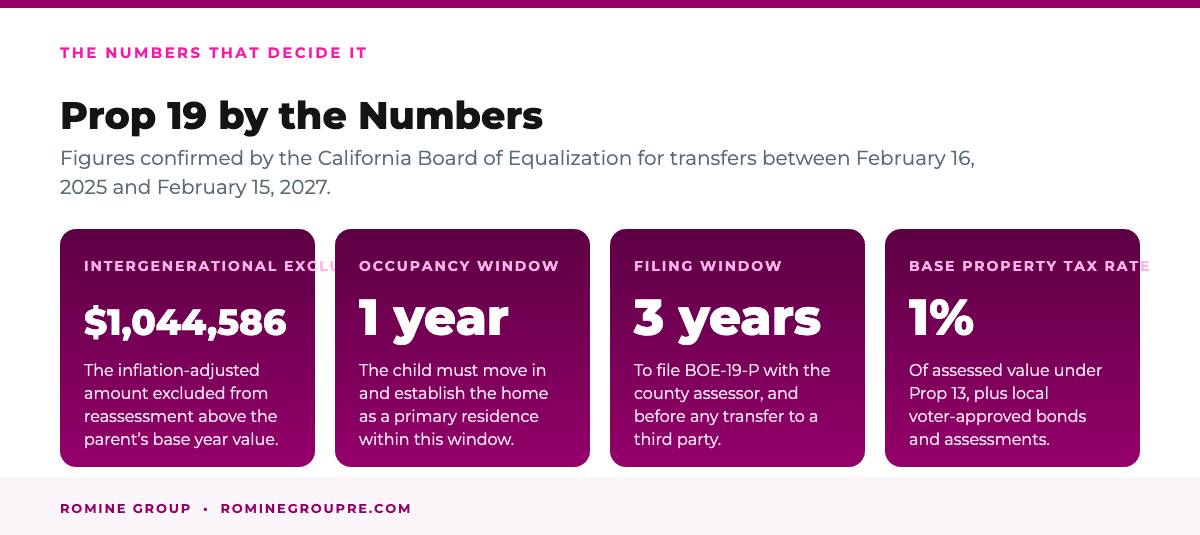
As of February 16, 2025, the reassessment exclusion amount under Proposition 19 for intergenerational transfers was adjusted to $1,044,586, applying to transfers between February 16, 2025 and February 15, 2027. That figure, confirmed by the California Board of Equalization, means the exclusion isn’t unlimited even when every condition is met. The cap trips up a lot of heirs.
Say a parent’s home was assessed at $250,000 under Prop 13 and it’s now worth $1,100,000. A gap of $850,000 falls under the current exclusion threshold. Within a year the child moves in, files the claim, and the assessed value stays near what the parent was paying. Push that home’s value to $1,600,000 and the child who moves in still faces a partial reassessment on the difference above the cap.
Multiple siblings inheriting the same property makes it messier. Only the heir who actually moves in gets the benefit. Three siblings with one moving in means the rest of the property gets reassessed to market value regardless of what the trust says.
What the Grandparent-to-Grandchild Exclusion Allows
Grandparents sometimes put a house in a trust meaning to skip a generation and leave it straight to grandchildren. The logic sounds fine. Skip the middle step, simplify the estate, protect the kids. Prop 19 built a gate that blocks most of those transfers.
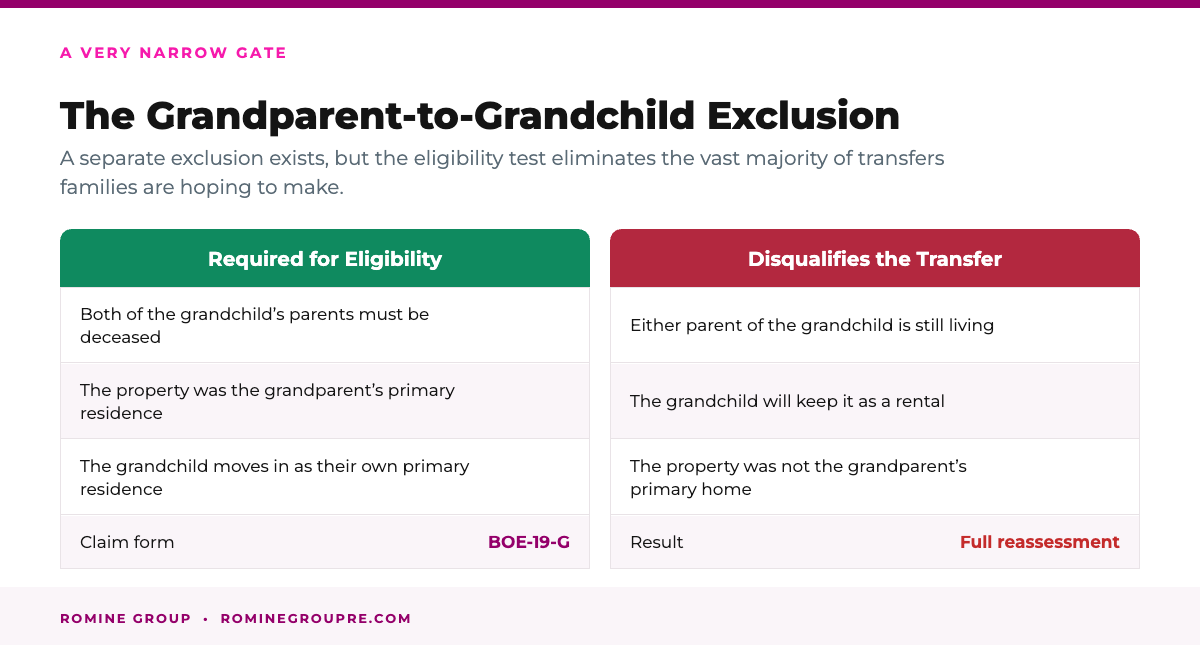
A separate grandparent-to-grandchild exclusion does exist under Prop 19, and it only applies when both of the grandchild’s parents are deceased. If either parent is living, the transfer isn’t eligible. That single condition wipes out the vast majority of grandparent-to-grandchild transfers families hope to make.
For grandparent-to-grandchild transfers the claim form is BOE-19-G. Filing it with your county assessor is required to claim the exclusion. Before the paperwork matters, though, the eligibility question has to be answered, and most families learn their situation won’t qualify only once they’re standing at the assessor’s counter.
If the grandchild won’t occupy the property as a primary residence, it gets reassessed to current fair market value even when the deceased-parent requirement is satisfied. A grandchild who inherits grandma’s house in Dinuba and wants to keep it as a rental gets no protection at all.
How Inherited Property Inside a Trust Is Affected by Prop 19
This is the part most people get wrong, because holding property in a trust sounds like protection against reassessment. Trusts and Prop 19 exclusions are two completely separate issues. Conflating them is an expensive mistake.
A revocable living trust is treated as the grantor’s property during their lifetime. When the parent dies and the property passes to a child through the trust, that counts as a change in ownership for Prop 19 purposes. The same rules apply. The property must have been the parent’s primary residence, the child has to move in within one year, and the BOE-19-P has to be filed.
Creating a trust does not create a Prop 19 exclusion. What a trust does is avoid probate, which matters enormously in California, where probate can drag a year or longer and attorneys’ fees are set by statute against the estate’s gross value. Avoiding probate and preserving a low property tax base are different goals requiring different strategies. If the property was never actually retitled into the trust, that’s a separate problem with its own fix, covered in our guide to the Heggstad petition.
In cases of trusts, the change in ownership date is the date the trust became irrevocable. For a revocable living trust that’s typically the date the grantor dies. For an irrevocable trust set up while the parents were alive, the clock may have started long before the family realizes. The one-year window to file could already be shut before anyone calls a county assessor.
Irrevocable trusts require a more complex analysis and can trigger a change in ownership at different points depending on structure. An irrevocable trust holding a family home in Tulare or Hanford might have triggered a reassessment event years before anyone died. Talk to an attorney who specializes in California property tax law before assuming the trust handles everything.
The Romine Group Team works with heirs throughout the Central Valley who are sorting through exactly this, helping families see their options once the property tax question has already been settled by a reassessment.
What Happens to Property Taxes When the Exclusion Does Not Apply
Sellers push back on this. Our parents owned the house forty years, so the assessed value can’t be that far from market. In California it can be, and usually is.
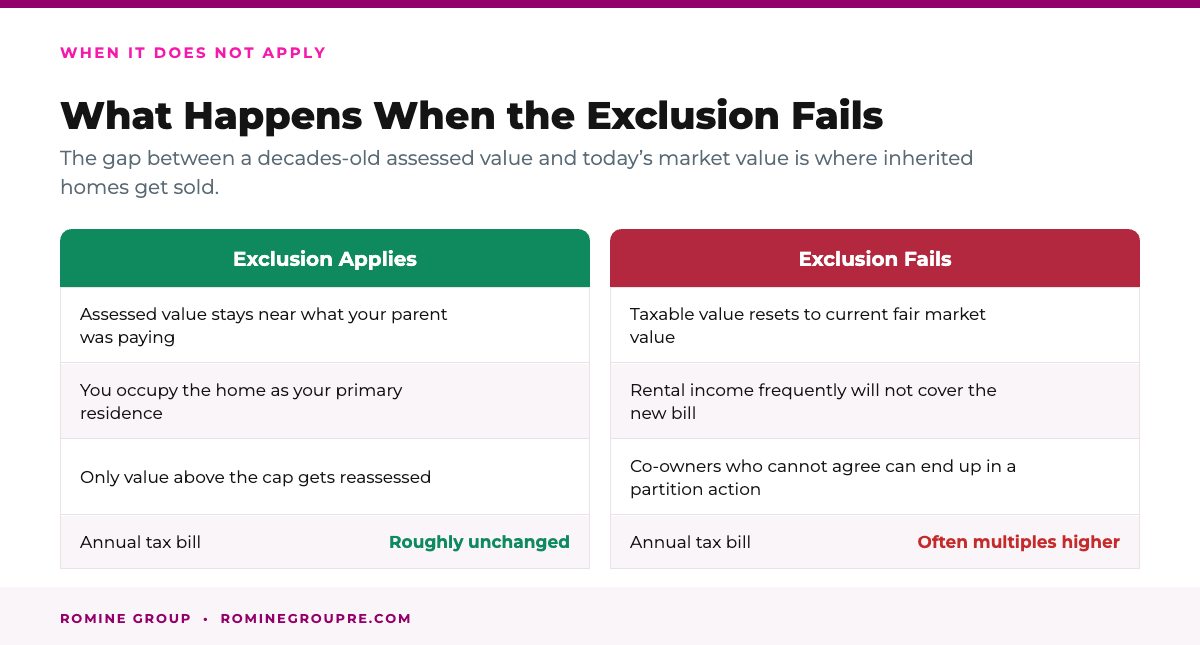
California’s base property tax rate under Proposition 13 is 1 percent of assessed value, plus local voter-approved bonds and assessments that vary from county to county. A home reassessed from $200,000 to $900,000 carries a tax jump that runs well into five figures annually before local add-ons. Families who planned to keep the property and rent it sometimes find the rental income doesn’t come close to covering the new bill, so the house gets sold anyway.
For heirs who don’t move in, full reassessment to fair market value often forces the sale of long-held family wealth. That hits hardest wherever a home bought in the 1980s for $150,000 now appraises far above it. Valley properties have appreciated enough over forty years to create the same squeeze, even without coastal price levels. The math on keeping it doesn’t work for an heir already carrying a mortgage somewhere else.
Plenty of them end up sold, and there’s no shame in that. If your share of the property taxes after reassessment costs more than the rent you’d collect, liquidating the asset and distributing proceeds to the beneficiaries is reasonable arithmetic. We buy these homes across the Central Valley, whether that means cash home buyers in Fresno or a company that buys homes in Bakersfield. If the inherited home still carries a loan, our guide on inheriting a house with a mortgage in California covers how that interacts with the tax question.
When siblings co-own and can’t agree, the property can end up in a partition action, a court proceeding that forces a sale. That’s the worst outcome for everybody. Legal fees, delays, and damaged family relationships. Getting ahead of the decision before emotions are running everything saves money and saves relationships.
How to Apply for the Parent-Child Exclusion After Prop 19
A successor trustee calls three weeks after a parent passes, house sitting in a revocable living trust, with no idea a filing deadline is attached to keeping the low property tax base. That call happens constantly.
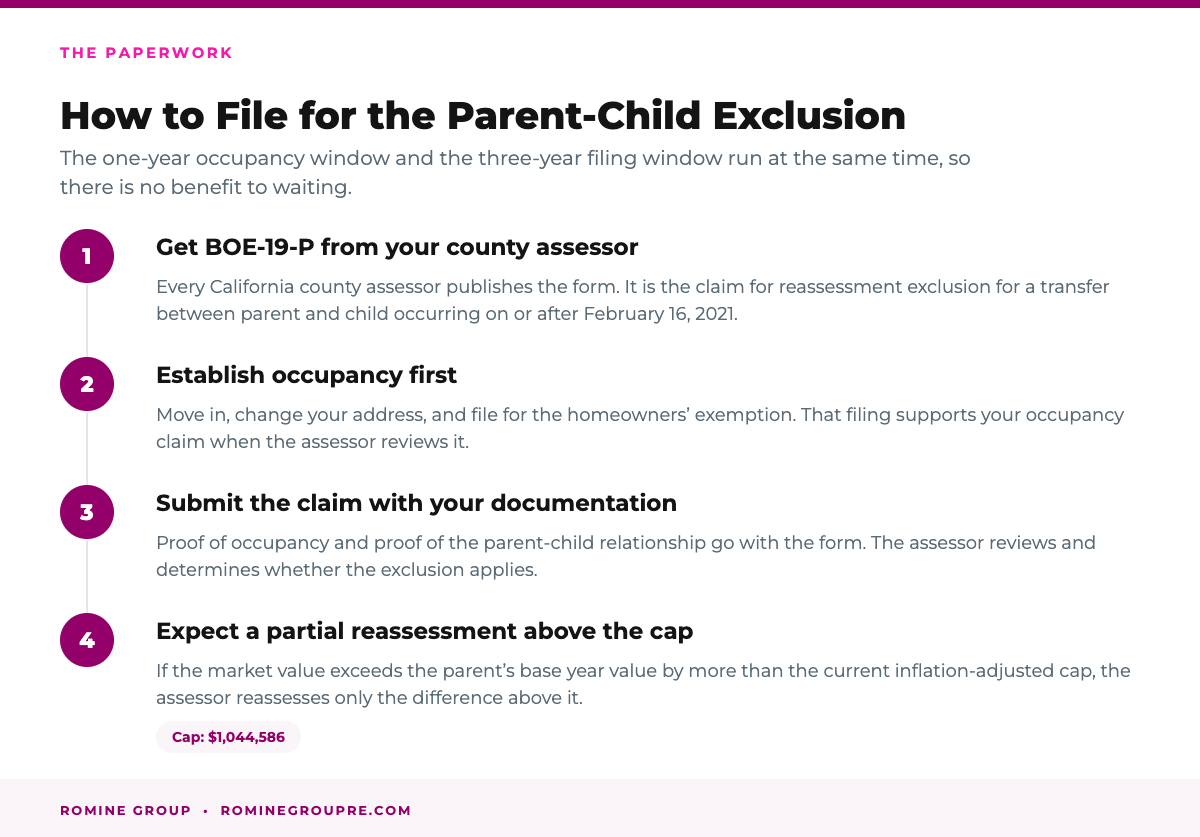
For a parent-to-child transfer, file BOE-19-P with your county assessor within three years of the transfer date, and before transferring the property to any third party. Three years sounds generous until you factor in probate delays, family disagreements, and the time it takes an heir to actually move in and establish occupancy.
The process runs like this. Get the BOE-19-P from your county assessor’s website, complete it, and submit it with documentation proving occupancy and the parent-child relationship. The assessor reviews the claim and decides whether the exclusion applies. If the home’s market value exceeds the parent’s base year value by more than the current inflation-adjusted cap, the assessor calculates a partial reassessment.
Missing a filing deadline or misreading the occupancy requirement can lock in a much higher annual property tax bill. The one-year occupancy window and the three-year filing window run at the same time, so waiting buys you nothing. Move into the home and file the claim as soon as the deed records. A few weeks of delay has turned plenty of straightforward transfers into a scramble at the assessor’s office.
This is the pattern worth avoiding. Adult children who inherit alongside siblings delay the occupancy decision while trying to reach a consensus that never arrives. Meanwhile the clock runs. Whoever is going to move in needs to do it, file the claim, and sort out the co-ownership arrangement separately.
What the Base Year Value Transfer Rule Means for Seniors
The parent-child exclusion gets the attention. Prop 19’s gift to aging homeowners who want to move is underappreciated and badly underused.
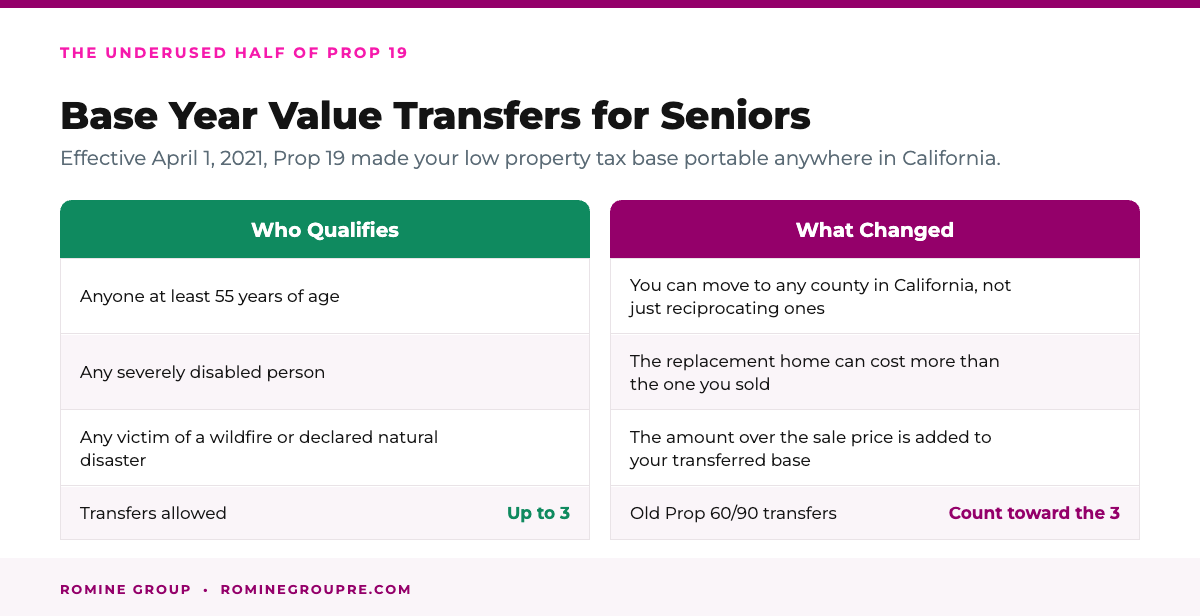
Effective April 1, 2021, Proposition 19 opened base value transfers to three groups. Any person at least 55 years of age, any severely disabled person, and any victim of a wildfire or natural disaster. Each can move the base year value from an original principal residence to a replacement property anywhere in California. Before Prop 19 that portability was limited to same-county moves, or to counties that had opted into a reciprocity agreement, and that was a short list. A retiree who wanted to leave Tulare County for the coast, or the reverse, was often stuck, because crossing a county line meant losing decades of accumulated tax savings.
Homeowners 55 or older and severely disabled homeowners can transfer their base year value up to three times under Prop 19, per the State Board of Equalization. That’s a per-person limit, regardless of whether you used a transfer under the old Prop 60/90 rules before April 1, 2021.
Someone who bought in Visalia in 1991 can now sell, carry the base year value along, and buy a smaller home anywhere in the state without restarting the tax clock. That flexibility changes the calculus on whether to sell a large family home or sit in it indefinitely just to protect a low rate.
One of the biggest improvements over the old rules is the new policy on replacement home value. Prop 19 allows the transfer even when the replacement home costs more, though the amount above the original home’s sale price does get added to the transferred base year value.
How Prop 19 Affects Your Estate Plan in California
At a statewide median of $777,566 as of June 2026, a typical family home inherited almost anywhere in California carries enough market value to create a real Prop 19 reckoning without active planning.

Most estate plans built before 2021 were designed under the old Proposition 58 rules. They assumed children could inherit any parcel of real estate, at any value, and hold the Prop 13 base indefinitely. That assumption is wrong now, and attorneys keep finding trusts that were never updated to match current law.
A properly structured living trust includes Prop 19 compliance language to help your children claim the exclusion. The trust document should name which property is the grantor’s primary residence and instruct the successor trustee to file the BOE-19-P promptly. It should also address what happens if the beneficiary can’t or won’t occupy the home inside the one-year window.
Prop 19 doesn’t change whether you need a living trust. It changes what you need the trust to accomplish. Probate avoidance is still a powerful reason to have one. The trust document alone doesn’t preserve the property tax base, though. That work happens through the child’s occupancy and a timely filing.
This is how it collapses in practice. An heir inherits a property packed with thirty years of belongings, opens the garage, and realizes the out-of-state siblings have no interest in sorting any of it. They want the sale and they want it fast. She’d be willing to move in and keep the low tax base, except three siblings each holding a share makes that decision legally complicated. They sell directly for cash, split the proceeds, and close before the family dynamics splinter further.
Rethinking your California estate plan in light of Prop 19? Knowing what the property is worth today, and what your heirs would face in a sale, is a useful starting point for any conversation with an estate attorney. You can see how Romine Group buys homes or reach out to Romine Group for a straight read on the number.
A third attempt to repeal the inheritance portions of Prop 19 is underway. The initiative, titled “Fix Prop 19 to Save Our Children’s Future,” began circulating petitions in late 2025. If proponents gather enough valid signatures by the May 2026 deadline, it could reach the November 2026 ballot. Plan under the current rules. Counting on a repeal is a bet most families can’t afford to lose.
Frequently Asked Questions
Is There a Way to Work Around Prop 19?
No shortcut eliminates the reassessment rules, though legitimate planning strategies can reduce the impact. Gifting property during the parent’s lifetime may lock in a lower assessed value depending on timing and structure, and that approach carries its own tax consequences an attorney should review carefully. Placing a property into a life estate or using certain trust structures can also change when the change in ownership occurs. Your best path is talking with a California estate planning attorney before a transfer happens, not after.
Is It Harder to Sell a House That Is in a Trust?
Not really, though the process adds a few steps. The successor trustee has authority to sign documents on behalf of the trust, so probate court never has to get involved. Buyers and title companies are generally comfortable with trust sales. If anything, a property held in a trust often sells faster than one moving through probate, because the successor trustee can act without court approval and the timeline stays cleaner.
Do You Have to Pay Taxes on Property Inherited Through a Trust?
California has no inheritance tax and no state estate tax. What people call the Prop 19 inheritance tax is really a property tax reassessment. When an inherited property doesn’t qualify for the parent-child exclusion, its taxable value resets to market value and the annual property tax bill climbs, often by thousands of dollars a year. Sell the inherited property and you may also face federal capital gains tax on appreciation above your stepped-up cost basis at the date of death, which is a separate issue from property taxes entirely.
What Happens When You Inherit Property Through a Trust?
In cases of trusts, the change in ownership date is the date the trust became irrevocable. For most revocable living trusts that’s the date the grantor passes away. From that point the county assessor can reassess the property unless an exclusion applies. The successor trustee’s job is transferring the deed to the beneficiary, notifying the county assessor of the change in ownership, and filing the appropriate exclusion claim as fast as possible. A beneficiary who intends to live in the home should establish occupancy and file for the homeowners’ exemption to support the claim. You can check out other frequent questions if you’re still working through the options.
More California Selling Guides
- Inheriting a House With a Mortgage in California
- Selling a House Left Out of a California Trust
- Using a Small Estate Affidavit to Skip Probate in California
- California Real Estate Withholding and Form 593
Inherited a California House and the Tax Bill Just Tripled?
If the reassessment has already happened and keeping the property no longer pencils, we buy inherited California homes exactly as they sit, contents and all, and we work with successor trustees and multiple heirs regularly. Tell us about the property below and we will get you a fair cash offer. No pressure, no obligation, and no fee for the conversation.
"*" indicates required fields
Prefer to talk it through first? Contact Romine Group and we will walk the situation with you before you commit to anything. You can also read how Romine Group buys homes to see exactly what the process looks like.